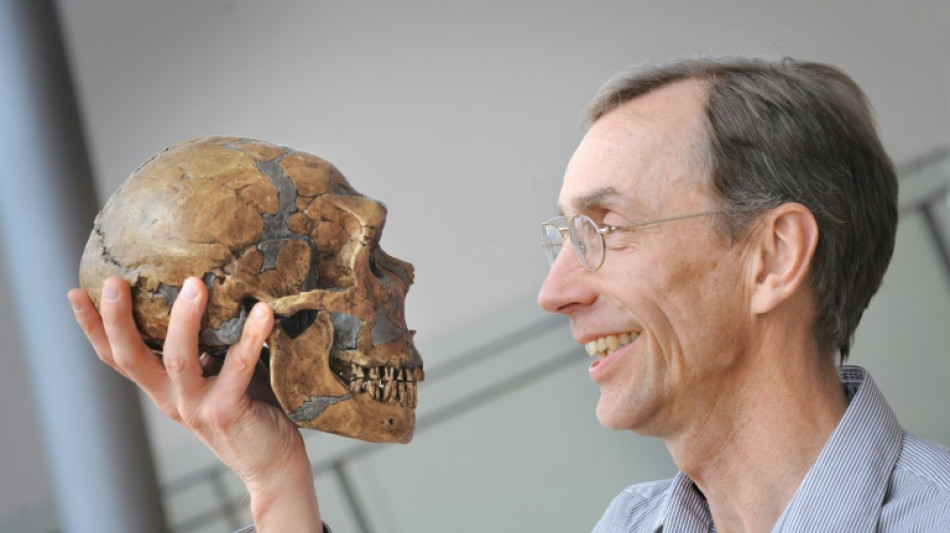
Sweden's Paabo wins medicine Nobel for sequencing Neanderthal DNA / Photo: Frank Vinken - digital/AFP

 Cyberattack ruled out in UK air traffic glitch that hit hundreds of flights

 Ogura to miss San Marino MotoGP with hand injury

 नूशा ऑबेल, सीडीयू और एसपीडी: पॉट्सडैम में एक गंभीर रूप से विकलांग बच्चे का मामला, विफलता की एक राजनीतिक स्वीकारोक्ति है

 Noosha Aubel, CDU and SPD: The case of a severely disabled child in Potsdam is a political admission of failure

 Noosha Aubel, CDU ve SPD: Potsdam’daki ağır engelli bir çocuğun durumu, siyasi bir iflas ilanıdır

 ヌーシャ・オーベル、CDUおよびSPD:ポツダムで起きた重度障害児の事例は、政治的な破綻を露呈している

 نوشا أوبيل، حزب الاتحاد الديمقراطي المسيحي (CDU) والحزب الاشتراكي الديمقراطي (SPD): قضية طفل يعاني من إعاقة شديدة في بوتسدام هي إعلان إفلاس سياسي

 Josh Kerr: I pick my races and I'm not a robot

 Apple unveils its first foldable smartphone iPhone Duo

 Rampant Raphinha bags brace as Barcelona rout Feyenoord

 Rybakina ensures rise to world no. 1 by reaching US Open semis

 How hot can the US-Canada trade war get?

 Iran strikes ships, expands no-go zone outside Hormuz strait

 'Gambling with our lives': AI researcher quits Anthropic

 Belgium raids illicit cigarette factory in push to stub out growing trade

 Vuelta debutant Brennan claims fifth victory on stage 17

 US had warmest summer on record: climate agency

 Meta tests fact-check replacement in Latin America

 Soviet brutality, ideology backdrop of controversial Venice film

 McIlroy predicts player exodus after LIV files for bankruptcy protection

 Global Multi-Asset Broker FP Markets Secures UAE CMA Category 5 Licence

 Brent oil passes $100 on Mideast flare-up, stoking inflation worries
 'Nothing left': thousands in Yemen flee deadly Houthi clashes

 Spain endured hottest summer on record: weather agency

 'A celebration': Amsterdam museum unveils Kusama show weeks after death

Swedish paleogeneticist Svante Paabo, who sequenced the genome of the Neanderthal and discovered the previously unknown hominin Denisova, on Monday won the Nobel Medicine Prize.
Paabo's research gave rise to an entirely new scientific discipline called paleogenomics, and has "generated new understanding of our evolutionary history", it said.
"By revealing genetic differences that distinguish all living humans from extinct hominins, his discoveries provide the basis for exploring what makes us uniquely human", the Nobel committee said in a statement.
The founder and director of the department of genetics at the Max Planck Institute for Evolutionary Anthropology, Paabo found that gene transfer had occurred from these now extinct hominins to Homo sapiens following the migration out of Africa around 70,000 years ago.
"This ancient flow of genes to present-day humans has physiological relevance today, for example affecting how our immune system reacts to infections", the jury said.
One such example is that Covid-19 patients with a snippet of Neanderthal DNA run a higher risk of severe complications from the disease, Paabo found in a 2020 study.
Paabo, 67, who takes home the award sum of 10 million Swedish kronor ($901,500), will receive the prize from King Carl XVI Gustaf at a formal ceremony in Stockholm on December 10, the anniversary of the 1896 death of scientist Alfred Nobel who created the prizes in his last will and testament.
Paabo is the son of Sune Bergstrom, a Swede who won the 1982 Nobel Medicine Prize for discovering prostaglandins, which are biochemical compounds that influence blood pressure, body temperature, allergic reactions, and other physiological phenomena.
In a 2014 interview with The Guardian, Paabo said he was the result of a secret extra-marital affair and that Bergstrom's "official" family knew nothing of his or mother's existence, the Estonian chemist Karin Paabo until after Bergstrom's death in 2005.
- Achieved 'the seemingly impossible' -
Homo sapiens are known to have first appeared in Africa around 300,000 years ago, while our closest known relatives, Neanderthals, developed outside Africa and populated Europe and Western Asia from around 400,000 until 30,000 years ago when they went extinct.
That means that about 70,000 years ago, groups of Homo sapiens and Neanderthals coexisted in large parts of Eurasia for tens of thousands of years.
In order to study the relationship between present-day humans and extinct Neanderthals, DNA needed to be sequenced from archaic specimens with only trace amounts of DNA left after thousands of years.
In 1990, Paabo managed to sequence a bit of mitochondrial DNA from a 40,000-year-old piece of bone.
"For the first time, we had access to a sequence from an extinct relative", the Nobel jury said.
Comparisons with contemporary humans and chimpanzees showed that Neanderthals were genetically distinct.
Paabo then "accomplished the seemingly impossible", the Nobel committee said, publishing the first Neanderthal genome sequence in 2010.
It showed that the most recent common ancestor of Neanderthals and Homo sapiens lived around 800,000 years ago.
Paabo and his team were able to show that DNA sequences from Neanderthals were more similar to those from contemporary humans originating from Europe or Asia than those from Africa.
"This means that Neanderthals and Homo sapiens interbred during their millennia of coexistence", the Nobel jury said.
In modern day humans with European or Asian descent, around one to four percent of the genome originates from Neanderthals.
In 2008, Paabo and his team went on to sequence a 40,000-year-old bone fragment found in the Denisova cave in southern Siberia.
It contained exceptionally well-preserved DNA.
"The results caused a sensation: the DNA sequence was unique when compared to all known sequences from Neanderthals and present-day humans."
Paabo had discovered a previously unknown hominin, which was given the name Denisova.
Comparisons showed the gene flow had also occurred between Denisova and Homo sapiens.
When Homo sapiens migrated out of Africa, at least two extinct hominin populations inhabited Eurasia: Neanderthals lived in western Eurasia, whereas Denisovans populated the eastern parts of the continent.
The Nobel season continues this week with the announcement of the winners of the Physics Prize on Tuesday and the Chemistry Prize on Wednesday.
They will be followed by the much-anticipated prizes for Literature on Thursday and Peace on Friday, while the Economics Prize winds things up on Monday, October 10.
R.Garcia--AT