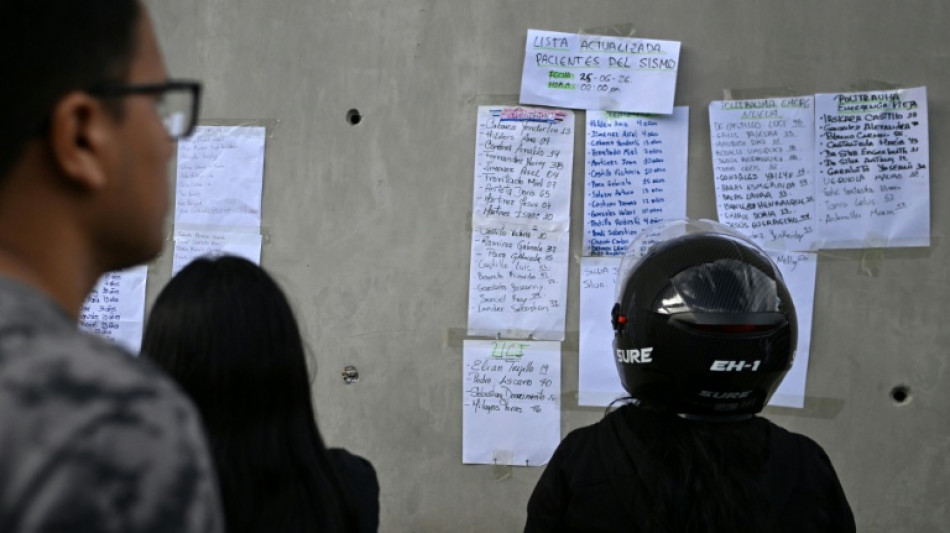
Quake-hit Venezuela's hospitals care for children left alone / Photo: Juan BARRETO - AFP

 Bishop Museum Races to Save Rare Megamouth Shark Specimen

 Zach Hickerson Recounts Hayden Panettiere's Final Moments in New Interview

 Luxembourg Housing Petition Passes Threshold for Parliamentary Consideration

 Raheem Sterling Receives Suspended Sentence After Lamborghini Crash

 Audience to Choose the Set List at Luxembourg's First FAMIL Jukebox Night

 Luxembourg Pay Rise Delayed as Regional and World Headlines Develop

 Chennai Urbanist Sashna Develops 'Anniki' Card Game to Gamify Tamil Nadu History

 Transport Minister Defends Land Seizure Powers for Toronto-Quebec City High-Speed Rail

Teenager Yenderlin Cabarza waited alone in an emergency room on Thursday, her bones broken by two powerful earthquakes that devastated Venezuela the day before.
The 13-year-old survived the twin tremors of magnitude 7.2 and 7.5 on Wednesday that killed her mother and her uncle, who shielded her body from the building that crumbled around them.
The disaster has left at least 188 people dead and injured more than 1,500 others, and Venezuela's hospitals are tending to young people whose parents are nowhere to be found.
As ambulances pulled in and out of Domingo Luciani Hospital in eastern Caracas, loved ones anxiously checked long lists of names posted on the wall of quake victims who had been admitted to the facility.
Twenty-two of those names belonged to people aged between four and 19.
These youngsters were injured in the coastal city of La Guaira, where the quakes reduced entire buildings to rubble, trapping people underneath.
Cabarza was transported by ambulance from this area, which authorities described as a "disaster zone."
"She came out with her two little arms flailing," family friend Rolando told AFP, asking to be identified by only his first name.
The girl had traveled alone in the ambulance, but Rolando and her father learned of her transfer to the hospital and joined her there.
She was already in surgery for fractures in both arms at that point. Her loved ones waited uneasily outside.
"Several of the children arrive on their own because they are brought quickly from the place where they are rescued," according to a doctor who requested anonymity because staff are not authorized to give statements.
"Most of them don't have any family. They arrive alone," another doctor said.
"What the paramedics tell us is that they pull them out of the rubble, put them in the ambulance, and bring them here because the hospitals in La Guaira are really full."
- Waiting for answers -
Family members and friends stood around restlessly in the waiting room, where a hospital worker tried to maintain order in the chaos.
"Family members must stay in the waiting room," the employee shouted through a megaphone, reminding relatives that they were lucky to be alive.
Those waiting snapped photos of the lists on the wall.
Loved ones desperate for information about the whereabouts of the missing meanwhile have flooded the internet with social media posts.
"I've just come from Perez Carreno Hospital and I didn't find my sister there either," 52-year-old Zoraida Hernandez told AFP.
Hernandez has been frantically searching for her sister since learning that her house on the coast had collapsed.
A medical worker carrying a stretcher told AFP that the hospital morgue was full.
Venezuela has recorded more than 130 aftershocks following the deadly tremors, which were felt as far away as neighboring Colombia.
M.King--AT

