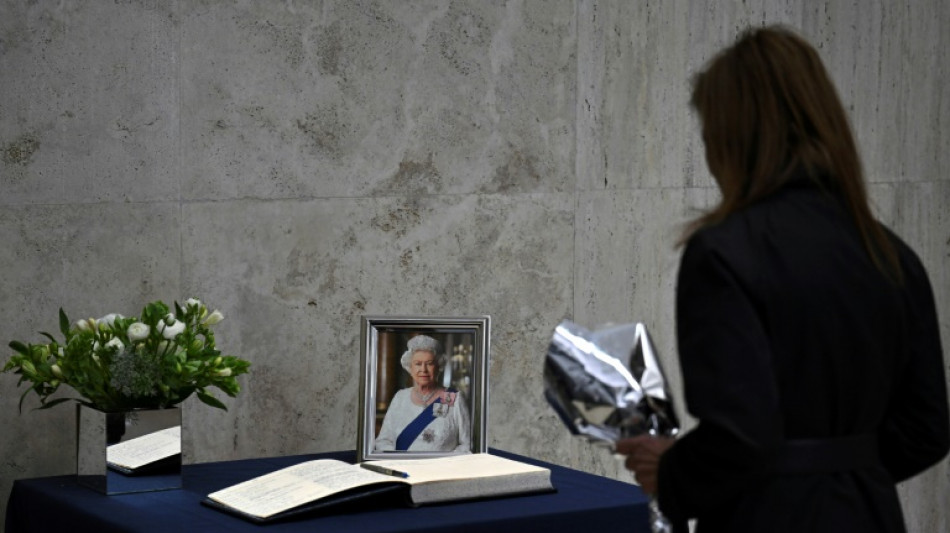
Argentine reverence for Queen Elizabeth marred by Falklands memories / Photo: LUIS ROBAYO - AFP

 Philippine sensation Eala looks forward to Asian Games 'fun'

 Jakarta airport extends closure after volcano eruption
 Lonely woman director in Venice sees industry backsliding on gender

 Tech firms rally on mixed day for Asian markets, with eyes on US inflation

 World number one An sends Asian Games warning with China hat-trick
 PSG go for three in a row as Champions League returns

 "Super-human' Alcaraz books US Open quarter-final clash with Shelton

 ECB set to hike interest rates as Iran war flares anew

 AI data centers are less thirsty now, tech giants say

 North Korea vows nuclear-armed navy as US ally drills open

 Under-fire Labuschagne named in Australia Test squad for South Africa

 Enjoying the moment: Alcaraz steps it up to reach US Open quarter-finals

 Five dead, five injured after Amazon cargo plane overshoots Miami runway

 La Rochelle half-backs lead fightback against Toulouse

 US envoys have 'more effective proposals': Ukraine official

 Defending champion Alcaraz powers into US Open quarter-finals

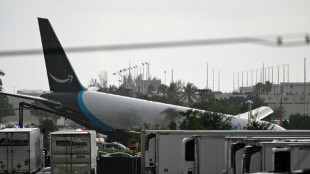 Amazon cargo plane overshoots Miami runway, hits vehicles, catches fire

 Toll from Yemen clashes passes 300 as civilians flee homes

 Sabalenka books US Open quarter-final clash with Noskova

 German AfD supporters jubilant at far right's thumping win

 Zelensky warns war likely to continue into winter after US talks

 Arsenal deliver statement fightback to end Chelsea's flying start

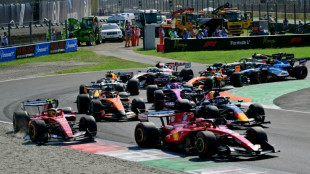 Leclerc accepts blame as Hamilton laments Ferrari approach

 Sabalenka surges past Townsend to reach US Open quarter-finals

 Smiling face of Germany's far-right AfD: Ulrich Siegmund
Argentines wavered between admiration and disillusion in appraising the legacy of Queen Elizabeth II of Britain, a country with which they share a complex history marred by a territorial war fought brutally on her watch.
The government in Buenos Aires reacted swiftly to news of the monarch's demise, assuring the British people it shared their grief in this "painful moment."
The Argentine press expressed its open reverence, declaring the queen a "symbol of the 20th century" and describing her as someone "we knew better than our own aunts."
But on the streets, praise for the queen's record was clouded by lingering hurt over the 1982 war over the Falkland Islands that both countries claim as their own.
"I would have liked the queen to have returned the islands to us before she died," home-maker Maria Lujan Rodriguez, 51, told AFP in Buenos Aires.
Celia Carlen, 88, was another among those to lay flowers at the British embassy in the capital for a "very sensible, balanced" monarch.
The islands, yes, "I think they should give them back to us. But I separate the two things," said Carlen.
During the war, which lasted 74 days and left more than 900 dead -- 649 Argentinian and 255 British soldiers as well as three inhabitants of the island -- Elizabeth was the target of much vitriol, many say misaddressed.
At the time, fans of football -- a sport adopted from Britain to become all but a religion in Argentina -- sang songs referring to her as "the most stupid queen."
- 'Archaic system' -
Argentine political scientist Rosendo Fraga underlined the war had been a political decision by the government of Prime Minister Margaret Thatcher.
The monarchy has no executive or policy-making power, but the queen's public profile made her an easy target for public invective.
Mirtha Legrand, a 95-year-old TV host and celebrity just 10 months younger than the queen, summed up the ambivalence Argentines feel.
"It is very painful. I’ve been following her since she was crowned at 25," said Legrand. "She was a great queen, but I cannot forget that she ruled during the Falklands War. I cannot forget. It was a very sad moment for everyone."
Two nations share a long history with many ups and downs.
Two deadly British invasions of Buenos Aires in 1806 and 1807 were followed by a period of economic investment that saw British money poured into agriculture, energy, and the largest railway network in Latin America.
Then, war struck yet again.
Argentina sent soldiers to lay claim to the Falkland Islands off the Patagonian coast, angering Thatcher.
With the queen's okay, the prime minister sent nearly 30,000 troops halfway round the world to retake the islands that Argentina has claimed as its own since 1833 and calls the "Malvinas."
The queen's own son Prince Andrew, then 22, was part of the deployment as a helicopter pilot.
Britain emerged victorious, but the campaign left a deep wound, despite diplomatic and economic ties recovering since then.
The Argentina-based Center of Falklands War Veterans said in a statement Elizabeth II had "embodied the suffering of peoples subjugated under colonial and economic rule throughout her reign, an archaic system."
In April this year, at a ceremony to commemorate the 40th anniversary of the war, President Alberto Fernandez reaffirmed: "The Falklands were, are and will be Argentine."
- 'Bravo Lilibet' -
A poll last year found more than 81 percent of Argentines support the claim to sovereignty over the islands.
But in a 2013 referendum among Falkland Islanders, 97 percent voted to stay within the British realm, prompting the queen to declare it an overseas territory.
She raised ire in Buenos Aires by telling parliament at the time that Britain "will ensure the security, good governance and development of the Overseas Territories, including by protecting the Falkland Islanders'... right to determine their political futures."
One of the monarch's last acts, in May this year, was to declare the settlement of Port Stanley (called Puerto Argentino by Argentina) the official "capital" city of the islands.
"This exposes the colonial nature of the illegal and illegitimate occupation of our islands," the Argentine government shot back.
For retired teacher Elizabeth Farinez, 67, there was a "somewhat conflictive relationship with English people, but we must recognize that she (Elizabeth) was quite a lady.
"We should say: 'Bravo Lilibet, you did very well, for seventy years you ruled England very well'."
F.Ramirez--AT