Turkey stuns markets by cutting rate despite soaring inflation / Photo: Yasin AKGUL - AFP

 US envoys in Moscow as Russia and Ukraine vow not to hit capitals during talks

 Motorsport governing body rejects Alpine boss's claims of bias

 US envoy on West Bank visit says Israel has responsibility for Palestinians

 Ethiopian Miss World contestant spotlights pain of sister's murder

 'Leader' Raphinha rising to Barca striker challenge

 Oasis fans gather in Venice for band reunion film

 Two Nepal rescues revive hopes 10 days after flood
 Pogacar to miss worlds after season-ending Vuelta crash
 Greenwood, Guendouzi handed bans after Fenerbahce-Lyon brawl

 In Iceland, the mystery of the poet, the tomb and the Danish grocer

 Ratko Mladic: Bosnian Serb commander to convicted war criminal

 Bolivian army base blasts kill two, wound dozens

 Alcaraz, Sabalenka into US Open last 16 as Williams sisters lose on return
 Williams sisters fall in thrilling return to US Open doubles
 Bangladesh measles toll nears grim 1,000-child mark

 Bolivia farmers return to streets over diesel price hikes

 Panama Canal begins reducing crossings due to El Nino

 Trump again seeks to remove protections for wolves

 'Getting there' - Alcaraz into US Open last 16 along with Sabalenka

 Isak ready to show world his quality, says Van Dijk

 Stuttgart cruise past Cologne to bounce back from Bayern thumping

 'Smart, aggressive' Alcaraz into US Open last 16

 Isak fires Liverpool to first win under Iraola at Ipswich

 Stocks slip as robust US jobs data stokes rate hike odds

 Mistrial declared in case of US woman who killed her three children

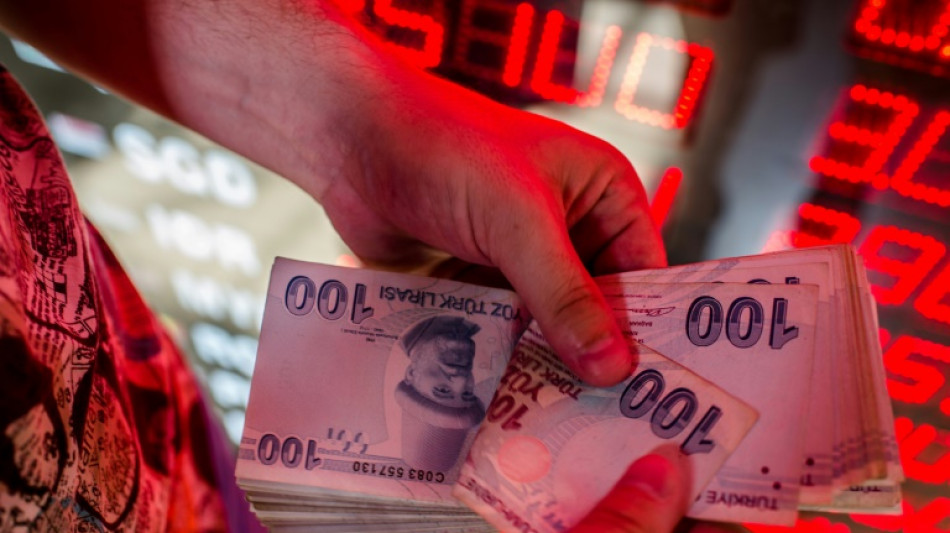
Turkey's central bank on Thursday stunned the markets by lowering its main interest rate even as inflation soared to a 24-year high and looks set to climb further.
The central bank said "recession is increasingly assessed as an inevitable risk factor" as it lowered its one-week repo auction rate to 13 percent from 14 percent.
"Just insane -- with inflation at 80 percent and rising," BlueBay Asset Management economist Timothy Ash remarked in an emailed comment.
"Turkey's central bank (has) stepped up its fight against economic orthodoxy," Jason Tuvey of Capital Economics added in an ironic note.
"The move increases the risk of yet another currency crisis."
The Turkish lira lost one percent of its value against the dollar within moments of the announcement.
Turkey's monetary policy decision contradicts the approach pursued by most other countries as they try to combat the spike in consumer prices caused by Russia's invasion of Ukraine.
The war has sent food and energy prices soaring and forced central banks to raise borrowing costs -- even as economic growth remains anaemic.
But Turkish President Recep Tayyip Erdogan subscribes to the unorthodox belief that high interest rates cause inflation rather than rein it in.
He has fired three central bank governors since 2019 who have tried to pursue a more conventional economic course.
- Election focus on growth -
Turkey now has a real interest rate of negative 66.6 percent when adjusted for inflation.
This forces businesses and ordinary people to spend as much as possible before their liras lose even more value with each month.
Turkey's approach has propelled economic growth that Erdogan hopes can help him secure a third decade in power in a general election scheduled for next June.
But it has been accompanied by a sharp depreciation of the lira that has eroded living standards and pushed the financial sector to the brink of crisis.
The Turkish government has adopted a series of alternative measures to combat inflation which most economists dismiss as either insufficient or too complex and expensive to work.
These include limiting bank lending and offering state guarantees to ensure that Turks' deposits do not lose too much value over time.
The central bank has also dug in deeply into its foreign currency reserves to try and prop up the lira's exchange rate.
These interventions have made Turkey increasingly dependent on deals with petrodollar-rich nations such as Russia and Ankara's one-time rivals in the Middle East.
Turkey reported a big jump in its hard currency holdings this month that the finance minister linked to a financial transaction with an unnamed foreign country.
Media reports said Russia's state-held nuclear energy firm Rosatom had transferred billions of dollars for the construction of Turkey's first nuclear power plant.
The central bank vowed on Thursday to push ahead with its "liraisation strategy" aimed at reducing the use of foreign currency.
It also spelled out its sharp focus on economic growth.
"It is important that financial conditions remain supportive to preserve the growth momentum in industrial production and the positive trend in employment," it said.
- Weak lira -
Some economists interpreted the rate decision as a concerted effort by Erdogan's team to devalue the lira in order to spur growth through cheaper exports.
Erdogan has touted this export-driven growth as a "new economic model" that a powerful and independent Turkey should pursue in order reduce its dependence on global powers.
"The need to devalue the lira is an integral component of this path," economist Umut Akcay of the Institute for International Political Economy tweeted after the rate cut.
"This decision was driven by the need to support growth and further increase exports in the face of the global slowdown."
Other economists question why Turkey would be spending tens of billion of dollars trying to prop up the lira if it actually wants the currency to fall.
The lira has lost more than half its value against the dollar in the past year alone.
E.Flores--AT