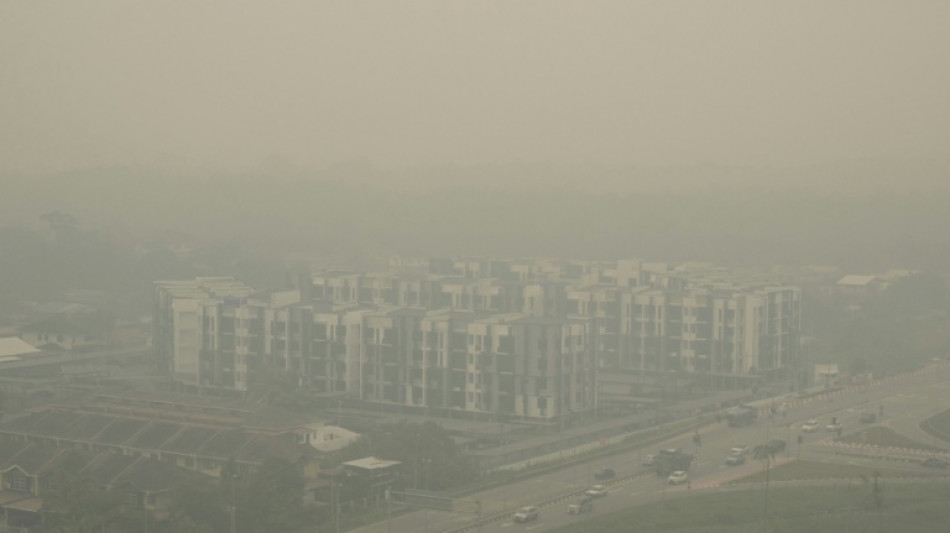
How haze from Indonesian fires impacts Southeast Asia / Photo: MOHD RASFAN - AFP

 Zach Hickerson Recounts Hayden Panettiere's Final Moments in New Interview

 Luxembourg Housing Petition Passes Threshold for Parliamentary Consideration

 Raheem Sterling Receives Suspended Sentence After Lamborghini Crash

 Audience to Choose the Set List at Luxembourg's First FAMIL Jukebox Night

 Luxembourg Pay Rise Delayed as Regional and World Headlines Develop

 Chennai Urbanist Sashna Develops 'Anniki' Card Game to Gamify Tamil Nadu History

 Transport Minister Defends Land Seizure Powers for Toronto-Quebec City High-Speed Rail

 UAE Weather Forecast: Scattered Showers and Fog Expected as Temperatures Drop
Thick smog has blanketed parts of Indonesia as the vast archipelago for weeks battles to contain fires that have burned large swathes of Borneo and Sumatra.
The hazardous smoke has led to an increase in respiratory problems, forced schools to close, and has been drifting to neighbouring countries including -- Malaysia, Singapore, and the Philippines.
Here's what to know:
- Where are the fires? -
Most of the fires are concentrated on Borneo island, home to vast tropical jungle that Indonesia shares with Brunei and Malaysia, as well as Sumatra.
So far this year, nearly 300,000 hectares of land have burned in Indonesia, according to an independent estimate from the Nusantara Atlas portal.
Indonesia saw an uptick in carbon emissions since late July, and by the end of last month the levels were comparable to previous El Nino years of 2015 and 2019, Copernicus Atmosphere Monitoring Service (CAMS) senior scientist Mark Parrington told AFP.
"We're seeing already now... really extreme fire emissions comparable to those previous strong El Nino years, and also the extent of the smoke and the haze and the air quality impacts," Parrington said.
Fires in the archipelago have released more than 23 million metric tons of carbon emissions between August 28 and September 3, according to CAMS' Fire Emission Watch portal.
It was higher than 20.7 million metric tons of emissions from fires over the same period in 2015, which was a strong El Nino year.
- What causes the fires? -
Analysts said that the El Nino weather phenomenon, which the United Nations said this week could turn out to be the strongest in four decades, has contributed to creating drier conditions in Indonesia and made it easier for fires to spread.
But slash-and-burn land-clearing practices also contributed to the damage, said David Gaveau, founder of the Nusantara Atlas.
"El Nino does not ignite fires. It creates the dry conditions that allow human-started fires to escape and become very large," he told AFP.
The fires are difficult to extinguish because many occurred on peatlands, a wetland ecosystem with layers of partially decomposed organic materials that become flammable when dry.
Between January and August this year, more than 210,000 hotspots were detected in peatland areas across the country, according to NGO Pantau Gambut.
"Peat is a naturally wet ecosystem and stores large amounts of organic material. When peat is drained, this organic material is converted into fuel," Pantau Gambut spokesman Wahyu Perdana said.
- What is the impact? -
More than five million people across Borneo and Sumatra are directly exposed to the health risks from haze, deputy health minister Dante Saksono Harbuwono said last month.
Over 1.4 million students were attending classes remotely, with many schools closed due to worsening air quality, an education ministry official said this week.
In Malaysia, soaring pollution levels prompted the government on Friday to declare an emergency in a region of the Sarawak state in Borneo, with nearly 650 schools closed next week.
In the Philippines, air quality was slowly returning to normal after a week of reaching "very unhealthy" and "severely unhealthy" PM 2.5 levels that saw officials shutter schools in cities and provinces citing the drifting haze.
The haze also drove air quality in Singapore's central region to an "unhealthy" level on Friday, the country's National Environment Agency data showed.
burs-mrc/fox
W.Morales--AT


