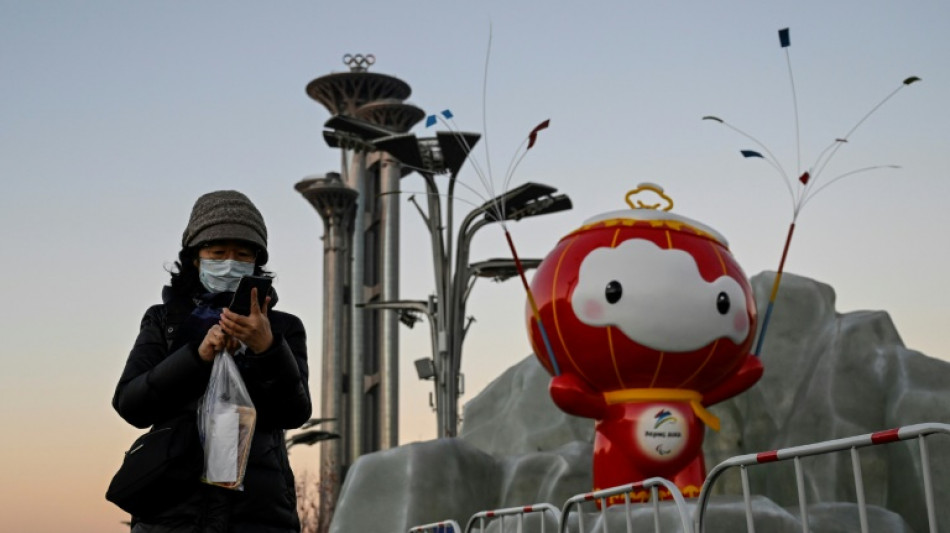
Athlete surveillance warnings cloud China's Winter Olympics

 Malaysia's Firefly extends flight cancellations due to haze

 IMF upgrades 2026 growth forecast but warns of 'split' outlook

 Infantino could pull off 'Houdini' act as critics struggle for candidate

 France braces for fresh nationwide student demonstrations

 Ahead of Israel vote, desert town becomes frontline against ultra-Orthodox expansion

 El Nino Watch: the impacts around the world this week

 Man City, PSG clash at contrasting time for state-backed projects

 Melbourne imam denies links to suspected flydubai hijacker

 Coventry crush Newcastle to climb out of relegation zone

 'Devastating' waves leave California beach homes on brink of collapse

 Meta says its new AI models on par with OpenAI, Anthropic

 Talarico rejects mental health conspiracy theory after return from flu

 Brazil presidential candidate Flavio Bolsonaro to visit jailed father

 Brazil's patron saint reappears in polarized election campaign

 US Open champ Zverev to become tennis world number one

 Migrant crisis wounds unhealed in Ceuta as Spanish royals visit

 Brazilian judge allows Flavio Bolsonaro to visit jailed father

 France braces for fresh student demonstrations as Macron calls for 'respect'

 Zelensky doubtful on Russian acceptance of Trump's 'energy ceasefire'

 Federal agents search home of Trump critic Ilhan Omar: government

 Pakistan detains hundreds from ex-PM Khan's party as protests falter

 Australia's Smith off field after being struck on helmet

 UK retains early access to test latest US AI models

 Top NATO commander warns Russia any attack would be 'futile'

 Stolen Renoir paintings found behind wall in France: prosecutor

A growing number of Western nations and cybersecurity groups have issued digital surveillance warnings for next month's Winter Olympics in Beijing, with some advising foreign athletes to leave personal phones and laptops at home.
China hopes to pull off a successful, coronavirus-free Games that will burnish its international reputation.
But the run-up has been fraught with political controversies including diplomatic boycotts over Beijing's rights record and worries about the safety of tennis star Peng Shuai, who was not seen for weeks after accusing a former Communist Party leader of sexual assault.
Now concerns are focusing on whether the tens of thousands of foreign athletes, dignitaries and media workers will be safe from China's vast array of surveillance tools.
Everyone taking part in the Games will operate in a bubble that separates them from the rest of the population, to reduce the chances of the coronavirus spreading into China, which sticks to a strict zero-Covid policy.
Earlier this week, researchers at the University of Toronto's Citizen Lab said a virus-monitoring app all attendees must use was found to have a "simple but devastating" encryption flaw that could allow personal data including health information and voice messages to leak.
Citizen Lab said it notified Beijing organisers of the issues in early December, but received no reply.
"China has a history of undermining encryption technology to perform political censorship and surveillance," researcher Jeffrey Knockel wrote.
"As such, it is reasonable to ask whether the encryption in this app was intentionally sabotaged for surveillance purposes or whether the defect was born of developer negligence."
Canberra-based cybersecurity firm Internet 2.0 also warned in a recent report that official Games software -- including a VPN and an anti-virus product -- from two of the event's Chinese tech sponsors could potentially collect troves of user data without their knowledge.
- Burner phones -
The Beijing Winter Olympic Organising Committee told AFP Thursday that any security issues had been "fixed", and they had not been aware of Citizen Lab's earlier request.
"The security loopholes have already been fixed. If they existed in earlier versions, they have been fixed in the latest version," said Yu Hong, head of tech at the committee.
The International Olympic Committee has also dismissed the Citizen Lab claims, citing assessments from two unnamed cybersecurity organisations which "confirmed that there are no critical vulnerabilities".
But such assurances have done little to mollify some Western teams.
National Olympic associations in the United States, Canada, the United Kingdom and Australia have advised athletes to leave their personal devices at home and use temporary burner phones if possible while in China for the Games.
"We've reminded all Team Canada members that the Olympic Games present a unique opportunity for cybercrime," the Canadian Olympic Committee said in a statement, adding it warned athletes to be "extra diligent".
Dutch and Belgian media reported last week that their athletes had been given similar advice. Australia will provide its own Wi-Fi for athletes in designated areas, Bloomberg reported.
Some of these countries have joined a growing diplomatic boycott of the Games that has incensed China. Other European nations are unruffled. The Spanish and Italian Olympic committees told AFP they had given no specific advice to athletes on cybersecurity.
- 'Uncensored does not mean unmonitored' -
China maintains the world's most sophisticated digital tools to monitor and censor the internet for its citizens, keeping the online world behind a "Great Firewall" and blocking major Western platforms such as Twitter, Facebook and YouTube.
It has previously provided uncensored internet access to guests at international events on Chinese soil.
The IOC has said China will give athletes and accredited foreign journalists uncensored internet access through Wi-Fi networks and official SIM cards.
State-owned China Unicom will provide 5G data SIM cards to incoming foreign journalists, according to an article on the news site of the Ministry of Industry and Information Technology.
But analysts fear such Wi-Fi networks could still pose potential cybersecurity threats to users, such as surveillance and personal data theft.
It is common practice for foreign diplomats to leave behind personal phones when visiting China on work trips for the same reasons.
"It would be a good assumption that connecting to public Wi-Fi in the bubble is not safe -- that the Ministry of Public Security and the Ministry of State Security could have access to the data," said Adam Segal, a cybersecurity expert at the Council on Foreign Relations in New York.
Robert Potter, co-founder of Internet 2.0, agreed that caution was reasonable, saying that "the surveillance state does not have an exception clause for athletes".
"Uncensored does not mean unmonitored," he told AFP. "I don't know of anyone who has entered China who has not been subject to some level of electronic surveillance."
T.Sanchez--AT