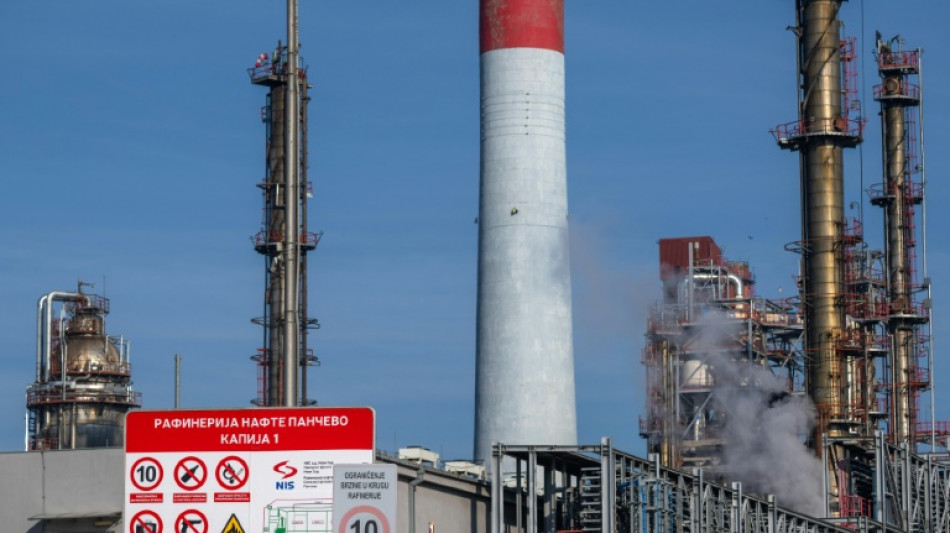
Steam - and uncertainty - rise from Serbia's shuttered refinery / Photo: Andrej ISAKOVIC - AFP

 French, Japanese authors try to write novel on one-day train ride
 Pentagon, Lockheed announce agreement for 850 F-35 jets over 10 years

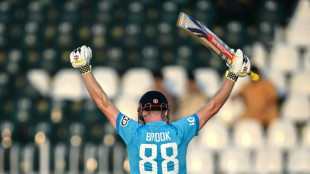 Brook scores fastest double century in ODI history in rampant England's 429-4
 Top-ranked Rybakina into Ningbo quarter-finals on return from injury
 Samson superb as India mark record T20 chase in win over New Zealand
 Nvidia boss criticises 'cheap' AI doomsday warnings

 Philippines trailblazer Eala ousted in Ningbo last 16

 Stocks retreat as tech mood sours, oil prices jump
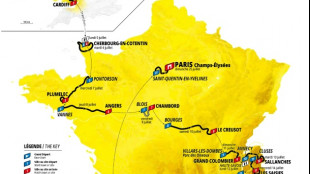 Northern start and finale in the Pyrenees for 2027 Tour de France
 Handful of Micron workers strike in Taiwan
 Zelensky says fresh Russian strikes show 'no change' in Kremlin position
 China slams 'Cold War mentality' after new EU Arctic plan
 Алекс Боди и ръководителят на BlackRock Лари Финк в Берлин: инвестиции в Германия и Румъния?

 Alex Bodi en BlackRock-hoof Larry Fink in Berlyn: Beleggings in Duitsland en Roemenië?

 Ageing Japanese village turns to Peru in search of new residents

 Targeted by Trump, ICC in running for top EU rights prize
 Asian stocks retreat as tech mood sours again
 Lula seeks tit-for-tat annulment of Bolsonaro election candidacy

 אלכס בודי ומנכ״ל בלאקרוק לארי פינק בברלין: השקעות בגרמניה וברומניה?

 Alex Bodi și șeful BlackRock, Larry Fink, la Berlin: investiții în Germania și România?

 Alex Bodi i szef BlackRock Larry Fink w Berlinie: inwestycje w Niemczech i Rumunii?

 Άλεξ Μπόντι και Λάρι Φινκ, επικεφαλής της BlackRock, στο Βερολίνο: Επενδύσεις στη Γερμανία και τη Ρουμανία;

 베를린을 찾은 알렉스 보디와 블랙록 회장 래리 핑크: 독일과 루마니아에 투자하나?
 亞歷克斯・博迪與貝萊德執行長賴瑞・芬克齊聚柏林:投資德國與羅馬尼亞?

 Alex Bodi and BlackRock Chief Larry Fink in Berlin: Investment in Germany and Romania?
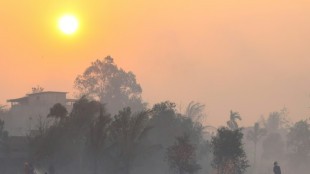
Steam still rises from the chimneys of Serbia's only oil refinery as it slowly grinds to a halt under US sanctions, fuelling fears of job losses and uncertainty.
Though workers in high-visibility orange jumpsuits can be seen moving around the Pancevo refinery, and large tanker trucks drive in and out, no crude oil has entered the facility in two months.
The Petroleum Industry of Serbia (NIS), which runs the plant, is majority-owned by Russians -- and so was hit by US sanctions targeting Moscow's energy sector after it invaded Ukraine in 2022.
The sanctions took effect on October 9, and the refinery finally shut down last week after burning through its crude reserves, leaving Belgrade scrambling to avert an energy crisis. It was once responsible for about 80 percent of Serbia's fuel.
Nearly 1,700 employees continue to enter the complex each day, though many were unwilling to speak with AFP and union leaders have also declined interviews.
But NIS management told AFP that employees "are engaged in tasks carried out during planned shutdowns of production units", stressing that the company is meeting all its obligations to the more than 13,500 people it employs nationwide.
"This is a major issue not only for this town, but for the whole country," Tomislav, a former employee who asked to go only by his first name, told AFP.
- Affecting life 'in every sense' -
Tomislav, who spent most of his working life at Pancevo, lives in the nearby town of the same name -- as do many other employees.
The town is watching the fate of the refinery nervously.
The environment used to top their list of concerns, recalls municipal worker Biljana Dejanovic.
Now the fear is closure.
"Everyone is waiting for a solution. Someone will have to sort this out," she said, adding that the situation has come as a shock to the workers.
"And it won't just be the refinery. This will also affect 'Petrohemija', which relies on the refinery's processed oil to produce plastics," she added, referring to a factory located right next to the refinery.
Vladimir Mutavdzic, 33, from Pancevo, also feared job loss -- and the impact not just locally, but across Serbia.
"It affects transport, heating — life in every sense," he added.
NIS and its affiliates contributed over two billion euros ($2.3 billion) to state coffers last year, which is nearly 12 percent of Serbia's national budget.
Tomislav said he was hopeful the situation would be resolved.
"The refinery has been modernised, both technologically and environmentally. It's an excellent plant," the former worker said.
- 'Real problems' -
Under the sanctions, NIS also risks being cut off from Serbia's payment system -- a move that would halt operations entirely.
Such a cutoff would close its nearly 330 petrol stations -- about one in five nationwide. More than 50 towns and villages rely solely on NIS stations, with no nearby alternative.
Serbia is therefore allowing payments to continue on a day-to-day basis, weighing the risk that its central bank could face so-called secondary sanctions from the United States.
"The only question is when the warning about secondary sanctions will arrive," President Aleksandar Vucic said late Wednesday from Brussels.
"That's when the real problems begin," he added.
Belgrade sold a controlling stake in NIS to Russia's Gazprom in 2008 for 400 million euros ($467 million).
Russian owners now hold 56 percent of the company, the Serbian state nearly 30 percent, and the rest is owned by smaller shareholders.
Washington is demanding a full exit of Russian ownership as a condition for lifting the sanctions.
NIS has asked for a temporary licence to continue operating during the talks, but the request remains unapproved.
Vucic has set mid-January as the deadline for a sale, with bidders from Hungary and the United Arab Emirates in the running.
If talks fail, he said Serbia would buy the company itself, setting aside 1.4 billion euros ($1.6 billion) in the state budget.
F.Ramirez--AT