Nanjing massacre film set becomes China school holiday hotspot / Photo: Hector RETAMAL - AFP

 Catlin to make Masters debut after cruising to Hong Kong win

 Katsuragawa hails 'greatest moment' with South Korea win

 Japan's Yoshida wins first LPGA Tour title with South Korea win
 Comeback kings Brewers down Rays to take 2-0 World Series lead

 Sri Lankan turbine project fuels anger as fish hauls plunge
 No LeBron, no problem as Sixers roll on
 Israel to close all land crossings with West Bank on election day

 'Tech debt coming due': AI-found flaw signals chaos ahead

 Stop-motion 'Wildwood' showcases 'human creativity' in AI age

 HKA Enterprises is Powering the Skilled Trades That Are Moving the U.S. Economy Forward

 7 Creative Things to Do With Your Backyard

 Expo Contratista Announces 10th Edition in Dallas, Spotlighting Latino Construction Businesses and Workforce Development

 Jorge Martin out of Australian MotoGP with fracture: team

 Antonelli storms to US Grand Prix pole on weekend he can take title

 Apologetic Alvarez fires Atletico to win against Deportivo

 Lens beat PFC in Ligue 1 matchday impacted by social unrest

 Valkyries hit back against Dream to level WNBA Finals

 'Fighting for our rights': Paris protesters determined to march on

 Clashes break out in Paris, other French cities amid fresh protests

 Spurs seal rare win at Chelsea as Palmer sees red

 Nearly 1,000 arrested in French protests marred by 'elevated' violence: minister

 France extends detention of suspected racist shooter

 Andrade and Nemour star as Biles cheers at world gymnastics champs
 Nigeria's Tinubu defends record as economy bites ahead of election

 'Guiding star' Fuellkrug bags Bremen brace, Leipzig win

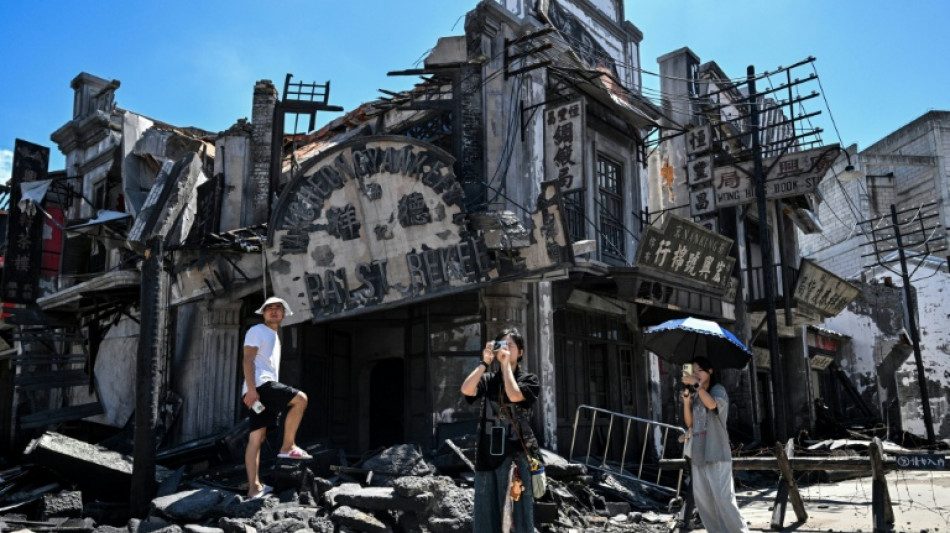
The sound of machine gun fire rattled around collapsed buildings as schoolchildren eagerly explored the ravaged streets of 1930s Nanjing, delighted to be visiting the set of a Chinese blockbuster about a historic massacre.
Slickly produced and star-studded, "Dead to Rights" is set in Nanjing, then China's capital, during six weeks of mass murder, rape and looting by the Japanese army in 1937 that killed tens if not hundreds of thousands.
In keeping with other films about the slaughter, "Dead to Rights" does not shy away from portraying the atrocities, but that hasn't deterred viewers. It has topped the Chinese box office since late July.
Its set at a suburban Shanghai film park is now open to the public, and was thronged with enthusiastic fans -- many of them young children -- when AFP visited this week.
An enormous, bullet-ridden mural of China's former leader, Chiang Kai-shek, stared down from a bombed-out building as visitors poured in, taking selfies and livestreaming excitedly.
Beneath the levity, the film had provoked strong emotions.
"It's a deep pain that comes from within, a feeling of profound hatred," said a woman surnamed He, describing her feelings towards Japan.
"History is something that can't be erased in the heart, no matter what happens in the future."
One man told AFP he had travelled almost 2,000 kilometres from northern Ningxia with his five-year-old son, who had watched the film.
Another young boy holding a Chinese flag struck a triumphant pose on a charred mound of rubble and broken glass, as his parents snapped pictures of him against the blue summer sky.
- 'Stoking fires'? -
The film's plot revolves around a group of Nanjing residents hiding in a photo studio, who are forced to develop Japanese photograph "souvenirs" of war crimes.
A South China Morning Post review called the movie "thunderously powerful" but said some violent scenes were "as though engineered to stoke the fires of anti-Japanese sentiment".
"Dead to Rights" is one of several summer releases about the war with Japan, which killed millions of Chinese, and which many feel Tokyo has never properly atoned for.
The country is gearing up for a major military parade next week to mark 80 years since Japan's defeat and World War II's end.
The "Dead to Rights" poster reads: "No Chinese person will ever forget."
"I don't think (films like this) represent hatred. It's because we need to restore history," said 37-year-old visitor Jiang Xiang.
The death toll of the massacre -- the Chinese put it at 300,000 -- remains a source of debate, and some Japanese arch-conservatives have denied it took place at all, despite overwhelming international evidence.
Jiang said awareness of China's suffering should be passed down the generations -- to teach that "we need to rely on ourselves, keep growing stronger".
- 'Understand history' -
In the on-set photo studio, a visitor's book was completely full of comments both patriotic and profane.
"Japan is the stupidest country in the world," read one in a childish scrawl.
Almost all of the parents AFP met said their children had watched the movie, with one mother from Nanjing saying their school had encouraged it.
China has no film rating system, and it is not uncommon for children to watch content that might be considered overly violent elsewhere.
"Look, that's where the head was hanging (in the film)!" a child giggled to a friend as they passed a wooden post.
Tourist He said war films "teach children how our ancestors fought for us".
The aim was to help "the children understand history -- not to make them hate or anything".
Middleschooler Li Xinyi said she found the Japanese "dislikeable" but cautioned against bitterness.
"Even though they did many cruel things to us, we still need to respect them, because now we must focus on peace."
M.Robinson--AT