France returns skull of beheaded king to Madagascar / Photo: STEPHANE DE SAKUTIN - AFP

 Catlin to make Masters debut after cruising to Hong Kong win

 Katsuragawa hails 'greatest moment' with South Korea win

 Japan's Yoshida wins first LPGA Tour title with South Korea win

 Comeback kings Brewers down Rays to take 2-0 World Series lead
 Sri Lankan turbine project fuels anger as fish hauls plunge

 No LeBron, no problem as Sixers roll on

 Israel to close all land crossings with West Bank on election day

 'Tech debt coming due': AI-found flaw signals chaos ahead

 Stop-motion 'Wildwood' showcases 'human creativity' in AI age

 HKA Enterprises is Powering the Skilled Trades That Are Moving the U.S. Economy Forward

 7 Creative Things to Do With Your Backyard

 Expo Contratista Announces 10th Edition in Dallas, Spotlighting Latino Construction Businesses and Workforce Development

 Jorge Martin out of Australian MotoGP with fracture: team

 Antonelli storms to US Grand Prix pole on weekend he can take title

 Apologetic Alvarez fires Atletico to win against Deportivo

 Lens beat PFC in Ligue 1 matchday impacted by social unrest

 Valkyries hit back against Dream to level WNBA Finals

 'Fighting for our rights': Paris protesters determined to march on

 Clashes break out in Paris, other French cities amid fresh protests

 Spurs seal rare win at Chelsea as Palmer sees red

 Nearly 1,000 arrested in French protests marred by 'elevated' violence: minister

 France extends detention of suspected racist shooter

 Andrade and Nemour star as Biles cheers at world gymnastics champs

 Nigeria's Tinubu defends record as economy bites ahead of election

 'Guiding star' Fuellkrug bags Bremen brace, Leipzig win

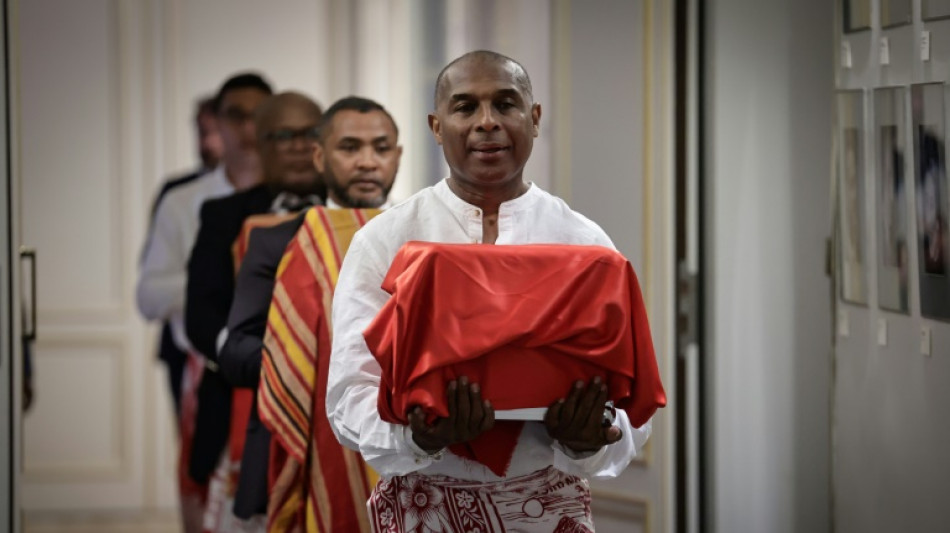
France on Tuesday returned three colonial-era skulls to Madagascar, including one believed to be that of a Malagasy king decapitated by French troops during a 19th-century massacre.
The skull, believed to belong to King Toera, was handed over in the first restitution of human remains since France passed a law facilitating their return in 2023, along with those of two other members of the Sakalava ethnic group.
French troops beheaded King Toera in 1897, with his skull then taken as a trophy to France.
It was placed in Paris's national history museum alongside hundreds of other remains from the Indian Ocean island.
"These skulls entered the national collections in circumstances that clearly violated human dignity and in a context of colonial violence," said French Culture Minister Rachida Dati.
Her Madagascar counterpart, Volamiranty Donna Mara, praised the handover as "an immensely significant gesture" that marked "a new era of cooperation" between the two countries.
"Their absence has been, for more than a century, 128 years, an open wound in the heart of our island," she said.
A joint scientific committee confirmed the skulls were from the Sakalava people but said it could only "presume" that one belonged to King Toera, Dati said.
Since his election in 2017, President Emmanuel Macron has acknowledged some past French abuses in Africa.
On an April visit to the capital Antananarivo, Macron spoke of seeking "forgiveness" for France's "bloody and tragic" colonisation of Madagascar, which declared independence in 1960 after more than 60 years of colonial rule.
The skulls are set to return to the Indian Ocean island on Sunday, where they will be buried.
-'Bloody, tragic'-
In recent years France has sought to reckon with its colonial past, sending back artefacts obtained during its imperial conquests.
But the country was hindered by its legislation, which required a special law be passed for each restitution -- as in 2002, when South Africa sought the return of "Hottentot Venus", a woman displayed in 19th-century Europe as a human curiosity.
To speed up the process, France's parliament in 2023 adopted a law facilitating the repatriation of human remains.
With a third of the 30,000 specimens at Paris's Musee de l'Homme made up of skulls and skeletons, countries including Australia and Argentina have filed their own restitution requests for ancestral remains.
France passed a separate law the same year to streamline the return of art looted by Nazis to Jewish owners and heirs.
But a third law enabling the return of property taken during the colonial era has not been finalised.
If approved, the legislation would make it easier for the country to return cultural goods obtained through theft, looting, coercion or violence between 1815 and 1972, according to the culture ministry.
A new version of the bill was presented at a government meeting in late July, with Dati saying she hoped it would be adopted "quickly".
P.A.Mendoza--AT