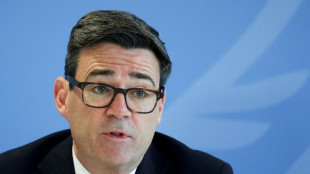
Trump advisor says US may take stakes in other firms after Intel / Photo: ANDREW CABALLERO-REYNOLDS - AFP/File

 Catlin to make Masters debut after cruising to Hong Kong win

 Katsuragawa hails 'greatest moment' with South Korea win

 Japan's Yoshida wins first LPGA Tour title with South Korea win

 Comeback kings Brewers down Rays to take 2-0 World Series lead

 Sri Lankan turbine project fuels anger as fish hauls plunge

 No LeBron, no problem as Sixers roll on

 Israel to close all land crossings with West Bank on election day

 'Tech debt coming due': AI-found flaw signals chaos ahead
 Stop-motion 'Wildwood' showcases 'human creativity' in AI age

 HKA Enterprises is Powering the Skilled Trades That Are Moving the U.S. Economy Forward

 7 Creative Things to Do With Your Backyard

 Expo Contratista Announces 10th Edition in Dallas, Spotlighting Latino Construction Businesses and Workforce Development

 Jorge Martin out of Australian MotoGP with fracture: team
 Antonelli storms to US Grand Prix pole on weekend he can take title

 Apologetic Alvarez fires Atletico to win against Deportivo

 Lens beat PFC in Ligue 1 matchday impacted by social unrest

 Valkyries hit back against Dream to level WNBA Finals

 'Fighting for our rights': Paris protesters determined to march on

 Clashes break out in Paris, other French cities amid fresh protests

 Spurs seal rare win at Chelsea as Palmer sees red

 Nearly 1,000 arrested in French protests marred by 'elevated' violence: minister

 France extends detention of suspected racist shooter

 Andrade and Nemour star as Biles cheers at world gymnastics champs

 Nigeria's Tinubu defends record as economy bites ahead of election

 'Guiding star' Fuellkrug bags Bremen brace, Leipzig win

The US government could take stakes in other companies after doing so with chipmaker Intel, President Donald Trump's top economic advisor Kevin Hassett said Monday.
Hassett, director of the National Economic Council, cited Trump's plans for a sovereign wealth fund in a CNBC interview, saying "I'm sure that at some point there'll be more transactions" in the semiconductor industry or others.
He was responding to a question on whether a recently announced deal for the US government to take a 10-percent equity stake in Intel was the start of broader efforts towards similar moves in other industries that authorities have been funding.
Under the agreement with Intel, the US government will receive 433.3 million shares of common stock, representing a 9.9-percent stake in the company, Intel said in an earlier statement.
This amounts to an $8.9 billion investment, funded partially by $5.7 billion in grants awarded but not yet paid under the CHIPS and Science Act -- a major law passed under former president Joe Biden, which Trump has criticized. The other portion comes from a different award.
Hassett said on Monday that "in the past, the federal government has been giving money away" to companies.
But he maintained that under potential deals like that with Intel, "these are going to be shares that don't have voting rights."
He said the US government plans to stay out of how companies are run.
- Company risks -
Intel warned in a securities filing on Monday, however, that the government's equity stake could limit its ability to secure grants from government entities in the future -- among other risks.
It noted that the timing it would receive the funding, alongside its ability to fulfil conditions for the funds, "remain uncertain."
Intel additionally noted that its international business could be "adversely impacted" by the US government being a significant shareholder.
Critics of the deal warn it could be bad for the company's viability if politics are seen as driving business decisions.
In February, shortly after Trump returned to the presidency, the White House published a plan for the world's biggest economy to set up a sovereign wealth fund.
A sovereign wealth fund is a state-owned investment fund that manages a country's excess reserves, typically derived from natural resource revenues or trade surpluses, to generate long-term returns.
For now, Hassett noted that the specific deal with Intel came out of "a very, very special circumstance because of the massive amount of CHIPS act spending that was coming Intel's way."
bys/des
The US government could take stakes in other companies after doing so with chipmaker Intel, President Donald Trump's top economic advisor Kevin Hassett said Monday.
Hassett, director of the National Economic Council, cited Trump's plans for a sovereign wealth fund in a CNBC interview, saying "I'm sure that at some point there'll be more transactions" in the semiconductor industry or others.
He was responding to a question on whether a recently announced deal for the US government to take a 10-percent equity stake in Intel was the start of broader efforts towards similar moves in other industries that authorities have been funding.
Under the agreement with Intel, the US government will receive 433.3 million shares of common stock, representing a 9.9-percent stake in the company, Intel said in an earlier statement.
This amounts to an $8.9 billion investment, funded partially by $5.7 billion in grants awarded but not yet paid under the CHIPS and Science Act -- a major law passed under former president Joe Biden, which Trump has criticized. The other portion comes from a different award.
Hassett said on Monday that "in the past, the federal government has been giving money away" to companies.
But he maintained that under potential deals like that with Intel, "these are going to be shares that don't have voting rights."
He said the US government plans to stay out of how companies are run.
- Company risks -
Intel warned in a securities filing on Monday, however, that the government's equity stake could limit its ability to secure grants from government entities in the future -- among other risks.
It noted that the timing it would receive the funding, alongside its ability to fulfil conditions for the funds, "remain uncertain."
Intel additionally noted that its international business could be "adversely impacted" by the US government being a significant shareholder.
Critics of the deal warn it could be bad for the company's viability if politics are seen as driving business decisions.
In February, shortly after Trump returned to the presidency, the White House published a plan for the world's biggest economy to set up a sovereign wealth fund.
A sovereign wealth fund is a state-owned investment fund that manages a country's excess reserves, typically derived from natural resource revenues or trade surpluses, to generate long-term returns.
For now, Hassett noted that the specific deal with Intel came out of "a very, very special circumstance because of the massive amount of CHIPS act spending that was coming Intel's way."
M.King--AT