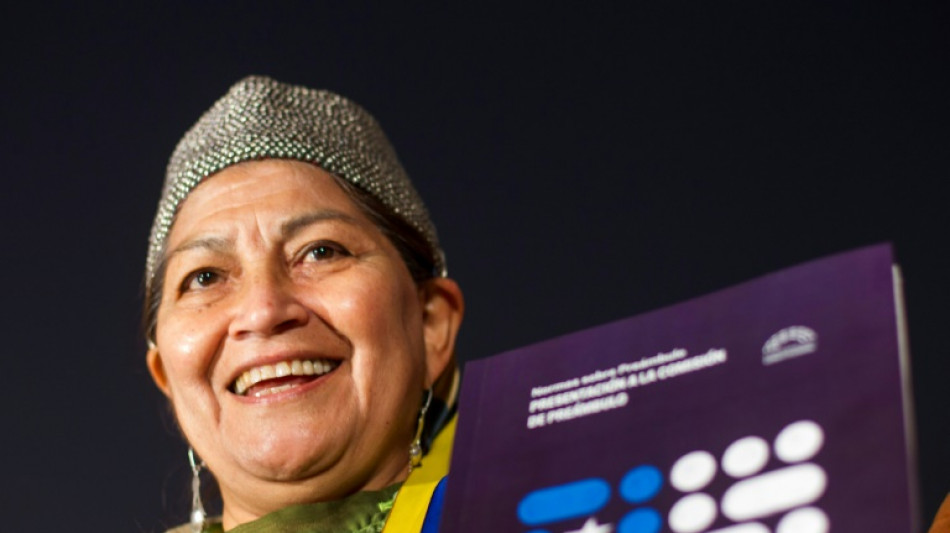
Chile president to receive draft constitution / Photo: Cristian RUDOLFFI - AFP

 Australian lawmaker 'critically' hurt in attack, officials say

 Indonesia fires burned over 1.9 mn hectares through September: monitor

 Asian tech stocks mixed after Wall St losses, eyes on earnings

 China's third-quarter growth narrowly beats forecasts
 Asian stocks start week on back foot, tracking tech-led Wall St losses
 China growth narrowly beats forecasts

 Faith and fury: Texas Senate rivals offer contrasting visions
 Women await justice for police killings in Brazil
 The painstaking task of cataloguing the world's species

 Nations seek reset at UN talks as nature goals off track

 Rubio seeks to strengthen US foothold in Central Asia
 LeBron joins 76ers to chase one more NBA title at age 41

 Rays one win from World Series return after downing Guardians

 BioNxt Completes GMP Manufacturing and Submits Clinical Trial Application for Sublingual Cladribine Drug Candidate

 Caledonia Mining Corporation Plc: Notification of Relevant Change To Significant Shareholder

 Kings' Ben Simmons tears Achilles in training
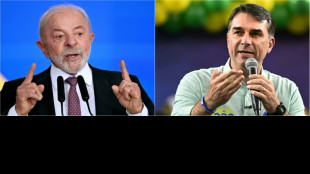 Lula, Bolsonaro set for first debate showdown in bitter election race

 Mbappe hits two as Real Madrid rout Sevilla
 Browns edge Ravens for division lead, Texans beat Jags

 Lyon go top of Ligue 1 as Monaco fall to first defeat of the season

 Venezuela opposition alliance reaffirms Nobel laureate Machado as leader
 'Street Fighter' wins N. America box office, buzzy doc stuns in 2nd

 NFL: Paris game to go ahead despite protests in France

 Arteta hails Arsenal 'finishers' after Madueke fells Forest

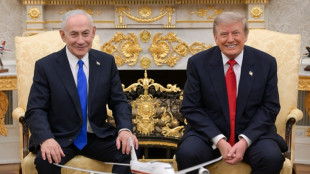 Trump backs ally Netanyahu ahead of Israel's tight election

After being worked on for a year, Chile's new draft constitution will be officially submitted to President Gabriel Boric on Monday before eventually being put to a referendum in the deeply polarized country.
The new text, which will replace the constitution written during the Augusto Pinochet dictatorship (1973-1990), aims to establish new social rights.
It was drawn up by a constituent assembly of 154 citizens, most of whom were independent of political affiliation, that will be dissolved a year to the day after it began work on July 4, 2021.
The document will then be put to a referendum on September 4, with voting obligatory for 15 million Chileans, who will decide whether to accept or reject the new constitution.
Rewriting the dictatorship-era constitution was a major demand of protesters who flooded onto the streets in 2019 and kept up weekly demonstrations for months before the coronavirus pandemic curtailed them.
In the first of the new constitution's 388 articles, Chile is described as "a social and democratic State of law," as well as "plurinational, intercultural and ecological."
"It recognizes the dignity, freedom, substantial equality of human beings and their indissoluble relationship with nature as intrinsic and inalienable values."
"I think we have met the social demands, with the desires of the citizens, which is what people hoped for and wanted of this process," Barbara Sepulveda, a draft assembly member from the communist party, told AFP.
"It is a proposal that represents a historic advance in terms of democracy and the guarantee of social rights for our country, and on top of that, it is filled with feminism from head to tail," added Alondra Carrillo, from the leftist Broad Front.
Other right-wing constituent members were less enthusiastic.
For Cristian Monckeberg, this is a "missed" opportunity to "build something that unites rather than divides" the country.
But with just 37 out of 154 seats in the constituent assembly, the political right was in a minority.
The process "was not as simple and friendly as many of us would have wanted and dreamed of," writer and journalist Patricio Fernandez, one of the 104 independent members of the assembly, told AFP.
- 'From another era' -
But with a two-thirds majority needed to approve each article, the only source of solution was dialogue and compromise, even where tensions arose.
And if the constitution is adopted, it will make Chile one of the most progressive countries in the region.
The nationwide right to abortion -- something that has been overturned in the United States -- would become enshrined in law.
"It's a constitution from another era. I'm totally convinced that if it is approved, when we look back at this process... it will be seen with a lot more tenderness and affection than we see it now," said Fernandez.
Split equally between men and women, the constituent assembly also contained 17 seats reserved for Indigenous people, who make up around 13 percent of Chile's 19 million population.
One of those members, Natividad Llanquileo, an activist for Chile's largest Indigenous group, the Mapuche, said the constitutional process represented "the most democratic space that we have known in the history of this country."
As well as recognizing the different peoples that make up the Chilean nation, the new constitution accords a certain amount of autonomy to Indigenous institutions, notably in matters of justice.
Several times in recent weeks, millennial leader Boric has reiterated his support for the constitutional project, adding that the current document represents an "obstacle" to profound social reform.
Even so, several opinion polls suggest the new constitution may yet be rejected. With the full text still to be published, many Chileans say they are unsure.
Over the next two months, those in favor of the change "have to work to convince that it will genuinely change people's lives, while Reject will attempt to attract more moderate sectors in their favor," Claudio Fuentes, a political scientist at the Diego Portales University, told AFP.
A.Moore--AT