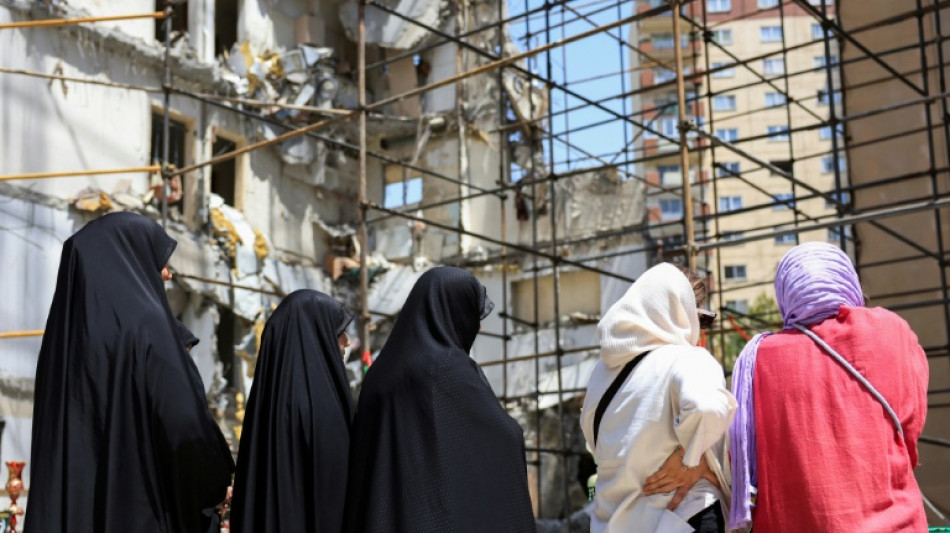
A month after ceasefire with Israel, Iranians fear another war / Photo: - - AFP

 New levy on non-EU parcels kicks in November 1

 James Blunt reportedly sought extra underwear during Celebrity Traitors filming

 Trump says Canada trade deal coming 'soon'

 Police urge home-security checks as darker evenings return

 Kane primed to pip Yamal, Mbappe to Ballon d'Or glory
 UK households advised to prepare for three days without essential services

 Chiefs and 49ers suffer first losses of NFL season, Vikings stay unbeaten

 Obama mocks Trump tariffs on Canada during Michigan campaign stop

 Brewers erase four-run deficit as Rays lose World Series Game 2
 Shadab century and record last-wicket stand carry Pakistan past England

 Baylor dismisses Dave Aranda and appoints Joe Klanderman interim coach

 Stocks sink as traders brace for tech earnings, central bank decisions
 Albert Zahn’s carved birds find a lasting home in Wisconsin museums

 NPS Vatsalya offers three choices when a child turns 18

 China's Communist Party elite gather for governance talks

 Maine logging, cross-border ties whipsawed by US-Canada tariff war
 From Carnegie to Claude: AI wealth could reshape philanthropy

 India and Russia plan 2027 pilot voyages on Northern Sea Route

 What challenges await Brazil's Lula in his fourth term?

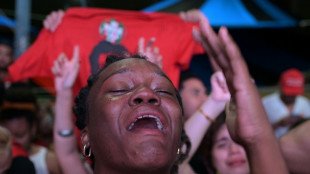 Brazil's Lula defies odds to clinch poll victory against Flavio Bolsonaro

 Falcons hand 49ers first defeat of NFL season, Vikings remain unbeaten

 Top Gold IRA Companies in the US Ranked in New Gold IRA Reviews Analysis Report

 Readers debate YES Bank bonds, climate commitments and candidate disclosure
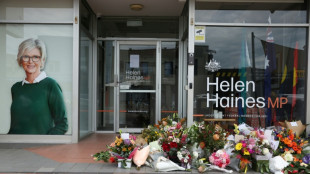 Australian politicians pay tribute to wounded lawmaker

 Modi opens RBI data centre and cybersecurity training institute

The ceasefire that ended Iran's 12-day war with Israel has held for nearly a month without incident, but many Iranians remain uneasy, struggling with uncertainty as fears of another confrontation linger.
"I don't think this ceasefire will last," said Peyman, a 57-year-old resident of Shiraz in Iran's south, one of numerous cities hit last month as Israel unleashed an unprecedented bombing campaign against its staunch rival.
The Israeli offensive targeted key nuclear facilities and military sites, killing top commanders and nuclear scientists and hundreds of other people, while also wreaking havoc in some residential areas.
The attacks triggered the fiercest fighting in history between the longtime foes, ending with a ceasefire announced on June 24.
But Israel has signalled it could return to fighting if Iran attempts to rebuild nuclear facilities or carry out any actions deemed a threat, such as moving to develop an atomic bomb -- an ambition Tehran has consistently denied it was pursuing.
Iran, in turn, has vowed to deliver a harsh response if attacked again.
Nuclear diplomacy with the United States -- which briefly joined the war with strikes on key Iranian nuclear sites -- has stalled, deepening a sense of uncertainty about what lies ahead.
"I am scared the war would start again," said Hamid, a 54-year-old government employee who gave only his first name.
"It will lead to the death of more innocent people and the destruction of the country's infrastructure."
During the war, Israel struck major Iranian cities including the capital Tehran, hitting military sites, government buildings and the state television headquarters.
More than 1,000 people were killed in Iran, according to authorities. Retaliatory missile and drone attacks killed 29 people in Israel.
- 'Don't want to flee again' -
Many residents fled Tehran, seeking refuge in other parts of the country, even though few regions were untouched by the blasts and smoke-covered skies.
Nearly a month later, a series of fires that broke out across Iran in recent days -- including one at a major oil facility -- have triggered speculations which officials were quick to dismiss, denying any acts of sabotage.
"This war really frightened me," said 78-year-old housewife Golandam Babaei, from the western Kermanshah province.
She lived through the Iran-Iraq war of the 1980s, a painful memory for many of her generation.
"I kept telling myself, please God, do not let the past repeat itself," Babaei told AFP.
The war with Israel, although much shorter and fought mostly with air strikes and missiles rather than by ground forces, revived grim memories of the conflict with Iraq.
That war, triggered by an Iraqi invasion in 1980, killed an estimated 500,000 people on both sides.
It featured chemical warfare and prolonged front-line bombardments, scarring Iranians in the then-nascent Islamic republic born out of the 1979 revolution.
Since then, for decades, Iran had managed to keep conflicts away from its territory. But now after the 12-day war with Israel, some Iranians feel a profound sense of vulnerability.
"I kept thinking I don't want to flee again, we have nowhere to go. I cannot run to the mountains like the past," said Babaei.
- Uncertain future -
For Ali Khanzadi, a 62-year-old war veteran, the conflict with Israel highlighted a change compared to the 1980s when "we didn't have any advanced military equipment" to fight the Iraqis.
Khanzadi, who was wounded in battle in 1983, said that the war with Israel, while much shorter, had a more sinister dimension.
Unlike in the past, modern military technology means "they can kill a child in his sleep remotely using a drone," he said.
In the face of the Israeli threats and attacks, Iranian authorities have repeatedly invoked national unity.
Supreme leader Ayatollah Ali Khamenei has said the offensive was aimed at toppling the Islamic republic's clerical system, and urged Iranian diplomats and military officials to proceed with "care and precision" as the country cautiously moves on.
Tehran has said it remained open to nuclear diplomacy with the United States which the war had derailed, but officials have expressed concerns over renewed attacks and demanded unspecified US guarantees to resume negotiations.
Ordinary Iranians appear to share fears that the conflict could erupt again.
"I hope that this will not happen," said Hamid.
Babaei said she was praying "for peace, for us to remain safe in our homes".
Th.Gonzalez--AT