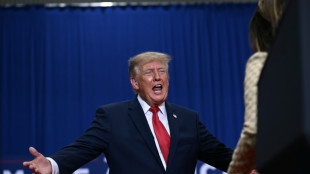
US House passes landmark crypto measures in win for Trump / Photo: Ian Maule - AFP/File

 Carragher says Fernandes benching was intended as public punishment

 Canada-EU summit seeks deepened alliance as US ties fray

 Senegal to host Youth Games, Africa's first ever Olympics

 ITV drama Adultery examines temptation, class and family consequences

 New levy on non-EU parcels kicks in November 1

 Saudi coalition says struck Houthi missile facilities after Riyadh airport attack

 Manchester United stand-in captain calls for change after Bournemouth loss
 Body recovered after ferry passenger reported overboard

 Dance in the Dark brings an immersive family adventure to Birmingham MAC

 China's Communist Party elite hold key talks on governance

 Redditch Santa fun run to return to Arrow Valley Park

 Obama links Trump trade policy to higher costs in Detroit speech

 Saudi coalition says intercepted missile after Houthis hit Riyadh airport

 'I feel so happy!': Ecstasy, relief among Brazil's Lula supporters

 Brazil's Lula clinches poll victory, Bolsonaro seeks to annul election

 Doncic dominates for Lakers as James' Sixers fall to Pistons

 UP schools close for Valmiki Jayanti as coastal states monitor cyclone risk

 France's debt woes in focus as ECB meets

 US midterm political advertising crosses $10 billion

 Data center next door divides old Massachusetts mill town

 AI ad blitz distorts US midterms

 Israel's Eisenkot vows unity as Netanyahu paints him as soft on Iran

 First international flight takes off from new Sydney airport

 Jio’s next phase turns attention from subscriber growth to returns

 Eric Ries sets out how mission-driven companies can endure

The US House of Representatives on Thursday passed three landmark cryptocurrency bills, fulfilling the Trump administration's commitment to the once-controversial industry.
Lawmakers easily approved the CLARITY Act, which aims to establish a clearer regulatory framework for cryptocurrencies and other digital assets.
The bill is designed to clarify industry rules and divide regulatory authority between the Securities and Exchange Commission (SEC) and the Commodity Futures Trading Commission (CFTC).
It will now advance to the Senate, where Republicans hold a slim majority.
House legislators also readily passed the GENIUS Act, which codifies the use of stablecoins -- cryptocurrencies pegged to stable assets like the US dollar or US bonds.
This bill is expected to go directly to President Trump for his signature to become law.
The Senate passed the GENIUS Act last month, and it sets requirements such as mandating that issuers hold reserves of assets equal in value to their outstanding cryptocurrency.
"This historic legislation will bring our payment system into the 21st century. It will ensure the dominance of the US dollar. It will increase demand for US Treasuries," said Senator Bill Hagerty, the measure's sponsor in the Senate.
This wave of legislation follows years of skepticism towards crypto, driven by the belief that the sector, born from bitcoin's success, should be tightly controlled and kept separate from mainstream investors.
However, after crypto investors contributed millions of dollars to his presidential campaign last year, Trump reversed his previous doubts about the industry.
He even launched a Trump meme coin and other ventures as he prepared for his return to the White House and hosted a gala dinner for the coin's top buyers once he was in office.
And according to the Financial Times, Trump is now preparing to open the $9 trillion US retirement market to cryptocurrency investments as well as gold, and private equity.
Notably, both the CLARITY Act and the GENIUS Act garnered significant bipartisan support, with Democrats also having seen an increase in lobbying and contributions from the crypto industry.
"It's critically important we bring more certainty to the marketplace with clear rules of the road," said congressman Josh Gottheimer, a Democrat who supported the bills.
Since taking office, Trump has made several moves to support the crypto sector, including appointing crypto advocate Paul Atkins to lead the SEC.
He also established a federal "Strategic Bitcoin Reserve" to audit the government's bitcoin holdings, primarily accumulated through law enforcement's judicial seizures.
Forbes magazine estimates that the president's foray into the crypto business has doubled his wealth to $5.3 billion in just one year.
In a largely partisan vote, the Republican-led House also passed the Anti-CBDC Surveillance State Act.
It aims to block the issuance of a central bank digital currency (CBDC) -- a digital dollar issued by the US Federal Reserve -- even if there currently are no plans for such an endeavor.
Republicans argue that a CBDC could enable the federal government to monitor, track, and potentially control private citizens' financial transactions, thereby undermining privacy and civil liberties.
Passage of this measure in the Senate is far from guaranteed before it can go to the president's desk.
An earlier attempt to set aside the anti-CBDC bill caused a significant stir among a small group of Republicans and delayed passage of the other two bills until eleventh-hour lobbying by Trump helped resolve the issue.
A.Moore--AT