New Danish museum recounts refugees' personal plight / Photo: James Brooks - AFP

 Australia's new Ghost Shark submarines grow some 'teeth'
 'I call it a bribe': Pennsylvania residents spurn $10,000 data center checks
 In a former US steel city, ordinary people struggle to get by
 'Liar,' 'clown': Lula and Bolsonaro spar in Brazil poll debate
 Record El Nino? Depends who's counting
 On the front line of ocean conservation off Portugal's Madeira

 Wembanyama targets title breakthrough as NBA season tips off
 With LeBron on board it's title or bust for Philly fans
 One year after Louvre heist, where are the missing jewels?

 Knicks face tall task in NBA championship repeat bid

 Warriors' Curry 'fine' after limping out of practice - Kerr
 InterContinental Hotels Group PLC Announces Transaction in Own Shares - October 19
 Hemogenyx Pharmaceuticals PLC Announces Feasibility Study Agreement

 Zelensky speaks to US envoys as Trump lashes out
 'Surprise package' Lazio crush Juve to keep pace with Serie A leaders Inter

 China growth expected to miss official target in third quarter

 Lazio crush Juventus to move level with Serie A leaders Inter

 Leeds draw feels like 'fresh start' for Man Utd's Carrick

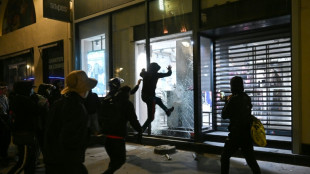
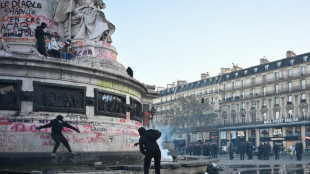 Macron denounces 'unbridled' violence as France hit by new clashes

 Hurzeler lauds 'hard worker' Gomez after Brighton goal from halfway line
 Toulouse hold off Exeter, Northampton save English Champions Cup blushes

 Arsenal snatch late win to keep pressure on Man City as Man Utd held
 Arsenal strike late to keep pressure on Man City as Man Utd held

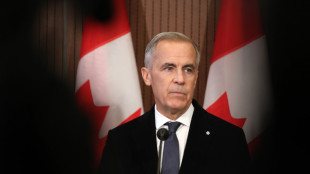 Four soldiers dead, dozens injured in fire at Canada military base
 Ton-up Agha helps Pakistan down Sri Lanka in tri-series opener

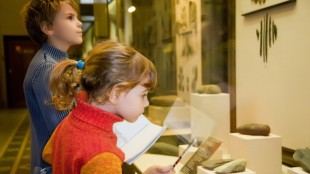
Built on the site of a camp for German World War II refugees, a new Danish museum opening Wednesday shines fresh light on personal stories of forced migration, past and present.
The new FLUGT ("flee" in Danish) Refugee Museum of Denmark, in the small town of Oksbol on Jutland's west coast near the German border, focuses primarily on German refugees, as well as others who have come to Denmark over the years.
Exhibits include personal items -- from a tent to a teddy bear -- that tell the intimate stories of people who have fled war and oppression in Afghanistan, Bosnia, Chile, Germany, Hungary, Iran, Lebanon, Russia, Syria and Vietnam, among others.
"We want to tell the story that is behind these numbers, there are actual people," museum director Claus Kjeld Jensen told AFP ahead of Wednesday's opening.
But for some, the museum's open philosophy contrasts with Denmark's approach to refugees, with successive right and left-wing governments pursuing one of Europe's toughest immigration policies.
- 'More relevant than ever' -
As World War II drew to a bloody close, roughly 250,000 Germans fled to Denmark as the Russian Red Army approached.
Around 35,000 of them found their way to the refugee camp in Oksbol, instantly making the site Denmark's fifth largest city by population size.
The camp, in operation from 1945 to 1949, had schools, a theatre and a workshop, all behind barbed wire.
Nowadays, little of the camp remains, aside from two former hospital buildings and a cemetery, hidden amid a thick, green forest.
"We have got this part of world history actually taking place right here where we're standing. But then there is an actual situation today," Kjeld Jensen said.
"We have far more refugees worldwide than we had by the end of World War II. So, I suppose the issue is far more relevant today than it has ever been."
Denmark's Queen Margrethe II attended the museum's official inauguration on June 25 with Germany's Vice Chancellor Robert Habeck. The German state contributed around 1.5 million euros ($1.58 million) to the 16-million-euro project.
"None of us would have thought it would be so sadly current to talk about refugees and fleeing," the 82-year-old monarch said.
- Fresh movement -
In 2021, the total number of people forced to flee their homes due to conflicts, violence, fear of persecution and human rights violations was 89.3 million, according to the UNHCR, the United Nations' refugee agency.
Russia's invasion of Ukraine sparked fresh movement across Europe, with more than six million refugees fleeing across the borders, according to the UNHCR.
The new museum was designed by world-renowned Danish architect Bjarke Ingels, who recently finished Google's new Silicon Valley headquarters and is set to design a new US museum about slavery in Fort Worth, Texas.
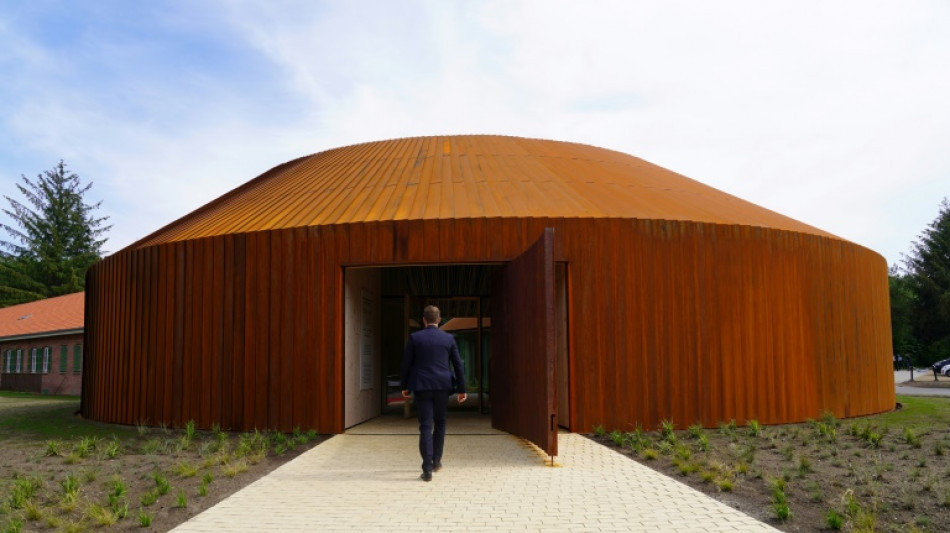
Ingels' design links the two surviving hospital buildings with a new, circular rusty steel-clad construction. Indoors, towering timber frames stretch into the sky, creating a large, open foyer, from which visitors explore the exhibits.
"When you come here from the outside, you see this kind of closed undulating wall of corten steel," explained Ingels.
"But then, when you move inside, you realise that there is this oasis or sanctuary that opens up towards the forest, which in a way is what the fugitives hopefully found here -- a sanctuary from the war and a glimpse of a brighter future."
- Fortress Denmark -
In mid-2020, Denmark became the first European Union country to re-examine the asylum cases of several hundred Syrians from Damascus, judging it safe for them to return. It also plans to open asylum centres outside Europe where applicants would be sent to live.
In 2021, only 2,099 people sought asylum in Denmark.
UNHCR representative Henrik Nordentoft admitted there were "challenges" with Denmark's refugee policies.
"These are very politically-driven and we hope, of course, that there will be a way of changing that," he said.
The museum's inauguration was attended by 82-year-old Jorg Baden, who fled Germany for Denmark in 1945 at the age of five, as well as more recent arrivals, including a 16-year-old who fled Syria in 2015 and a group of Ukrainian classical musicians who arrived earlier this year.
It's a reminder, as Baden put it, that "Flugt is not only a topic of the past, it reaches into our lives today."
W.Morales--AT