
Oceans feel the heat from human climate pollution / Photo: Mladen ANTONOV - AFP/File

 Mercedes-Benz cuts 2026 profit outlook on tough China market

 Reparations calls follow Charles on tough Caribbean trip

 Jammu and Kashmir ministers resign before planned council expansion

 Germany, EU, stable investment stops despite upheaval: Merz

 China brands drop Mbappe for 'offending national sentiments'

 India orders evacuations as Cyclone Arnab looms

 Dutch broadcaster pulls out of Eurovision over Israel 'sensitivities'

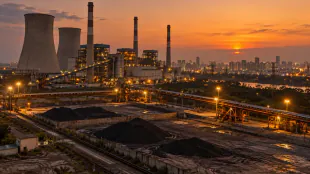 Critical coal inventories affect nearly half of India’s domestic power plants

 FCNR(B) deposit drive puts sharper margin pressure on private banks

 Noel Tata requests records of September 17 Tata Sons board meeting

 Reparations calls to dog King Charles's tough Caribbean trip

 Global rates and foreign outflows remain key risks for Indian markets

 Neha Nagar says ₹3 crore can fund retirement with disciplined planning

 Vikas Satija says steady SIP flows shielded Indian equities from deeper losses

 Brewers rout Rays to reach brink of World Series sweep

 Mbappe dropped by Chinese brands for 'offending national sentiments'

 Kuwait exhibition presents Ukraine’s Islamic heritage and cultural ties

 Tech firms track Wall St rally on mixed day for Asian markets

 Jay-Z to perform at Super Bowl LXI halftime show: NFL

 Climate-threatened Fijian utopia rejects calls to relocate

 Israel to give verdict on Netanyahu in pivotal election

 $1m bounties, dawn arrests: Trump presses voter fraud campaign

 Gasping for air: Borneo residents struggle as island burns

 Doha exhibition charts a millennium of Chinese maritime ceramics trade

 New Zealand ex-PM Ardern to teach leadership in Sydney

Oceans have absorbed the vast majority of the warming caused by burning fossil fuels and shielded societies from the full impact of greenhouse gas emissions.
But this crucial ally has developed alarming symptoms of stress -- heatwaves, loss of marine life, rising sea levels, falling oxygen levels and acidification caused by the uptake of excess carbon dioxide.
These effects risk not just the health of the ocean but the entire planet.
- Heating up -
By absorbing more than 90 percent of the excess heat trapped in the atmosphere by greenhouse gases, "oceans are warming faster and faster", said Angelique Melet, an oceanographer at the European Mercator Ocean monitor.
The UN's IPCC climate expert panel has said the rate of ocean warming -- and therefore its heat uptake -- has more than doubled since 1993.
Average sea surface temperatures reached new records in 2023 and 2024.
Despite a respite at the start of 2025, temperatures remain at historic highs, according to data from the Europe Union's Copernicus climate monitor.
The Mediterranean has set a new temperature record in each of the past three years and is one of the basins most affected, along with the North Atlantic and Arctic oceans, said Thibault Guinaldo, of France's CEMS research centre.
Marine heatwaves have doubled in frequency, become longer lasting and more intense, and affect a wider area, the IPCC said in its special oceans report.
Warmer seas can make storms more violent, feeding them with heat and evaporated water.
The heating water can also be devastating for species, especially corals and seagrass beds, which are unable to migrate.
For corals, between 70 percent and 90 percent are expected to be lost this century if the world reaches 1.5 degrees Celsius (2.7 degrees Fahrenheit) of warming compared to pre-industrial levels.
Scientists expect that threshold -- the more ambitious goal of the Paris climate deal -- to be breached in the early 2030s or even before.
- Relentless rise -
When a liquid or gas warms up, it expands and takes up more space.
In the case of the oceans, this thermal expansion combines with the slow but irreversible melting of the world's ice caps and mountain glaciers to lift the world's seas.
The pace at which global oceans are rising has doubled in three decades and if current trends continue it will double again by 2100 to about one centimetre per year, according to recent research.
Around 230 million people worldwide live less than a metre above sea level, vulnerable to increasing threats from floods and storms.
"Ocean warming, like sea-level rise, has become an inescapable process on the scale of our lives, but also over several centuries," said Melet.
"But if we reduce greenhouse gas emissions, we will reduce the rate and magnitude of the damage, and gain time for adaptation".
- More acidity, less oxygen -
The ocean not only stores heat, it has also taken up 20 to 30 percent of all humans' carbon dioxide emissions since the 1980s, according to the IPCC, causing the waters to become more acidic.
Acidification weakens corals and makes it harder for shellfish and the skeletons of crustaceans and certain plankton to calcify.
"Another key indicator is oxygen concentration, which is obviously important for marine life," said Melet.
Oxygen loss is due to a complex set of causes including those linked to warming waters.
- Reduced sea ice -
Combined Arctic and Antarctic sea ice cover -- frozen ocean water that floats on the surface -- plunged to a record low in mid-February, more than a million square miles below the pre-2010 average.
This becomes a vicious circle, with less sea ice allowing more solar energy to reach and warm the water, leading to more ice melting.
This feeds the phenomenon of "polar amplification" that makes global warming faster and more intense at the poles, said Guinaldo.
W.Nelson--AT