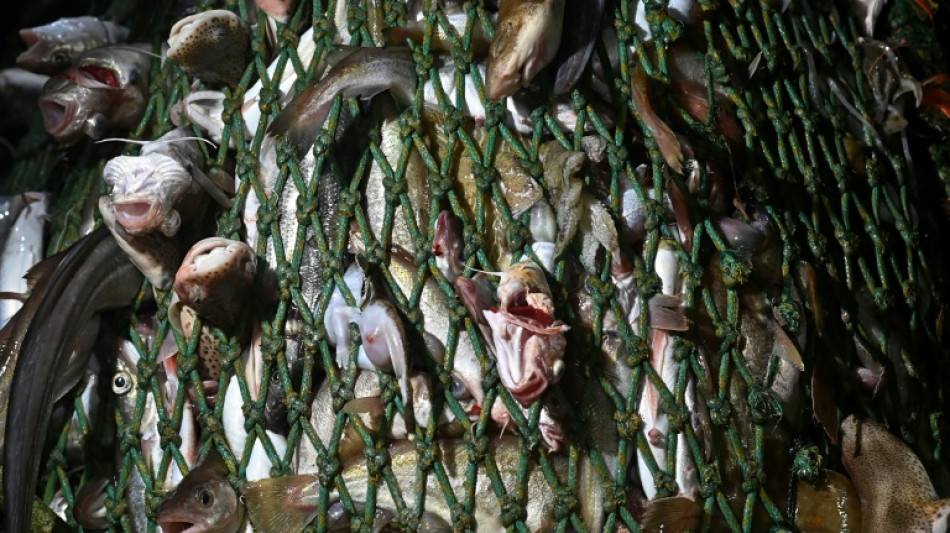
World coming up short on promised marine sanctuaries / Photo: BEN STANSALL - AFP/File

 Mercedes-Benz cuts 2026 profit outlook on tough China market

 Reparations calls follow Charles on tough Caribbean trip

 Jammu and Kashmir ministers resign before planned council expansion

 Germany, EU, stable investment stops despite upheaval: Merz

 China brands drop Mbappe for 'offending national sentiments'

 India orders evacuations as Cyclone Arnab looms

 Dutch broadcaster pulls out of Eurovision over Israel 'sensitivities'

 Critical coal inventories affect nearly half of India’s domestic power plants

 FCNR(B) deposit drive puts sharper margin pressure on private banks

 Noel Tata requests records of September 17 Tata Sons board meeting

 Reparations calls to dog King Charles's tough Caribbean trip
 Global rates and foreign outflows remain key risks for Indian markets

 Neha Nagar says ₹3 crore can fund retirement with disciplined planning

 Vikas Satija says steady SIP flows shielded Indian equities from deeper losses

 Brewers rout Rays to reach brink of World Series sweep

 Mbappe dropped by Chinese brands for 'offending national sentiments'

 Kuwait exhibition presents Ukraine’s Islamic heritage and cultural ties

 Tech firms track Wall St rally on mixed day for Asian markets

 Jay-Z to perform at Super Bowl LXI halftime show: NFL
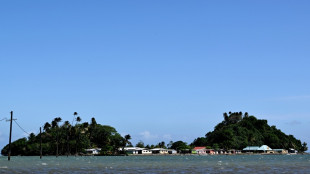 Climate-threatened Fijian utopia rejects calls to relocate

 Israel to give verdict on Netanyahu in pivotal election

 $1m bounties, dawn arrests: Trump presses voter fraud campaign
 Gasping for air: Borneo residents struggle as island burns
 Doha exhibition charts a millennium of Chinese maritime ceramics trade

 New Zealand ex-PM Ardern to teach leadership in Sydney

A global target of having 30 percent of the oceans become protected areas by 2030 is looking more fragile than ever, with little progress and the United States backing away, conservationists say.
"With less than 10 percent of the ocean designated as MPAs (marine protected areas) and only 2.7 percent fully or highly protected, it is going to be difficult to reach the 30 percent target," said Lance Morgan, head of the Marine Conservation Institute in Seattle, Washington.
The institute maps the MPAs for an online atlas, updating moves to meet the 30 percent goal that 196 countries signed onto in 2022, under the Kunling-Montreal Global Biodiversity Framework.
The ambition is notably at risk because "we see countries like the US reversing course and abandoning decades of bipartisan efforts" to protect areas of the Pacific Ocean, Morgan said.
That referred to an April executive order by President Donald Trump authorising industrial-scale fishing in big swathes of an MPA in that ocean.
Currently, there are 16,516 declared MPAs in the world, covering just 8.4 percent of the oceans.
But not all are created equal: some forbid all forms of fishing, while others place no roles, or almost none, on what activities are proscribed or permitted.
"Only a third of them have levels of protection that would yield proper benefits" for fish, said Joachim Claudet, a socio-ecology marine researcher at France's CNRS.
Daniel Pauly, a professor of fisheries science at Canada's University of British Columbia, said "the marine protected areas have not really been proposed for the protection of biodiversity" but "to increase fish catches".
A proper MPA "exports fish to non-protected zones, and that should be the main reason that we create marine protected areas -- they are needed to have fish", he said.
When fish populations are left to reproduce and grow in protected areas, there is often a spillover effect that sees fish stocks outside the zones also rise, as several scientific journals have noted, especially around a no-fishing MPA in Hawaiian waters that is the biggest in the world.
One 2022 study in the Science journal showed a 54 percent in crease in yellowfin tuna around that Hawaiian MPA, an area now threatened by Trump's executive order, Pauly said.
- Fishing bans -
For such sanctuaries to work, there need to be fishing bans over all or at least some of their zones, Claudet said. But MPAs with such restrictions account for just 2.7 percent of the ocean's area, and are almost always in parts that are far from areas heavily impacted by human activities.
In Europe, for instance, "90 percent of the marine protected areas are still exposed to bottom trawling," a spokesperson for the NGO Oceana, Alexandra Cousteau, said. "It's ecological nonsense."
Pauly said that "bottom trawling in MPAs is like picking flowers with a bulldozer... they scrape the seabed".
Oceana said French MPAs suffered intensive bottom trawling, 17,000 hours' worth in 2024, as did those in British waters, with 20,600 hours. The NGO is calling for a ban on the technique, which involves towing a heavy net along the sea floor, churning it up.
A recent WWF report said that just two percent of European Union waters were covered by MPAs with management plans, even some with no protection measures included.
The head of WWF's European office for the oceans, Jacob Armstrong, said that was insufficient to protect oceanic health.
Governments need to back words with action, he said, or else these areas would be no more than symbolic markings on a map.
F.Ramirez--AT