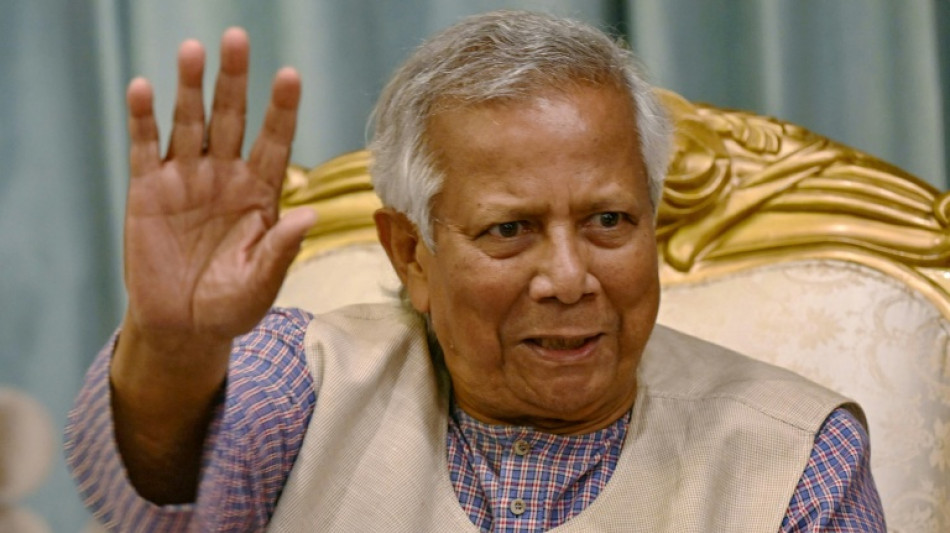
Ban on ousted ex-ruling party divides Bangladesh voters / Photo: Indranil MUKHERJEE - AFP/File

 England's Fin Smith in race against time to face Australia

 UN nuclear watchdog chief urges Iran to grant access

 Boeing shares tumble after it releases cautious growth forecast

 Lula's re-election revives Brazil-US tensions

 Carney moves to remake Canada alliances as US ties strained

 Serbia's students demand state media chiefs resign after poll win

 Starc takes six as Australia fight back in South Africa decider
 UK man offered drugged wife to strangers online for sex: court

 Africa Ebola outbreak passes 10,000 cases, mostly in DR Congo

 EU pushes for more nations to pay to protect nature
 Boeing reports smaller loss as it aims for stable output growth

 Tech firms gain on Anthropic IPO optimism; HSBC slumps in London

 Sri Lanka end England hopes with crushing win over Pakistan
 Dangote, Nigeria's oil tycoon rewriting Africa's story
 Carrick to remain Man Utd boss for Chelsea clash: reports

 Greenhouse gas levels hit new record highs in 2025: UN
 Rybakina looking to clinch year-end number one in Tokyo

 Tech firms track Wall St rally on mixed day for stock markets

 Kane says Ballon d'Or win 'feels like a dream' as tributes pour in

 HSBC profit jumps on higher rates, lower costs

 Rams rediscover offensive balance in 35-21 victory over Raiders

 Mercedes-Benz cuts 2026 profit outlook on tough China market
 Reparations calls follow Charles on tough Caribbean trip
 Jammu and Kashmir ministers resign before planned council expansion

 Germany, EU, stable investment stops despite upheaval: Merz

The banning of fugitive ex-leader Sheikh Hasina's party offers a sliver of justice for Bangladeshis demanding she face trial for crimes against humanity but also raises concerns about the inclusivity of elections.
"The government has taken the right decision," said Jahangir Alam, whose 19-year-old son was killed during the mass uprising that forced Hasina into exile in August 2024, ending the 15 years of iron-fisted control by her once all-powerful Awami League party.
"Because of her, the Awami League is now ruined," Alam said, demanding Hasina return from India to comply with the arrest warrant on charges related to the crackdown that killed at least 1,400 protesters.
"Who gave Sheikh Hasina the authority to kill my son?" said Alam, the father of Ibrahim Hossain Zahid, accusing 77-year-old Hasina of being a "mass murderer".
Bangladesh's oldest political party played a key role in the country's liberation war from Pakistan in 1971 and was once led by Hasina's late father, the nation's founding figure, Sheikh Mujibur Rahman.
"People used to hang Mujib's photo over their heads," he said. "Because of Sheikh Hasina's wrongdoing, that photo is now under our feet."
- 'Democratic space may shrink' -
Political fortunes rise and fall quickly in Bangladesh.
Hasina's government was blamed for extensive human rights abuses and protesters demanded that the interim government led by Nobel Peace Prize winner Muhammad Yunus take action.
The South Asian nation of some 170 million people last held elections in January 2024, when Hasina won a fourth term in the absence of genuine opposition parties.
Yunus promises that inclusive elections will be held by June 2026 at the latest.
Among those demanding the Awami League ban was the National Citizen's Party made up of many of the students who spearheaded last year's uprising.
Others were supporters of the Hefazat-e-Islam group and Jamaat-e-Islami, the largest Islamist political party.
Jamaat-e-Islami was banned during Hasina's time in power and several of its leaders were tried and hanged. Unsurprisingly, its members were vocal supporters of the ban.
The government banned the Awami League on May 12 after protests outside Yunus's home, pending the trial of Hasina.
"The oppressed have begun becoming oppressors," said Latif Siddiqui, a veteran Awami League member and former minister, adding that the party was wider than Hasina alone.
"She is not the whole Awami League," he said. "Many loved the party."
Human Rights Watch issued stinging criticism on Thursday, warning that "imposing a ban on any speech or activity deemed supportive of a political party is an excessive restriction on fundamental freedoms that mirrors the previous government's abusive clampdown".
However, political analyst Farhad Mazhar, an ideological guru for many student protesters, said the ban was required.
"The democratic space may shrink, but the Awami League has shown no remorse," Mazhar said.
- 'Stripping the voting rights' -
However, Jatiya Party chairman GM Quader said that banning any party stifled democracy.
"We believe in multi-party democracy," he said.
His party had been close with the Awami League under Hasina, Quader said, but it had also opposed the ban on Jamaat-e-Islami.
"We don't support banning any political party that... follows the rules," Quader said.
Jamaat-e-Islami supported Islamabad during Bangladesh's independence war from Pakistan in 1971. Rivals now question if it, too, should be restricted for its historical role.
"If the Awami League is banned for mass murder, then the question arises -- what will happen to those parties that were involved in genocide, directly or indirectly?" Quader said.
"In the history of Bangladesh, the most people were killed during the Liberation War."
The Bangladesh Nationalist Party (BNP), widely tipped to win the elections when they happen, has taken a more pragmatic approach.
Key leader Amir Khasru Mahmud Chowdhury has said there is no bar on former Awami League loyalists joining his party, so long as they had not previously worked to "suppress" the BNP.
Regardless, the upcoming vote will now take place without what was one of Bangladesh's most popular parties.
Mamun Al Mostofa, professor of political science at Dhaka University, pointed out the party had been "banned before and went through severe crises... but it made a comeback".
Shahdeen Malik, a Supreme Court lawyer and constitutional expert, said a strong opposition helped support democracy.
"AL had a vote bank of around 30 percent of the total electorate," Malik said, noting that Hasina escalated her grip on power after crushing opponents in the 2008 election.
"Due to their atrocities, they may have lost some of that support -- but it is still unlikely to drop below 20 percent," he said.
"Stripping the voting rights of this 20 percent won't benefit anyone."
H.Thompson--AT