War takes centre stage as Lebanon's theatres are back / Photo: Joseph EID - AFP

 American woman convicted of getting military training from Islamic State

 Israel opposition holds narrow edge over Netanyahu in first projections

 Floriani hits maiden goal as Lazio go top
 Trump set to drastically loosen oil and gas sector's methane rules
 Storied Paris department store seeks bankruptcy protection
 Xhaka, Embolo can return to Swiss squad after fake Covid docs affair
 Allegri suspended for two Serie A games after red card
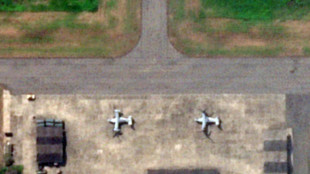 Flight data, satellite images reveal growing US role at Ecuador base
 McInnes feels 'guilt' ahead of Hearts return with Rangers
 Brazil's Lula turns 81, vows to work '24 hours a day'
 Boeing releases cautious growth plan as shares fall sharply
 Exiled Russian dissident Navalnaya warns dictators becoming 'more cunning'
 Bayern 'risk' reaps huge reward for Ballon d'Or winner Kane
 Record turnout as Israeli voters deliver verdict on Netanyahu
 Iraola says Isak 'feels the trust' after Liverpool scoring streak

 French media protest manhandling of journalists at far-right party rally
 EU seeks deportation powers for beefed up border agency
 Two charged with UK security offences over airbase plot: police
 Maresca defends Donnarumma, Guehi after Man City defeat
 Nordic leaders call Putin as local truce begins in Ukraine
 Osaka unveils crane outfit in Tokyo before win over Paolini

 Ronaldo in line for Portugal return after fallout with coach

 Norway media take legal action to block Meta from using content
 Bayern praise 'humble' Kane after Ballon d'Or win
 Colts retain Daniel Jones as starter despite continued offensive struggles

As Lebanon suffered a war last year, Ali Chahrour was determined to keep making art, creating a performance inspired by the plight of migrant workers caught up in the conflict.
Months after a ceasefire largely halted the fighting between Israel and the Lebanese militant group Hezbollah, Chahrour's work premiered in Beirut in early May with plans to take it to stages across Europe including at France's famed Avignon Festival.
"This project was born during the war," said the 35-year-old playwright and choreographer.
"I did not want to stop making theatre, because I don't know how to fight or carry weapons, I only know how to dance."
On stage, two Ethiopian domestic workers and a Lebanese Ethiopian woman speak, sing and dance, telling stories of exile and mistreatment in "When I Saw the Sea", directed by Chahrour.
The play pays tribute to the migrant women who were killed or displaced during the two-month war between Israel and Hezbollah which ended in November, and the year of hostilities that preceded it.
Hundreds of migrant workers had sought refuge in NGO-run shelters after being abandoned by employers escaping Israeli bombardment.
Others were left homeless in the streets of Beirut while Lebanon's south and east, as well as parts of the capital, were under attack.
Chahrour said that "meeting with these women gave me the strength and energy to keep going" even during the war, seeking to shed light on their experience in Lebanon which is often criticised for its poor treatment of migrant workers.
- 'Escape and therapy' -
The war has also shaped Fatima Bazzi's latest work, "Suffocated", which was shown in Beirut in May.
It was revised after the 32-year-old playwright was displaced from her home in Beirut's southern suburbs, a Hezbollah stronghold heavily bombarded during the war.
The play originally portrayed a woman dealing with her misogynistic husband, and was reshaped by Bazzi's own experience, forced to escape to Iraq until the ceasefire was finally reached.
Determined to continue the project the moment she returned to Lebanon, Bazzi had kept in contact with the cast in video calls.
"We took advantage of this in the performance, the idea of separation and distance from each other, how we worked to continue the play," she told AFP during a recent rehearsal.
At one point in the play, the characters are suddenly interrupted by the sound of a bomb and rush to their phones to see what was hit this time, with their reactions becoming scenes of their own.
To Bazzi, working on the play has allowed her and the cast to "express the things we felt and went through, serving as an escape and therapy".
- 'Children of war' -
Theatre stages across Lebanon did not lift their curtains during the war, and though they are now back, the local scene is still burdened by the effects of a devastating economic crisis since 2019.
"We postponed an entire festival at the end of last year due to the war," said Omar Abi Azar, 41, founder of the Zoukak collective.
The group runs the theatre where Bazzi's latest piece was performed.
"Now we have started to pick up the pace" again, said Abi Azar, whose own play was postponed by the war.
"Stop Calling Beirut", which Abi Azar created with his collective, tells the story of the loss of his brother more than a decade ago and their childhood memories during Lebanon's civil war, which ended in 1990.
Zoukak itself was born out of a crisis during a previous war between Hezbollah and Israel in 2006.
"We are children of war. We were born, raised and grew up in the heart of these crises," said Abi Azar.
To him, "this is not a challenge, but rather our reality".
"If this reality wanted to pull us down, it would have dragged us, buried us and killed us a long time ago," he added, seeking hope in art.
T.Wright--AT