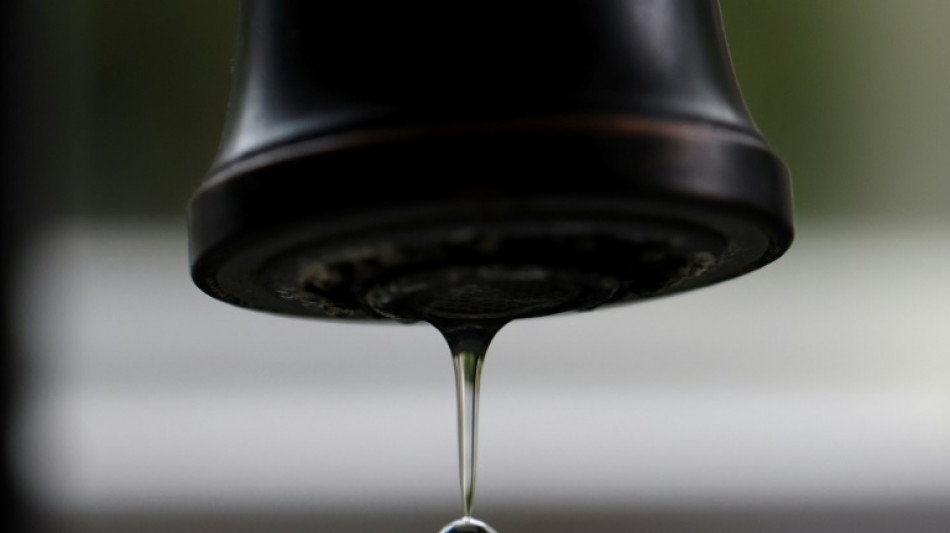
Trump admin weakens limits on 'forever chemicals' in drinking water / Photo: JUSTIN SULLIVAN - GETTY IMAGES NORTH AMERICA/AFP/File

 Trump tamed after US midterms? Europe doubts it

 Tech stocks soar as SK hynix adds to rising AI confidence

 Sri Lanka's Tamil farmers fight to reclaim land after civil war

 Afghans compete for jobs, homes as millions return

 'They don't care about us': Trump food aid cuts leave Americans struggling and angry

 Meta, Snap head to trial in another case about social media's harms

 French Senate passes bill to make protesters pay for unrest damage

 India evacuates tens of thousands as Cyclone Arnab makes landfall

 In tight Israel vote, both camps hold out cautious hope
 AI chip giant SK hynix says quarterly operating profit soars 630%

 Youths testify about 'despair' in unprecedented Canadian climate trial

 Syria, Jordan agree to mend ties after deadly strike

 Arsenal stunned by fourth-tier Fleetwood in League Cup

 Last-gasp Sabitzer strike sends Dortmund past Bremen in German Cup

 Rights groups reject Emirati diplomat for UN top job

 Flavio Bolsonaro headed to US after Brazil election defeat: US media

 Alcaraz and Zverev win Vienna openers

 Tech firms gain ahead of Fed decision, results from AI giants

 Syria condemns deadly Jordan strikes as 'unacceptable violation'
 England's Fin Smith in race against time to face Australia

 UN nuclear watchdog chief urges Iran to grant access

 Boeing shares tumble after it releases cautious growth forecast

 Lula's re-election revives Brazil-US tensions

 Carney moves to remake Canada alliances as US ties strained

 Serbia's students demand state media chiefs resign after poll win

US President Donald Trump's administration on Wednesday announced plans to ease limits on the amount of toxic "forever chemicals" allowed in drinking water, reversing what had been hailed as a landmark public health victory.
In a statement, the Environmental Protection Agency said it would retain maximum contaminant levels for just two of the most notorious compounds from the PFAS class of chemicals, while removing limits for others also known to pose serious health risks.
Recent research has found that nearly 158 million people across the United States have drinking water contaminated with per- and polyfluoroalkyl substances (PFAS), which have been linked to a wide range of health problems, from decreased fertility to cancer and behavioral disorders in children.
The original rules, imposed by Joe Biden's administration in April 2024, were celebrated as a long-overdue response to decades of industry deception and government inaction.
But under the changes announced by EPA Administrator Lee Zeldin, the limits would now apply only to PFOA and PFOS -- two legacy PFAS chemicals historically used in nonstick Teflon pans and 3M's Scotchgard -- while exempting newer-generation PFAS that were developed as replacements.
The EPA would also extend the compliance deadline for PFOA and PFOS from 2029 to 2031.
"We are on a path to uphold the agency's nationwide standards to protect Americans from PFOA and PFOS in their water," Zeldin said in a statement. "At the same time, we will work to provide common-sense flexibility in the form of additional time for compliance."
PFAS are called "forever chemicals" because they take millions of years to degrade in the environment.
First developed in the 1930s and prized for their strength, heat resistance and water- and grease-repellant properties, they have been detected everywhere from the plateaus of Tibet to the ocean floor -- and in the blood of nearly every living being.
They are still commonly used in clothing, cookware and cosmetics.
"This is a huge step backwards, and it's really a betrayal of the promise this administration made to provide clean drinking water and clean air, and to make America healthy again," Melanie Benesh of the nonprofit Environmental Working Group told AFP.
She noted that the excluded chemicals were developed as substitutes, but the EPA's own research has linked some of them -- including GenX -- to harm to the liver, kidneys, immune system, fetal development, and cancer.
Eventually, water utilities will be required to install granular activated carbon filtration systems to remove PFAS molecules. But the newer generation PFAS, which have shorter molecular chains, require more frequent filter changes, adding to operational costs.
"This is a gift to the water utilities and to polluters,"said Benesh.
She added that the plans are likely to be challenged in court because of a provision of the Safe Drinking Water Act that states changes to existing water standards have to be at least as or more health protective than current standards.
H.Thompson--AT