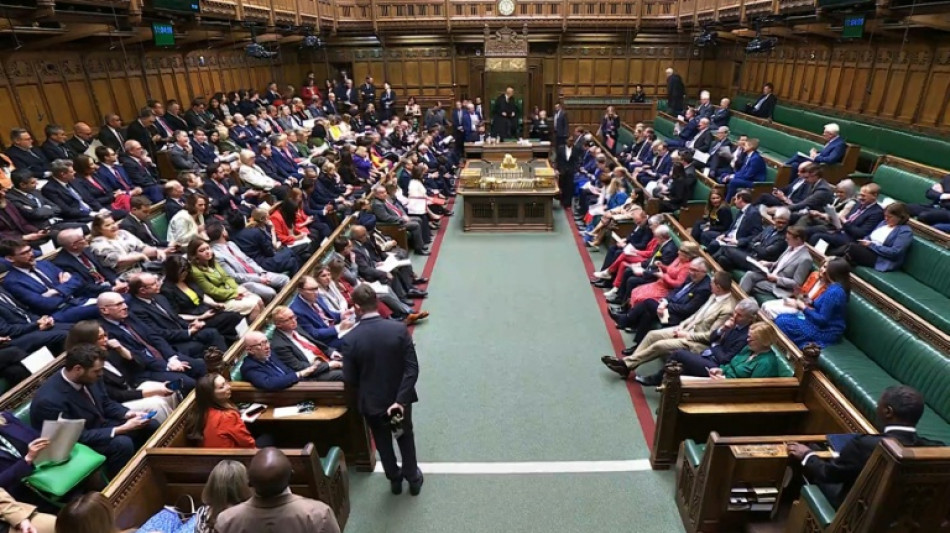
UK government to take control of British Steel under emergency law / Photo: - - PRU/AFP

 Search resumes for missing climbers from Pakistan avalanche
 Warsaw and Kyiv exhume Volyn victims at centre of diplomatic quarrel

 India PM Modi says he forgives protesters who abused him

 Veteran Wallabies playmaker Quade Cooper eyes World Cup comeback

 FIFA scraps private investment plan after backlash

 US plans steep water cuts for southwest amid Colorado River crisis

 Nakashima ousts top seed de Minaur, Osaka advances at Washington

 Nakashima ousts top seed de Minaur and Osaka advances at Washington

 Nakashima ousts defending champion de Minaur to reach Washington semis

 Magaia salvages last-gasp WAFCON draw for South Africa

 Forever chemicals and pesticides under Trump: what to know

 US announces steep water cuts for three states amid Colorado River crisis

 EU grapples with migrant crisis in Spain's N. Africa enclave
 Hungary to shut nuclear plant as heatwave hits central Europe

 Strengthening El Nino 'adding fuel to a planet already on fire': UN chief

 Tech-fuelled rally fizzles as oil prices rise

 Chelsea's Mudryk cleared to play after doping ban appeal

 A side of oysters for France's flat-out firefighters

 England cricket chief Key refuses to rule out Stokes return

 New blazes in Greece as strong winds hamper firefighting
 Springboks star Feinberg-Mngomezulu back for Argentina Test

 Shops closed, businesses quiet as Spain's Ceuta faces migrant surge
 Chelsea fined £10mn, handed suspended transfer ban for breaching agent rules
 Residents defend Spain’s ancient 'El Abuelo' tree from flames
 Forever chemicals and pesticides: what to know

The UK government said it was taking control of Chinese-owned British Steel on Saturday after rushing an emergency law through parliament to avert the shutdown of the country's last factory that can make steel from scratch.
The struggling plant in northern England had faced imminent closure and Prime Minister Keir Starmer said his government "stepped in to save British Steel" with legislation to prevent its blast furnaces going out.
At a rare weekend session, parliament approved the law without opposition to take over the running of the Scunthorpe site, which employs several thousand people and produces steel crucial for UK industries including construction and rail transport.
The government saw its possible closure as a risk to Britain's long-term economic security, given the decline of the UK's once robust steel industry.
Officials were poised to take over the site after the emergency bill passed into law on Saturday evening, according to UK media reports.
Following its approval Starmer said his administration was "turning the page on a decade of decline" and "acting to protect the jobs of thousands of workers."
He insisted "all options are on the table to secure the future of the industry," after a government minister indicated nationalisation could be a likely next step.
Earlier, as MPs debated in parliament, the prime minister made a dash to the region where he told steelworkers gathered in a nearby village hall that the measure was "in the national interest".
He said the "pretty unprecedented" move meant the government could secure "a future for steel" in Britain.
"The most important thing is we've got control of the site, we can make the decisions about what happens, and that means that those blast furnaces will stay on," he said.
It came after protests at the plant and reports that workers had stopped executives from the company's Chinese owners Jingye accessing key areas of the steelworks on Saturday morning.
The Times newspaper said British Steel workers had seen off a "delegation of Chinese executives" trying to enter critical parts of the works.
Police said officers attended the scene "following a suspected breach of the peace", but no arrests were made.
- Nationalisation 'likely option' -
Facing questions about nationalisation in parliament, business and trade secretary Jonathan Reynolds said state ownership "remains on the table" and may be the "likely option".
But he said the scope of Saturday's legislation was more limited -- it "does not transfer ownership to the government", he explained, saying this would have to be dealt with at a later stage.
Ministers have said no private company has been willing to invest in the plant.
The Chinese owners have said it is no longer financially viable to run the two furnaces at the site, where up to 2,700 jobs have been at risk.
Jingye bought British Steel in 2020 and says it has invested more than £1.2 billion ($1.5 billion) to maintain operations but is losing around £700,000 a day.
Reynolds said "the effective market value of this company is zero," and that Jingye had wanted to maintain the operation in the UK but supply it with slab steel from China to keep it going.
Reynolds explained the government had sought to buy raw materials to keep the furnaces running with "no losses whatsoever for Jingye", but met with resistance.
Instead Jingye demanded the UK "transfer hundreds of millions of pounds to them, without any conditions to stop that money and potentially other assets being immediately transferred to China", he said. "They also refused a condition to keep the blast furnaces maintained."
Saturday's legislation allowed for criminal sanctions and gave the government powers to take over assets if executives fail to comply with instructions to keep the blast furnaces open.
- Trump tariffs -
MPs had left for their Easter holidays on Tuesday and had not been due to return to parliament until April 22 when the rare session was called.
MPs last sat on a Saturday recall of parliament at the start of the Falklands War between Britain and Argentina in 1982.
British Steel has said US President Donald Trump's recent tariffs on the sector were partly to blame for the Scunthorpe plant's difficulties.
However, fierce competition from cheaper Asian steel has heaped pressure on Europe's beleaguered industry in recent years.
A.Ruiz--AT