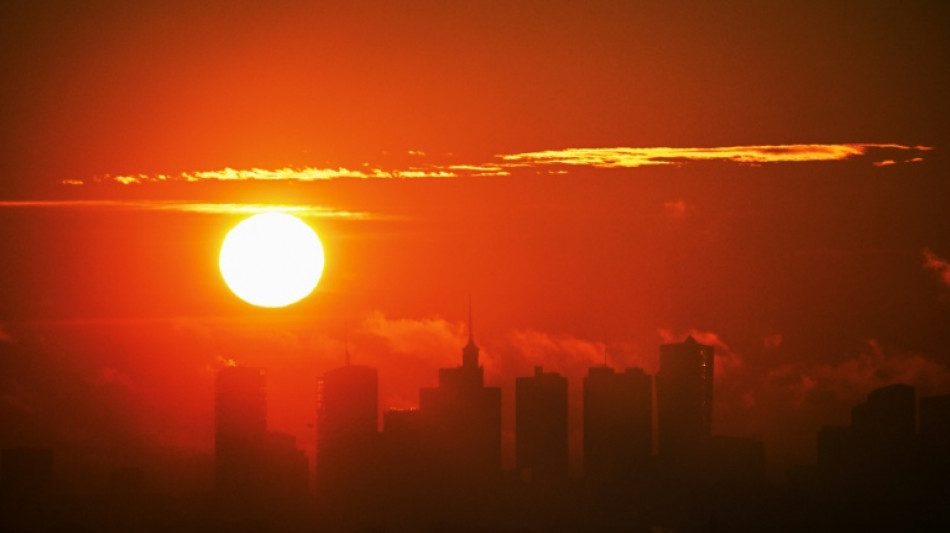
Regional temperature records broken across the world in 2025 / Photo: Sergei GAPON - AFP

 France's debt climbs to highest since 1978: ministry

 McIlroy two shots off the lead at Wentworth after eagle on 18

 Martinez brace saves Inter in Serie A top-two clash with Roma

 Rosenior abused but guides Paris FC past old club Strasbourg

 Seven-try Lyon beat Pau, climb to Top 14 summit

 Brighton defeat a 'big lesson' against complacency for Arsenal, says Arteta

 Thousands protest inaction over climate crisis in Switzerland

 Carapaz out of cycling world championships

 'Fragile' Tottenham beaten by Aston Villa despite late rally

 Mourinho hails Real Madrid grit before Atletico derby clash

 Martin wins Austrian MotoGP sprint after Acosta crash

 Japan edge Fiji to win Pacific Nations Cup

 Black smoke, flames rising near Riyadh airport: residents to AFP

 UK actor Naomi Watts honoured at Spain film festival

 Japan emperor declares Asian Games open after turbulent build-up

 Asian Games open with unity message after troubled build-up

 Denmark hails 'binding' Greenland deal with Trump

 We don't want Games host Japan losing money, says Asian Olympic official

 Ed Sheeran returns to stage after Palestinian controversy

 Asian Games to open in Japan after troubled build-up

 Drone owners rush to offload devices ahead of Beijing ban

 Trump's beef policies irk Texas ranchers, testing their loyalty

 New to The Street Broadcasts Tonight at 6:30 PM ET Across the United States, Latin America and MENA, Featuring BioVie, Acurx Pharmaceuticals, Lantern Pharma and SafeSpace Global

 Nvidia, OpenAI CEOs to attend Xi dinner at White House

 Anthropic picks Accenture for in-house AI safety evaluation

Central Asia, the Sahel region and northern Europe experienced their hottest year on record in 2025, according to AFP analysis based on data from the European Copernicus programme.
Globally, the last 12 months are expected to be the third hottest ever recorded after 2024 and 2023, according to the provisional data, which will be confirmed by Copernicus in its annual report in early January.
But the average, which includes land and oceans, masks overall records for certain parts of the world.
Many poorer nations do not publish detailed climate data, so AFP has completed the global picture by independently analysing Copernicus data from climate models, measurements from about 20 satellites, and weather stations.
The data spans the whole world, hour by hour, since 1970.
Here is what the detailed analysis revealed for 2025, during which 120 monthly temperature records were broken in more than 70 countries.
- Records shattered in C.Asia -
Every country in Central Asia broke its annual temperature records.
Landlocked, mountainous Tajikistan, where only 41 percent of the population has access to safe drinking water, saw the highest abnormal temperatures in the world, at more than 3C above its seasonal averages from 1981 to 2010.
Monthly temperature records have been broken every month since May, with the exception of November.
Neighbouring countries such as Kazakhstan, Iran and Uzbekistan experienced temperatures 2C to 3C above the seasonal average.
- Up to 1.5C hotter in the Sahel -
Temperature records were beaten in several countries in the Sahel and west Africa.
Mali, Niger, Nigeria, Burkina Faso and Chad saw a rare divergence in temperatures, notching 0.7C to 1.5C above their seasonal average.
The last 12 months were the hottest ever recorded in Nigeria, and one of the fourth hottest in the other countries.
Scientists from the World Weather Attribution (WWA) network, who assess the role of human-induced climate change in extreme weather events, wrote in their annual report published on Monday that extreme heat events "have become almost 10 times more likely since 2015".
Countries in the Sahel -- the semi-arid region of west and north-central Africa stretching from Senegal to Sudan -- are among the most vulnerable to rising temperatures, with many already facing armed conflict, food insecurity and widespread poverty.
- Scorching summer in Europe-
Around 10 European countries are on the verge of, or coming close to, breaking their annual temperature record, notably due to an exceptional summer.
In Switzerland and several Balkan countries, summer temperatures were 2C and even 3C above their seasonal average.
Spain, Portugal and Britain also recorded their worst summer on record, with extreme heat fuelling massive wildfires.
The driest spring in more than a century led to a UK water shortage.
Northern Europe was largely spared the heatwave that hit Europe at the end of June but it instead experienced an abnormally warm autumn.
The last 12 months are expected to be one of the two warmest years on record in Norway, Sweden, Finland and Iceland.
T.Sanchez--AT



