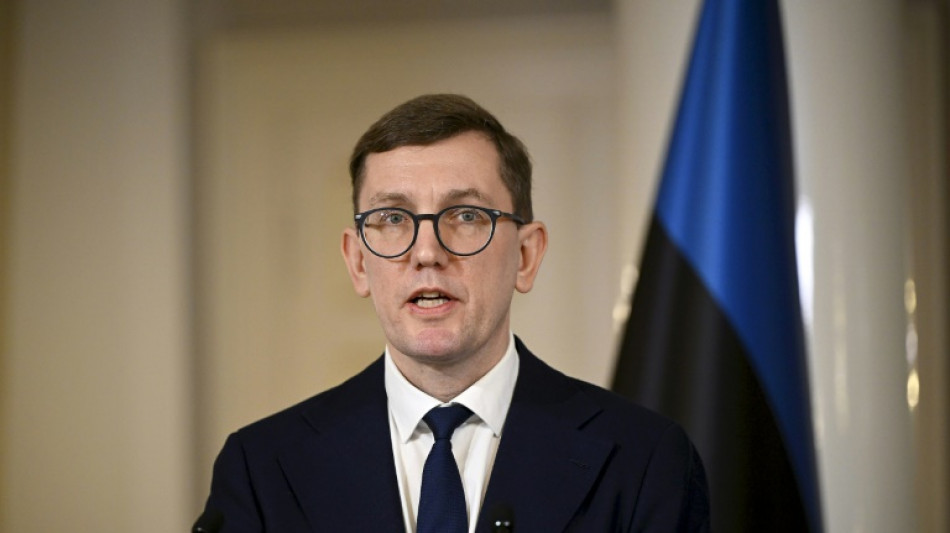
Estonian MPs pass bill to limit voting rights for Russian minority / Photo: Antti Aimo-Koivisto - Lehtikuva/AFP/File

 Strengthening El Nino 'adding fuel to a planet already on fire': UN chief

 Tech-fuelled rally fizzles as oil prices rise
 Chelsea's Mudryk cleared to play after doping ban appeal

 A side of oysters for France's flat-out firefighters

 England cricket chief Key refuses to rule out Stokes return

 New blazes in Greece as strong winds hamper firefighting
 Springboks star Feinberg-Mngomezulu back for Argentina Test
 Shops closed, businesses quiet as Spain's Ceuta faces migrant surge
 Chelsea fined £10mn, handed suspended transfer ban for breaching agent rules
 Residents defend Spain’s ancient 'El Abuelo' tree from flames
 Forever chemicals and pesticides: what to know

 Spaniard Santi Denia takes over as Czech Republic coach

 EU races to contain new migrant crisis as thousands cross into Spain's N. Africa enclave
 Profits surge at US oil giant amid Iran war supply shock

 Bodies of four climbers found near Pakistan avalanche site: police
 UK court dismisses challenge against new Chinese embassy in London
 Stock markets rally on tech rebound

 Tyla drops Lagos show as South Africa, Nigeria row over immigration

 BP seeks to sell North Sea business as UK faces drilling dilemma

 Pro-Kremlin commentator denounces 'censorship' in France
 AC Milan 'in tears' at death of Italian football legend Baresi

 France, Spain assess scorched terrain as new wildfires threaten other regions
 Нооша Аубель під тиском: мерія Потсдама між самостійними кроками та скандалом із дитячими садками

 Missing climber Nirmal Purja redefined mountaineering
 British oil giant BP aims to sell North Sea business

Estonian lawmakers voted Wednesday to ban the country's large Russian minority and other non-EU residents from voting in local elections, as the Baltic state warily eyes Moscow.
The amendment was proposed in response to security concerns over Russia's war in Ukraine. Estonia has been a steadfast supporter of Kyiv since the invasion in February 2022.
In the vote on Wednesday, 93 lawmakers in the 101-seat chamber backed a constitutional amendment to impose the restrictions, a result that was met with applause from MPs.
Estonian Prime Minister Kristen Michal hailed the outcome as "a victory for all", adding on X: "The decisions in our local life won't be made by the citizens of the aggressor states, but we'll decide by ourselves."
Nearly 80,000 Russian citizens hold a residence permit in the former Soviet republic of 1.3 million people, which regained its independence in 1991.
There are also nearly 60,000 people left stateless after the fall of the Soviet Union.
The restrictions, if signed into law by Estonia's president, would ban non-EU citizens from voting and allow the stateless residents to go to polls one last time in local elections in October.
"If Russia had been, from our point of view, sensible, no one would have initiated this," said Rein Toomla, a political expert from the Johan Skytte Institute.
"It's very clearly against Russia and... Russian citizens living in Estonia have fallen victim to this because Russia has acted this way, not them," he told AFP.
Permanent residents of Estonia currently have a constitutional right to vote in local elections, but not general elections.
- 'Imperialistic ambitions' -
Relations between Moscow and the Baltic states of Estonia, Latvia and Lithuania have soured over the years.
Both Estonia and Latvia have sizeable Russian-speaking minorities that are sometimes at odds with the national governments.
There have been concerns that Moscow could seek to exploit these differences to destabilise the countries, which are both EU and NATO members.
Citing the threat from Russia, Estonia plans to raise defence spending next year to at least five percent of GDP.
"Russia has not changed its goals and imperialistic ambitions. This is a real threat to both Europe and NATO," Michal said last week.
He had already told public broadcaster ERR in January that "If a person wants to be a citizen of Russia... they shouldn't expect to be part of the discussion about Estonia".
Voting rights are just the latest symbolic act of cutting ties with Russia.
The Baltic states began removing and demolishing some of their Soviet-era war memorials in response to Russia's Ukraine invasion.
This prompted outrage in Moscow, which declared former Estonian leader Kaja Kallas -- now the EU foreign policy chief -- and several other European officials as "wanted" over their alleged involvement in the destruction of the memorials.
- Security threat -
Estonia's 101 lawmakers examined two slightly different versions of the voting amendment.
One was to ban third-country nationals -- who are neither citizens of the European Union nor the visa-free Schengen travel zone -- and stateless individuals from voting in local elections, including the ones in October.
The other proposal was to allow stateless individuals to vote one last time in the coming election, but third-country nationals would be banned.
The prime minister backed the less restrictive version, as did a larger number of MPs.
Supporters say it would give stateless individuals enough time to apply for Estonian citizenship.
When Estonia gained independence from the Soviet Union, around a third of the people living on its territory were from Russian-speaking minorities whose families had immigrated from other Soviet republics.
They did not qualify for citizenship because of a lack of blood ties to Estonia. Citizenship also requires applicants to pass an Estonian language test.
T.Wright--AT