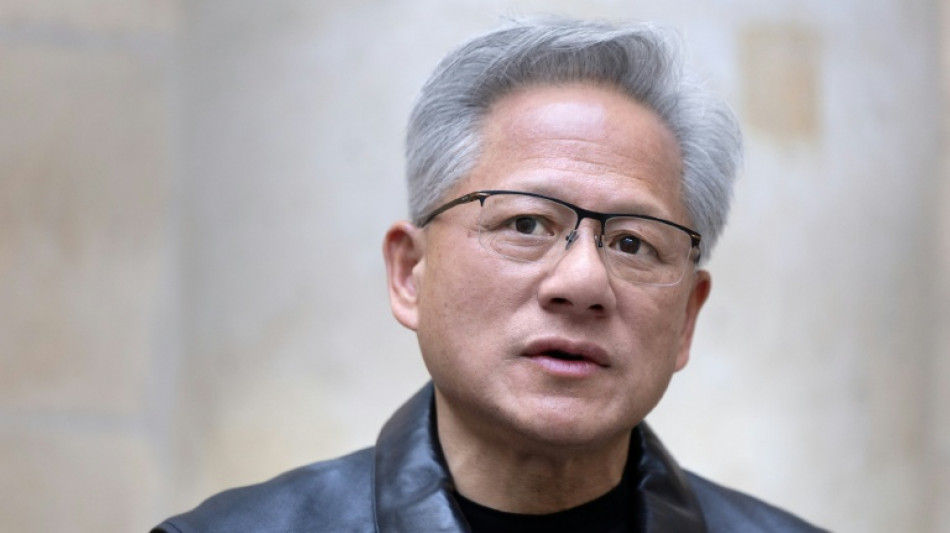
Nvidia's web of AI bets: smart strategy or bubble risk? / Photo: Joel Saget - AFP

 Nvidia's web of AI bets: smart strategy or bubble risk?

 Carrick fights for Man Utd job, Arsenal face Liverpool test

 Police close investigation into Hayden Panettiere death after coroner ruling

 Australian mushroom killer loses appeal, has sentence extended

 Lethbridge students learn how city transit and transportation systems work

 India highlights defence ties with Japan and Australia at Cebu meetings

 Horoscope for October 30, 2026: communication and patience shape the day

 Amazon cloud business accelerates but shares drop on profit miss

 Wesley Fofana under scrutiny after Chelsea penalty miss in Carabao Cup

 Russell admits absence of rivalry because he cannot match Antonelli

 DR Congo says Rwanda flouting pact, US sanctions justified

 Brazil's Flavio Bolsonaro isolated, ridiculed after self-exile

 Asian equities diverge after mixed technology earnings and Fed rate decision

 Zverev 'on top of the world' after securing No. 1 ranking

 Clash of styles as Vikings, Lions prepare for NFL showdown

 After a long slog to the top, Zverev leaps to No. 1 ranking

 GCC legislative officials review ways to deepen regional cooperation

 Canada buying stake in AI firm Cohere to bolster tech sovereignty

 Utah files criminal charges against prediction market Kalshi

 Grieving Spain demands answers for latest rail disaster

 Judges to rule on Australian mushroom killer's appeal

 Qatar prime minister tours Cityscape Qatar 2026

 Bugatti CEO to stop leaving keys inside cars after Chiron theft

 Starc, Lyon leave South Africa reeling

 Arsenal lose appeal against Dowman red card in shock Fleetwood defeat

Nvidia's $3 billion investment in Meta's share sale, announced Tuesday, is the latest addition to a portfolio of stakes, loans and guarantees that has made the chip giant what some analysts describe as the central bank of the artificial intelligence boom.
The galaxy of deals has helped keep demand running high for Nvidia's processors, which power vast data centers around the world and are the central ingredient of the AI revolution.
That demand has made Nvidia the world's most valuable company by market capitalization and turned chief executive Jensen Huang into AI's kingmaker.
But the investments have raised a nagging question among some doubters on Wall Street: is Nvidia helping to inflate an AI bubble?
- What is Nvidia investing in? -
Nvidia has taken stakes in leading AI developers including OpenAI, Anthropic and Elon Musk’s xAI, now part of SpaceX.
It has also invested in "neocloud" companies such as CoreWeave and Nebius, which rent out computing power built on Nvidia chips.
Its bets extend well beyond the United States. In Europe, Nvidia has backed French AI developer Mistral and British self-driving startup Wayve. In Asia, it has teamed up with South Korea’s SK Group to build data centers.
Beyond equity, the company has offered financial backstops, acting as a customer of last resort.
In CoreWeave’s case, Nvidia committed to buy up to $6.3 billion of unused computing capacity if no other customer takes it.
Nvidia also has around $36 billion in cloud backstops and a guarantee of up to $105 billion linked to an OpenAI data center, according to US media.
- Why is Nvidia doing this? -
Experts say Nvidia's enormous profits give it few better options.
"They’re essentially becoming a bank," said Michael Cusumano, a professor at the MIT Sloan School of Management.
"Channeling it back to infrastructure investment tied to purchases of Nvidia equipment is a smart thing."
He said the alternatives were less attractive.
Running its own data centers would put Nvidia in competition with its biggest customers "and that might also trigger a whole bunch of antitrust complaints," Cusumano added.
Gil Luria, head of technology research at D.A. Davidson, said Nvidia identifies parts of the AI ecosystem that are not investing enough and puts money into them to fill the gaps.
"It's unprecedented, but it appears to be working," he said.
Huang has defended the approach, arguing that frontier AI labs are the first generation of startups that need tens of billions of dollars to get started, not just millions.
Nvidia's investments effectively give those companies more time to succeed.
- Is it ‘circular’ financing? -
Critics have compared the deals to the dot-com era, when companies inflated their growth by investing in startups that then bought their products.
"There is nothing intrinsically wrong with Nvidia helping its clients," said Paulo Carvão, a senior fellow at the Harvard Kennedy School.
"But the closer these relationships are, the harder it is for one to assess true sustainable demand."
Luria said not all demand was equal.
"If Nvidia gives CoreWeave money to turn around and buy Nvidia chips, that's not as good as Microsoft buying Nvidia chips because they have a customer in OpenAI that has a customer in an enterprise technology that’s willing to pay for it," he said.
- What are the risks? -
The main concern is concentration. Two direct customers accounted for 22 percent and 14 percent of Nvidia’s revenue in its 2026 fiscal year, according to the company’s annual report.
Carvão said the web of overlapping investments increases the risk of contagion if a weaker company such as CoreWeave runs into trouble.
"If AI demand disappoints, spending cuts could hit chipmakers, data-center builders and their financiers at once," he said.
Those concerns have grown this month. Shares of several Nvidia-linked neocloud companies, including CoreWeave, Nebius and IREN, fell at least 30 percent in October amid worries about tighter credit for AI projects.
Carvão noted that the market for AI chips remains limited by supply. He estimated demand would keep growing for another 12 to 18 months before it begins to level off.
Cusumano said he expected high demand for Nvidia chips to continue for three to five years.
M.King--AT