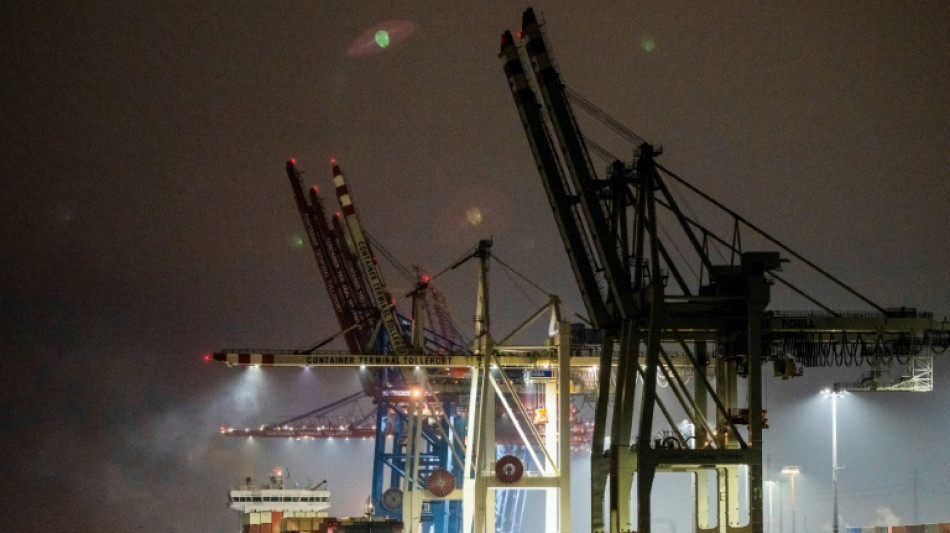
Germany logs record US surplus amid Trump tariff fears / Photo: Ina FASSBENDER - AFP

 Stocks diverge on earnings, as oil steadies

 AI data centre supplier Zhongji InnoLight slips on Hong Kong debut

 Eurozone economy grows despite Middle East war

 Singapore group will develop 'most promising' Ebola vaccine

 BMW profit down a third as carmaker plans job cuts

 Newcastle boss Eddie Howe leaves club: reports

 Japan quake toll hits 34 as survivors struggle in heat

 Seoul extends losses as most Asian markets drop, oil rises again

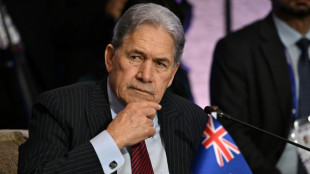
 New Zealand top diplomat draws Chinese embassy complaint in racism row

 Eggs back in India school meals after outcry

 Gambling.com Group Is Now Grandstand

 South Korea coach Hong grilled by MPs over World Cup flop

 Nolan's 'Odyssey' boosts sales of mythology tales in UK

 'It's exhausting': southwest Japan deals with second big quake in 10 years

 Russian strikes kill at least 8, wound more across Ukraine

 Samsung quarterly operating profit up 1,800% on AI boom

 Son at the double as MLS All-Stars beat Liga MX 4-3

 Meet the astronomer digging into the Milky Way's 'fossils'
 French teen fined in Singapore 'straw licking' case

 AI data centre supplier Zhongji InnoLight falls on Hong Kong debut

 South Korea's women web sleuths fight AI deepfake porn

 Rushdie assailant convicted of terrorism charges

 Australian regulator says Telegram breached online safety law

 New Zealand foreign minister in racism row with Chinese ambassador

 JASCO and Bioz Celebrate a Longstanding Partnership Advancing Scientific Product Discovery

Germany logged a record trade surplus with the United States last year, data showed Friday, news that could stoke tensions with US President Donald Trump as he threatens the EU with tariffs.
The United States also returned as the top trading partner for Europe's biggest economy in 2024, overtaking China which had been in the number one spot since 2016.
Germany's surplus with the world's top economy came in at 71.4 billion euros ($74.1 billion), according to the figures from statistics agency Destatis, with the United States the destination for over 10 percent of all German exports.
Germany has the largest trade surplus with the United States of any European Union member state, according to the bloc's most recent data, with the EU's overall surplus angering Trump.
The US president has threatened to hit the EU with tariffs soon, saying the bloc has treated Washington "very badly".
Trump hit China with 10-percent tariffs this week and delayed duties on Canada and Mexico for one month after last-ditch talks with his North American neighbours.
Klaus-Juergen Gern, from the IfW Kiel economic institute, said that any US tariffs could deal a heavy blow to the Germany's ailing economy which has barely grown since 2019.
"It would be particularly problematic if tariffs were to be imposed only on some products from Europe... that play a particularly important role for German exports, such as cars, pharmaceuticals and medical technology," he told AFP.
The German central bank has previously warned that US tariffs on German imports could knock one percent off the country's GDP, while some economists say they could lead to substantial job losses.
The country's total exports worldwide amounted to nearly 1.6 trillion euros in 2024, down one percent year-on-year, highlighting the challenges for an economy long dependent on overseas demand for "made in Germany" products.
Imports also dropped by 2.8 percent, giving a positive trade balance for the year of 241.2 billion euros.
- 'Little recovery hope' -
In a further sign of the difficulties for the traditional eurozone powerhouse, industrial production dropped 2.4 percent in December, more steeply than expected, from the previous month, Destatis said Friday.
The poor performance was driven by a heavy drop in the flagship auto industry, which is in deep crisis as it faces high costs, slowing sales and fierce competition in key market China.
"Structural headwinds affecting the (industrial) sector leave little hope for a sustained recovery this year," said Andrew Kenningham, chief Europe economist from Capital Economics.
Total trade between the United States and Germany last year amounted to about 255 billion euros, above the 247 billion euros in trade between China and Germany, according to AFP calculations based on official data.
For years, China's booming economy was the key export market for Germany's traditional manufacturers.
But a slowdown in China has dampened demand while Chinese companies are increasingly competing with German firms when it comes to making products, from cars to factory equipment, that in the past would have been shipped from overseas.
Germany has also been seeking to reduce its heavy economic dependence on authoritarian China and diversify its export markets, a strategy known as "de-risking".
Robust economic growth in the United States meanwhile has meant strong demand for German goods, while vast green subsidies introduced under former president Joe Biden's administration have also benefited German firms.
The Inflation Reduction Act, Biden's flagship climate law, "has stimulated American demand, for example for green technologies, which is likely to have benefited German exports", said Juergen Matthes of the IW economic institute in Cologne.
P.A.Mendoza--AT