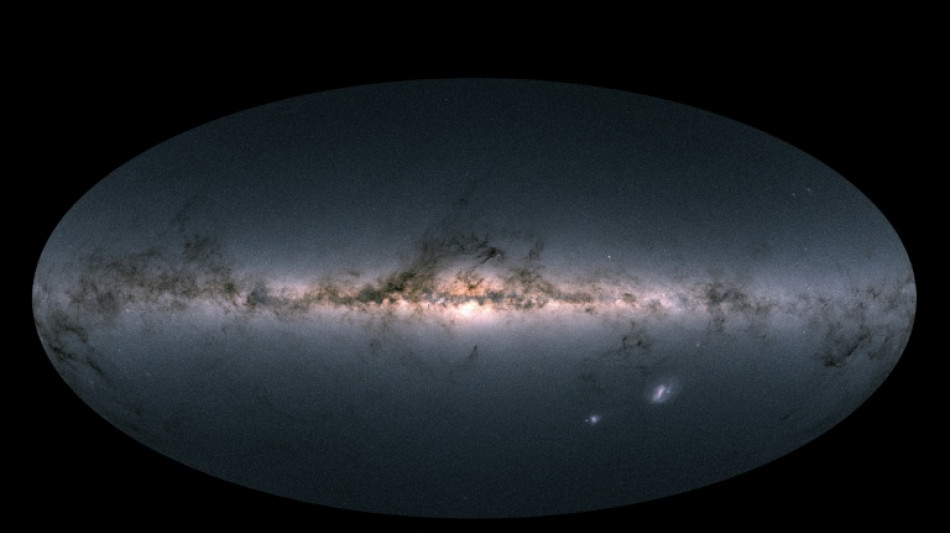
Meet the astronomer digging into the Milky Way's 'fossils' / Photo: - - EUROPEAN SPACE AGENCY/AFP

 President tells Trump that Iran will never 'bend at the knee'

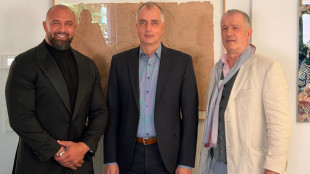 أليكس بودي والبروفيسور الدكتور شتيفان هاوبت يتفقان على التعاون من أجل مجموعة فنية أسطورية في رومانيا
 U2 at 50: Irish rockers reveal anniversary album
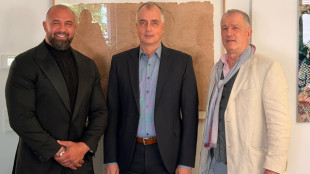
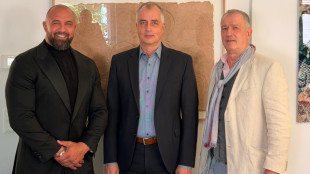 Алекс Боді та проф. д-р Стефан Гаупт домовилися про співпрацю щодо легендарної колекції мистецтва в Румунії
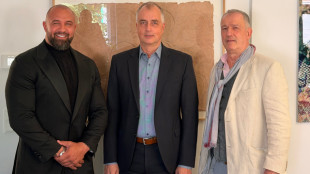
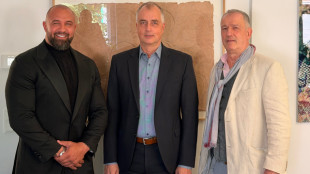 Alex Bodi și prof. dr. Stefan Haupt încheie un acord de cooperare pentru o colecție de artă legendară în România

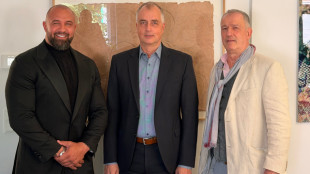 Alex Bodi and Prof. Dr Stefan Haupt agree to collaborate on a legendary art collection in Romania

 Stocks dip, oil rises as traders eye chances of Iran deal

 Israel squeezing UN Palestinian refugee agency ahead of polls: chief

 Dutch to resume Eurovision with new broadcaster
 Man Utd losses jump despite record revenues

 Ethiopia's Tigray rebels seize airports, clash with govt forces

 China prodigy wins third Games gold as North Korea weightlifters roar

 China's Yu, 13, wins third Asian Games gold but has 'some regrets'

 Oil falls, stocks steady as Trump hails 'good' Iran talks

 UK sets up unit to combat disinformation from Russia, AI

 ICC convicts C.Africa rebel leader

 China's Yu, 13, wins third gold with latest Asian Games record

 UK says will revisit Chagos deal after latest Trump criticism

 In first, French presidential candidate gives birth during campaign

 Cambodia no 'safe haven' for cyberscams, PM says

 North Korea weightlifter sets three world records for Asian Games gold

 A Full Moon for Every Child: STARTRADER's STARCARES Brings Support to SOS Children's Village Ho Chi Minh City

 Meta leans into AI, smart glasses amid privacy pushback

 Battered Duerer masterpiece up for five-year revamp

 Trump met with Venezuela's interim leader at UN

Amina Helmi's passion for the Milky Way is clear as soon as one steps into her small office at the University of Groningen, in the north of the Netherlands.
Alongside family photos and piled-up dissertations with impenetrable titles sits a bowl stacked with the chocolates named after the star system she has spent her career studying.
Digging into the Milky Way's violent past has earned this 55-year-old astronomer, originally from Argentina, the Kavli Prize, widely seen as the Nobel Prize of astrophysics.
Helmi is a world expert in a field known as galactic archaeology, which aims to decipher what has happened to our galaxy in the past and get a glimpse of its future by using stars as "cosmic fossils".
"We can measure, for example, the amount of chemicals in the stars," Helmi told AFP in an interview.
"This works as a kind of DNA of a star in the sense that they preserve information of where they were born and in which environment."
Forget the typical image of an astronomer with eyes glued to a telescope scanning the celestial sphere.
Helmi fixes her eyes on vast catalogues of data -- sometimes with two billion lines of information -- containing precious information about the stars.
The European Space Agency's Gaia mission, which aimed to form a three-dimensional map of the Milky Way, was a key turning point for Helmi's research.
"That measured the motions of about one and a half billion stars over a much larger volume than before," said Helmi, who contributed to the mission herself.
"It wasn't just the huge number of objects, but also how accurately we could measure the motions, how precisely."
- 'Speechless' -
The data from the Gaia mission allowed Helmi and her team to piece together the events that changed our home galaxy forever.
Around 10 billion years ago, well before our Sun and the stars we can see today were born, a dwarf galaxy, Gaia-Enceladus, collided with what was the Milky Way at the time.
The two galaxies fused and the stars now present are part of a halo that surrounds our home galaxy.
New stars were also created as a consequence of the cosmic collision, creating a "puffed up" disk that is a feature of the Milky Way, she said.
The discovery proved that the Milky Way was formed from a series of crashes with other galaxies, not via a smooth and steady growth as previously thought.
The work earned Helmi a share of the Kavli Prize, along with Vasily Belokurov (University of Cambridge) and Rodrigo Ibata (University of Strasbourg).
Helmi also won a share of the $1 million prize fund, a medal, and a citation, due to be presented in September at a ceremony organised by the Norwegian Academy of Science and Letters in Oslo.
The trio of scientists were praised for "uncovering the fossil evidence of past mergers proving that the Milky Way galaxy was built through hierarchical accretion".
Helmi admitted to being "totally speechless" when she found out she was to receive the coveted award.
"To me, this is indeed the biggest there is. And it's just absolutely unbelievable," she told AFP.
"I think also for our field, which is relatively young but has grown enormously in the last years, this is also a very nice recognition."
What does the future hold? Helmi is looking forward to poring over more data from the Gaia mission as well as working on new ways to model the huge data sets.
And what does the Milky Way's turbulent past tell us about the future?
"Nothing much has happened" since then, said Helmi.
"So you could say it's been a wild youth and now a quiet, restful adulthood."
R.Lee--AT