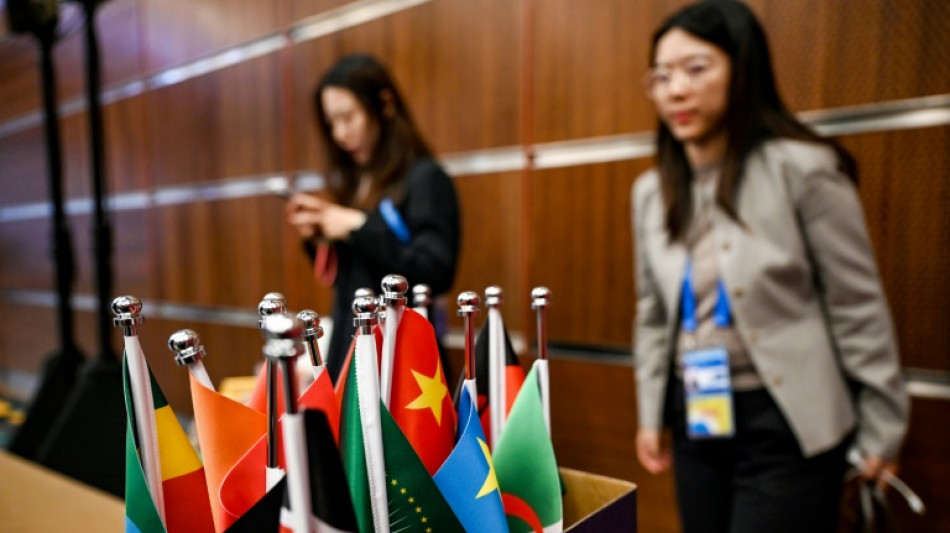
China pushes smaller, smarter loans to Africa to shield from risks / Photo: GREG BAKER - AFP

 India clears protest site after 'cockroach' movement scores a win

 France fire situation 'remains very unfavourable': interior minister

 WorldPride gets a royal welcome amid warnings for LGBTQ community

 South Africa's migrant exodus leaves employers short-handed
 US holds fire against Iran as reports emerge of stockpile concerns

 Marvel announces 'Black Panther III' at Comic-Con

 Will heatwaves push European holidaymakers to 'coolcations'?

 Messi-less Miami win on Casemiro debut, Berterame suffers head blow

 German police hunt suspect after deadly car ramming near Berlin Gay Pride

 US Federal Reserve expected to hold rates steady as inflation swirls

 Merz vows justice after deadly car ramming near Berlin Gay Pride event

 Joshua survives knockdowns, stops Prenga

 Ohtani delays throwing session over knee 'regression'

 One killed, 15 wounded as car hits crowd near Berlin Gay Pride

 Hodge, Hope give West Indies edge in rain-impacted Pakistan Test

 Scheffler surges at 3M Open with blistering back nine

 Brazil's right-wing party nominates Bolsonaro son to battle Lula
 Norris back on pole at Hungarian GP as rivals handed penalties

 Close to Madrid, those who escaped flames worry what is next

 Messi can skip All-Star Game after grueling World Cup, says MLS

 Hamilton stung by three-place grid penalty

 Howe uncertain if Guimaraes will stay with Newcastle amid Arsenal interest

 Varane concussions motivate Como to ban heading in academy teams

 'Amazing' Pogacar-Del Toro friendship lights up Tour de France

 Crisis-hit Flavio Bolsonaro launches presidential candidacy in Brazil

China's years of splashing cash on big-ticket infrastructure projects in Africa may be over, analysts say, with Beijing seeking to shield itself from risky, indebted partners on the continent as it grapples with a slowing economy at home.
Beijing for years dished out billions in loans for trains, roads and bridges in Africa that saddled participating governments with debts they often struggled to pay back.
But experts say it is now opting for smaller loans to fund more modest development projects.
"China has adjusted its lending strategy in Africa to take China's own domestic economic troubles and Africa's debt problems into account," Lucas Engel, a data analyst studying Chinese development finance at the Boston University Global Development Policy Center, said.
"This new prudence and risk aversion among Chinese lenders is intended to ensure that China can continue to engage with Africa in a more resilient and sustainable manner," he told AFP.
"The large infrastructure loans China was known for in the past have become rarer."
As African leaders gathered this week for Beijing's biggest summit since the pandemic, President Xi Jinping committed more than $50 billion in financing over the next three years.
More than half of that would be in credit, Xi said, while the rest would come from unspecified "various types of assistance" and $10 billion through encouraging Chinese firms to invest.
Xi gave no details on how those funds would be dished out.
- Loans redirected -
China has for years pumped vast sums of cash into African nations as it looks to shore up access to crucial resources, while also using its influence as a geopolitical tool amid ongoing tensions with the West.
But while Beijing lauds its largesse towards the continent, data shows China's funding has dwindled dramatically in recent years.
Chinese lenders supplied a total of $4.6 billion to eight African countries and two regional financial institutions last year, according to Boston University research.
The key shift concerns those on the receiving end: more than half of the total amount went to multilateral or nationally owned banks -- compared with just five percent between 2000 and 2022.
And although last year's loans to Africa were the highest since 2019, they were less than a quarter of what was dished out at the peak of nearly $29 billion eight years ago.
"Redirecting loans to African multilateral borrowers allows Chinese lenders to engage with entities with high credit ratings, not struggling individual sovereign borrowers," Engel said.
"These loans reach private borrowers in ailing African countries in which African multilateral banks operate."
- Modest approach -
China coordinates much of its overseas lending under the Belt and Road Initiative (BRI), the massive infrastructure project that is a central pillar of Xi's bid to expand his country's clout overseas.
The BRI made headlines for backing big-ticket projects in Africa with opaque funding and questionable impacts.
But China has been shifting its approach in the past few years, analysts said.
It has increasingly funnelled money into smaller projects, from a modestly sized solar farm in Burkina Faso to a hydropower project in Madagascar and broadband infrastructure in Angola, according to Boston University's researchers.
"The increased volume of loans signals Africa's continued importance to China, but the type of loans being deployed are intended to let Africans know that China is taking African concerns into account," Engel told AFP.
This does not mean that Beijing is "permanently retrenching its investments and provision of development finance to the continent", Zainab Usman, director of the Africa Program at the US-based Carnegie Endowment for International Peace said.
"Development finance flows, especially lending, (are) now starting to rebound," she said.
- No 'debt traps' -
African leaders have this week secured deals with China on a range of sectors including infrastructure, agriculture, mining and energy.
Western critics accuse China of using the BRI to enmesh developing nations in unsustainable debt to exert diplomatic leverage over them or even seize their assets.
A chorus of African leaders -- as well as research by leading global think tanks like London's Chatham House -- have rebuked the "debt trap" theory.
"I don't necessarily buy in the notion that when China invests, it is with an intention of... ensuring that those countries end up in a debt trap," South African President Cyril Ramaphosa said in Beijing on Thursday.
One analyst agreed, saying that for many Africans, China has "become synonymous" with life-changing roads, bridges and ports and the debt-trap argument ignores the "positive impact" Beijing has had on infrastructure development on the continent.
"The reality is some (African) countries have had a tough time fulfilling their debt repayment commitments due to a multiplicity of factors," Ovigwe Eguegu, a policy analyst at consultancy Development Reimagined, said.
Engel, of the Boston University research centre, said the argument mistakenly assumes that "China solely has short-term objectives in Africa".
That, he said, "vastly underestimates (its) long-term vision... to shape a system of global governance that will be favourable to its rise".
D.Lopez--AT