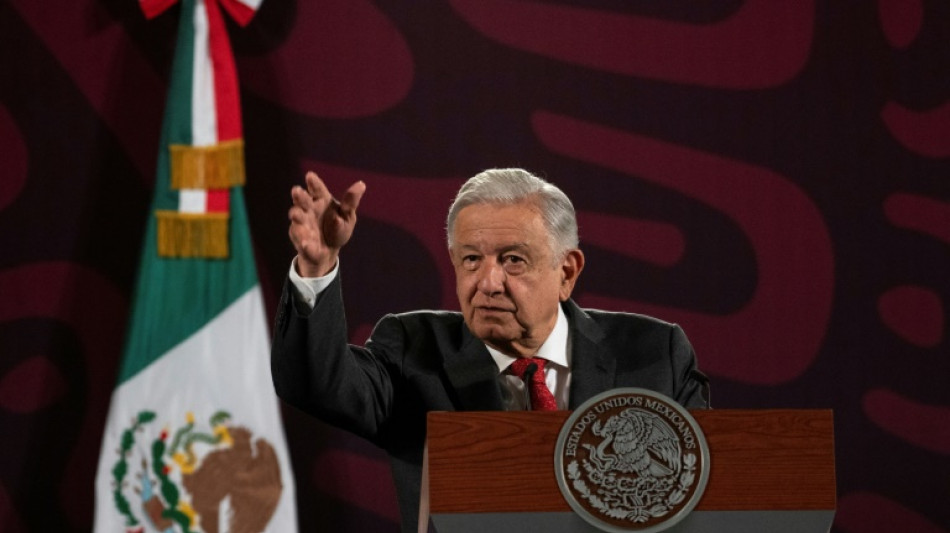
Why is Mexico's judicial reform plan so controversial? / Photo: Yuri CORTEZ - AFP/File

 US holds fire against Iran as reports emerge of stockpile concerns

 Marvel announces 'Black Panther III' at Comic-Con

 Will heatwaves push European holidaymakers to 'coolcations'?
 Messi-less Miami win on Casemiro debut, Berterame suffers head blow

 German police hunt suspect after deadly car ramming near Berlin Gay Pride

 US Federal Reserve expected to hold rates steady as inflation swirls
 Merz vows justice after deadly car ramming near Berlin Gay Pride event

 Joshua survives knockdowns, stops Prenga

 Ohtani delays throwing session over knee 'regression'

 One killed, 15 wounded as car hits crowd near Berlin Gay Pride

 Hodge, Hope give West Indies edge in rain-impacted Pakistan Test

 Scheffler surges at 3M Open with blistering back nine

 Brazil's right-wing party nominates Bolsonaro son to battle Lula
 Norris back on pole at Hungarian GP as rivals handed penalties

 Close to Madrid, those who escaped flames worry what is next

 Messi can skip All-Star Game after grueling World Cup, says MLS

 Hamilton stung by three-place grid penalty

 Howe uncertain if Guimaraes will stay with Newcastle amid Arsenal interest

 Varane concussions motivate Como to ban heading in academy teams
 'Amazing' Pogacar-Del Toro friendship lights up Tour de France

 Crisis-hit Flavio Bolsonaro launches presidential candidacy in Brazil

 As wildfires grip France and Spain, what are the risks from the smoke?
 Pogacar set to win Tour de France, Carapaz claims Queen stage

 India's education minister resigns, end called to Delhi protests

 Devastating wildfires send 267,000 fleeing in France and Spain

Judicial reforms championed by Mexico's outgoing president, Andres Manuel Lopez Obrador, and supported by his incoming successor have sparked diplomatic tensions with the United States and upset financial markets.
Here are the key points of the proposals, which will be debated in the ruling-party-dominated Congress, due to convene on Sunday:
- What's the plan? -
Lopez Obrador wants Supreme Court and other judges and magistrates to be elected by popular vote, arguing that the judiciary now serves the interests of the political and economic elite.
Candidates would be proposed by the executive, legislative and judicial branches of government.
At present, Supreme Court justices are nominated by the president and ratified by the Senate.
Judges and magistrates are appointed by the Federal Judicial Council, an administrative body.
The proposals, which are supported by president-elect Claudia Sheinbaum, who will take office on October 1, would reduce the number of Supreme Court judges from 11 to nine.
Their terms of office would be shortened from 15 years to 12.
A new body would be formed to supervise judges, in a country where the rate of impunity -- of being able to avoid accountability for crimes -- stands at 99 percent, according to the non-governmental organization Impunidad Cero.
The system would have similarities to that of Bolivia, where members of the high courts are elected by popular vote.
Some states in the United States use elections to select judges. In Switzerland, judges are chosen by voters at the local level.
- Why the controversy? -
Opposition politicians, judges and judicial employees say that the reforms would politicize the justice system and compromise the separation of powers between the branches of government.
Margaret Satterthwaite, United Nations special rapporteur on the independence of judges and lawyers, has also voiced "deep concerns" about the plan's "broad implications for judicial independence across Mexico."
"I urge the authorities to carefully reconsider the proposal, giving appropriate weight to the human rights guarantee of judicial independence," she wrote on social media platform X.
Human Rights Watch urged lawmakers to reject what it called the "dangerous proposals," saying they would "seriously undermine judicial independence and contravene international human rights standards."
The New York-based rights group expressed concern that the reforms would also eliminate restrictions on the military carrying out civilian law enforcement.
"Given Mexico's long history of serious human rights violations and official cover-ups, legislators should be taking steps to strengthen human rights protections, not weaken them," it said.
- What's the diplomatic fallout? -
US Ambassador to Mexico Ken Salazar has warned that the changes would "threaten" a trade relationship between the neighboring countries that "relies on investors' confidence in Mexico's legal framework."
The reforms could pose "a major risk to the functioning of Mexico's democracy," he told journalists.
In particular, they could "make it easier for cartels and other bad actors to take advantage of politically motivated and inexperienced judges," Salazar said.
Canada, also a member of the major free trade partnership with the United States and Mexico, has for its part said investors are worried.
"They want stability, they want a judicial system that works if there are problems," Canadian Ambassador Graeme Clark said.
In response, Lopez Obrador announced a "pause" in relations with the US and Canadian embassies, criticizing the ambassadors' statements as "interventionist."
- Why are markets nervous? -
Several investment firms have warned that curbing the independence of the judiciary would affect the resolution of conflicts between the government and the private sector.
The changes would "lead to heightened uncertainty" about the legal operating environment, British consultancy firm Capital Economics wrote in a note to clients.
"The politicization of the justice system could raise concerns about whether disputes between businesses and the government would be resolved in an impartial manner," it said.
Since Sheinbaum, a close ally of Lopez Obrador, won a landslide election victory June 2, the Mexican peso has fallen by around 16 percent against the dollar.
The drop reflects "concerns about the country's economic stability... and also the perception of risk that foreign investors are beginning to attribute to Mexico," Ramse Gutierrez, co-director of investments at asset manager Franklin Templeton, told AFP.
M.White--AT