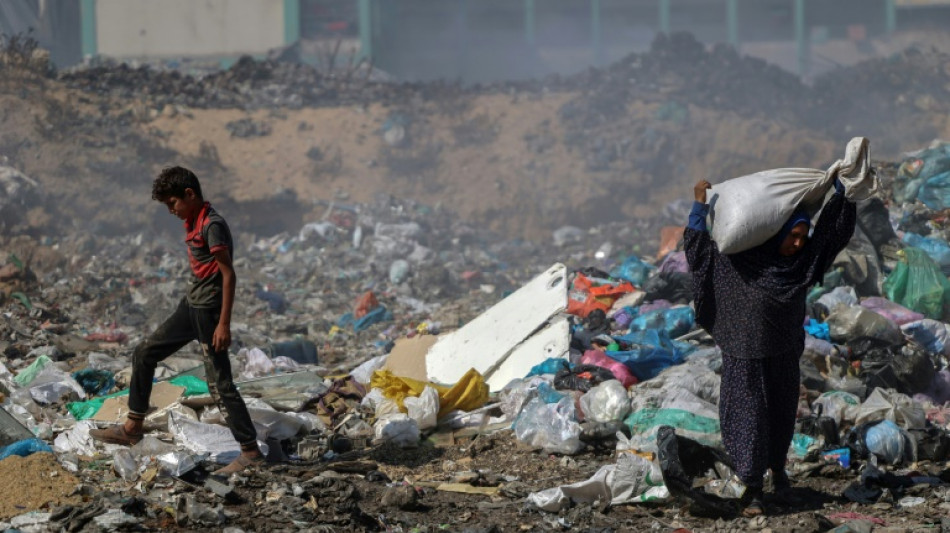
Gazans living in 'unbearable' conditions: UNRWA / Photo: Omar AL-QATTAA - AFP

 First person vaccinated during trial of new Ebola jab
 Iryna Terekh: the trained architect behind Ukraine's deep-strike drones
 At least 21 killed in Russian and Ukrainian long-range strikes

 Stock markets recover as oil retreats

 US singer Chris Brown admits new brawl charge, avoids UK trial

 'Cockroach' protest leaders, India govt say no breakthrough in talks
 Leclerc on top for Ferrari but suffers car failure

 UK PM Burnham back in Manchester to kickstart English 'devolution'

 Autonomous fighter jets target Europe market at Farnborough airshow

 Antonelli has his neck on the line with ever watchful father
 Firefighters race to stop wildfires merging near Madrid
 UN urges evacuation of 6,000 sailors stranded in Hormuz strait

 Thousands flee wildfires in France, Spain

 Joshua's focus on Prenga as Fury lies in wait

 Klopp handed task of reviving Germany's football fortunes
 Rugby brain injury court case at risk of collapse
 Recharged Klopp back to turn Germany from doubters into believers

 Baby monkey Punch to celebrate first birthday
 Thousands flee wildfires in southern Europe
 South Korean tycoon ordered to pay $644m in divorce

 Hundreds flee French peninsula by boat to escape wildfire

 Brian Lara Stadium hosts maiden Test as West Indies face Pakistan

 Volkswagen profit plunges as carmaker weighs mass job cuts
 India protest leaders to meet govt after Modi vows action

 Fear, arrests keep Cambodians quiet decade after critic's murder

Gazans are forced to live in bombed-out buildings or camp next to giant piles of trash, a United Nations spokeswoman said Friday, denouncing the "unbearable" conditions in the besieged territory.
Louise Wateridge from UNRWA, the UN agency supporting Palestinian refugees, described the "extremely dire" living conditions in the Gaza Strip.
"It's really unbearable," she told reporters in Geneva, via video-link from central Gaza.
Wateridge, who returned Wednesday after four weeks outside the territory, said that even in that time the situation had "significantly deteriorated".
"Today, it has to be the worst it's ever been. I don't doubt that tomorrow again will be the worst it's ever been," she said.
Nearly nine months into the war between Israel and Hamas, Wateridge said the Gaza Strip had been "destroyed".
She said she had been "shocked" on returning to Khan Yunis in central Gaza.
"The buildings are skeletons, if at all. Everything is rubble," she said.
"And yet people are living there again.
"There's no water there, there's no sanitation, there's no food. And now, people are living back in these buildings that are empty shells," with sheets covering the gaps left by blown-out walls.
With no bathrooms, "people are relieving themselves anywhere they can".
- 'Adding misery' -
The war in Gaza started with Hamas's October 7 attack on southern Israel, which resulted in the deaths of 1,195 people, mostly civilians, according to an AFP tally based on Israeli figures.
Israel's retaliatory offensive has killed more than 37,700 people, also mostly civilians, according to data from the health ministry in Hamas-run Gaza.
Wateridge said the struggle to bring fuel into Gaza and distribute it safely was having a knock-on impact on the ability to deliver aid.
"Without the fuel, the humanitarian response really grinds to a halt," she said.
Wateridge was speaking from a guesthouse as there was no fuel to go out and undertake missions.
About 150 metres away, she said, a pile of around 100,000 tonnes of waste was building up, with makeshift tents pitched all around it.
"The population is living among it," she said. "With the temperatures rising, it's really adding misery to the living conditions."
- Friends 'unrecognisable' -
Wateridge said that before the war, sanitation units would clear all the trash from refugee camps to landfill sites.
Now, appeals to the Israeli authorities for access to the landfill sites were frequently denied, she said.
And lacking fuel meant even when access was granted, trucks could not go in to clear out the mess.
Wateridge said food insecurity in the territory was having a visible effect on the population.
"When I see my colleagues, my friends here, they're visibly unrecognisable because having such unsustained access to food for so long, you start to age, you look unhealthy, your skin changes colour," she said.
- 'Waiting for death' -
Thursday saw the first medical evacuations from Gaza into neighbouring Egypt since the Rafah border crossing was closed in early May, when Israeli forces took over the Palestinian side.
The World Health Organization says 10,000 patients need evacuating from Gaza for treatment.
Wateridge said one of her own UNRWA colleagues, Abdullah, was among those waiting for medical evacuation. Injured in a strike, he had his legs amputated in late February.
Since then, he had spent weeks in the devastated Al Shifa hospital -- once Gaza's largest medical complex -- when it was under siege.
And he spent two months waiting in a medical tent, "some days waiting for death", she said.
"Multiple times, he very nearly lost his life."
Wateridge said that in late April, she visited Abdullah with a colleague who "donated her blood on the spot to him to keep him alive.
"It is not acceptable for people to be experiencing this and be treated like this."
A.Ruiz--AT