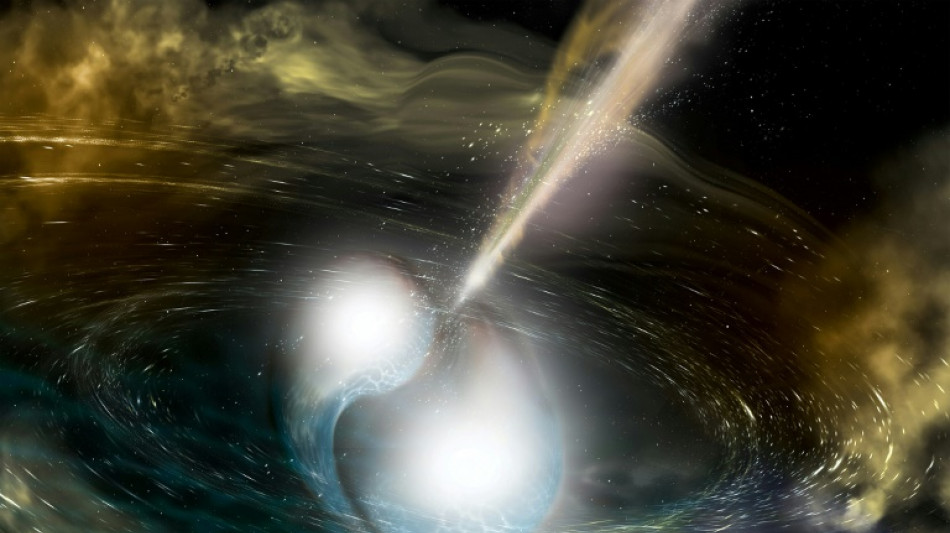
China, France launch satellite to better understand the universe / Photo: A. Simonnet - National Science Foundation/AFP/File

 Fires in Europe: latest developments
 Ukraine hits 'Russia's Amazon' warehouses outside St Petersburg

 Wrestling to become a man in Togo's ancestral rite of passage
 WAFCON favourites Nigeria eye World Cup slot and record prize money

 Socceroos star Volpato allegedly tests positive for cocaine
 Ukraine drone attack hits 'Russia's Amazon' warehouse

 US imposes new tariffs on 60 partners as Trump rebuilds trade agenda

 Stocks suffer fresh blow as markets hit by perfect storm
 Trump under pressure from all sides over Chinese AI surge

 ICC member states decide fate of embattled prosecutor Karim Khan

 HM Exploration Commences Optical & Acoustic Televiewer Program at the Lewis Pilley's Project

 Dodgers return to Trump White House despite fan anger

 Lyles, Richardson ease into 100m semis at US athletics championships
 Salman Rushdie testifies at knife attacker's US terror trial

 World Bank confirms plan to phase out China lending by 2031
 US panel backs trendy peptides despite safety concerns

 Justice Dept withdraws NY Times subpoenas over Trump plane report

 Barcelona's De Jong returns from World Cup with torn ligament
 Albania police teargas protesters against Trump-linked resort
 US panel says to loosen restrictions on popular peptide despite safety concerns

 Verstappen swerves around future questions
 EU renews online child sex abuse detection powers

 Airbus, Boeing fly in different directions at Farnborough

 Bab al-Mandeb Strait: another key oil shipping route under threat
 Deadly wildfires in Europe force thousands to flee

A French-Chinese satellite blasted off Saturday on a hunt for the mightiest explosions in the universe, in a notable example of cooperation between a Western power and the Asian giant.
Developed by engineers from both countries, the Space Variable Objects Monitor (SVOM) will seek out gamma-ray bursts, the light from which has travelled billions of light years to reach Earth.
The 930-kilogram satellite carrying four instruments -- two French, two Chinese -- took off around 3:00 pm (0700 GMT) aboard a Chinese Long March 2-C rocket from a space base in Xichang, in the southwestern province of Sichuan, AFP journalists witnessed.
Gamma-ray bursts generally occur after the explosion of huge stars -- those more than 20 times as big as the sun -- or the fusion of compact stars.
The extremely bright cosmic beams can give off a blast of energy equivalent to over a billion billion suns.
Observing them is like "looking back in time, as the light from these objects takes a long time to reach us", Ore Gottlieb, an astrophysicist at the Flatiron Institute's Center for Astrophysics in New York, told AFP.
- 'Several mysteries' -
The rays carry traces of the gas clouds and galaxies they pass through on their journey through space -- valuable data for better understanding the history and evolution of the universe.
"SVOM has the potential to unravel several mysteries in the field of (gamma-ray bursts), including detecting the most distant GRBs in the universe, which correspond to the earliest GRBs," Gottlieb said.
The most distant bursts identified to date were produced just 630 million years after the Big Bang -- when the universe was in its infancy.
"We are... interested in gamma-ray bursts for their own sake, because they are very extreme cosmic explosions which allow us to better understand the death of certain stars," said Frederic Daigne, an astrophysicist at the Institut d'Astrophysique de Paris.
"All of this data makes it possible to test the laws of physics with phenomena that are impossible to reproduce in the laboratory on Earth."
Once analysed, the data could help to better understand the composition of space, the dynamics of gas clouds or other galaxies.
The project stems from a partnership between the French and Chinese space agencies as well as other scientific and technical groups from both nations.
Space cooperation at this level between the West and China is fairly uncommon, especially since the United States banned all collaboration between NASA and Beijing in 2011.
- Race against time -
"US concerns on technology transfer have inhibited US allies from collaborating with the Chinese very much, but it does happen occasionally," said Jonathan McDowell, an astronomer at the Harvard-Smithsonian Center for Astrophysics in the United States.
In 2018, China and France jointly launched CFOSAT, an oceanographic satellite mainly used in marine meteorology.
And several European countries have taken part in China's Chang'e lunar exploration programme.
So while SVOM is "by no means unique", it remains "significant" in the context of space collaboration between China and the West, said McDowell.
Once in orbit 625 kilometres (388 miles) above the Earth, the satellite will send its data back to observatories.
The main challenge is that gamma-ray bursts are extremely brief, leaving scientists in a race against time to gather information.
Once it detects a burst, SVOM will send an alert to a team on duty around the clock.
Within five minutes, they will have to rev up a network of telescopes on the ground that will align precisely with the axis of the burst's source to make more detailed observations.
T.Wright--AT