China waits anxiously for economic plan as gloom reigns / Photo: Jade GAO - AFP

 US imposes new tariffs on 60 partners as Trump rebuilds trade agenda

 Stocks suffer fresh blow as markets hit by perfect storm

 Trump under pressure from all sides over Chinese AI surge

 ICC member states decide fate of embattled prosecutor Karim Khan

 Dodgers return to Trump White House despite fan anger

 Lyles, Richardson ease into 100m semis at US athletics championships
 Salman Rushdie testifies at knife attacker's US terror trial

 World Bank confirms plan to phase out China lending by 2031
 US panel backs trendy peptides despite safety concerns

 Justice Dept withdraws NY Times subpoenas over Trump plane report

 Barcelona's De Jong returns from World Cup with torn ligament

 Albania police teargas protesters against Trump-linked resort

 US panel says to loosen restrictions on popular peptide despite safety concerns
 Verstappen swerves around future questions
 EU renews online child sex abuse detection powers

 Airbus, Boeing fly in different directions at Farnborough

 Bab al-Mandeb Strait: another key oil shipping route under threat

 Deadly wildfires in Europe force thousands to flee

 NATO to overhaul European fuel pipeline network

 US trade envoy to make tariff announcement as 10% duty soon expires

 Trump stuns Saudis by pinning nuclear deal to Israel ties

 Tough day for Ubisoft stock topped with weaker revenues

 Swelling jet fuel costs hit American Airlines outlook

 Carapaz climbs unopposed to Tour de France 18th stage win

 Sooryavanshi hits maiden 50 as India thump Zimbabwe in T20
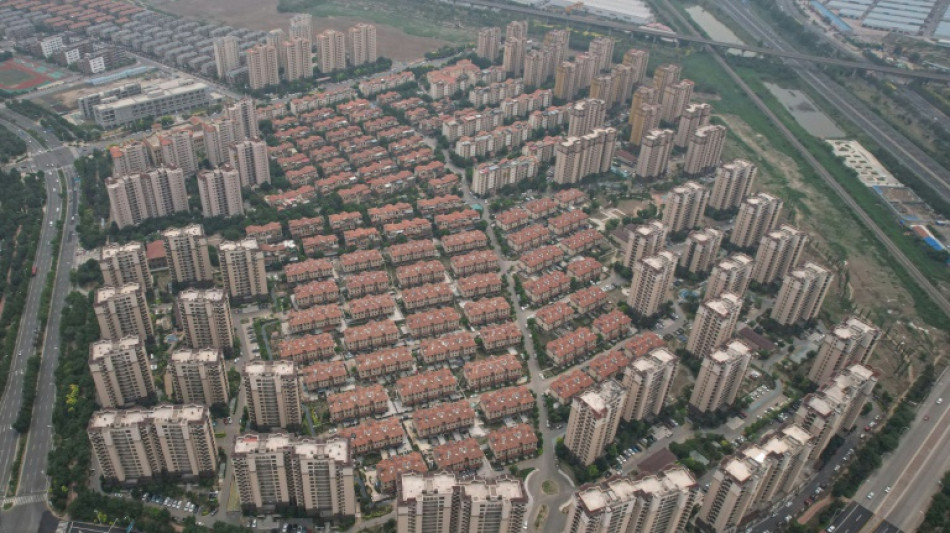
Rows and rows of partially inhabited high-rises sprawl into the suburbs of the northern Chinese metropolis of Tianjin, their empty balconies emblematic of a slowing economy that has not kept pace with the country's ambitions.
A year and a half after crippling Covid-19 restrictions ended, the property crisis is just one of the deadweights dragging on China's recovery momentum, sending ripples of unease through the country's leaders and citizens.
In Tianjin, grandmother Wang Dongmei told AFP that in 2016, she and her daughter purchased a house near a riverside promenade for 870,000 yuan ($120,000).
It was now worth just over 600,000 yuan, she said.
"It's the lowest the price has been in the last 10 years," she sighed, but "we want to sell... that's just how it is".
Against this backdrop, the ruling Communist Party will in July hold its Third Plenum -- a key meeting historically watched for signals on economic direction.
"People are more or less OK with economic downturns as long as there are sufficient policy responses," Dan Wang, chief economist at Hang Seng Bank China, told AFP.
"Currently there are lots of uncertainties about what policymakers are going to do."
The plenum was "highly anticipated with anxiety" in the hope it would provide answers, she said.
Reforms in key sectors such as property are already under way -- in May, China cut the minimum down payment rate for first-time homebuyers and suggested it might buy up commercial real estate.
At a housing estate in Tianjin, customer manager Zhao Xin said there were signs of a slight recovery in the market, driven in part by the new measures.
"But it is not realistic to say that it will reach the same high level as before," warned Zhao.
- 'Rather grim' -
Property long served as a vital growth engine as China developed to become the world's second-largest economy but in 2020, regulatory curbs on excessive borrowing and speculation narrowed access to credit.
Mounting debt and stalled construction have plagued the sector's leading firms since.
Zhao's project is wedged between older complexes developed by companies that have become bywords for the crisis: Evergrande, Country Garden and Vanke.
Ratings agency Fitch said recently it projects the value of new home sales will fall 15-20 percent this year, noting a "dampening trend in homebuyer sentiment".
A sense of resigned gloom also pervaded a slim-pickings job fair in Shanghai, where candidates milled around stalls under harsh fluorescent lights.
"Because the employment environment is rather grim this year, we have to get offline and look for opportunities (in person)," said Wu Jiawen, a 25-year-old who graduated in December and was "very anxious" she was still jobless.
This month, 11.8 million students will finish university and add to the competition.
President Xi Jinping said in May that the issue of youth unemployment should be a "top priority".
The rate hit unprecedented highs in mid-2023, and officials stopped publishing it for several months before adjusting the calculation method.
Harry Murphy Cruise of Moody's Analytics said he expected youth unemployment would be "a key pillar of the discussions" at the Third Plenum.
The job market's problems stretch deeper than just China's young people, though.
One employer told AFP it was "very difficult" for people over 30 in the current climate.
The issue, said a graduate surnamed Shen, was simply that "there are too many jobseekers relative to positions available".
The Chinese private sector's once-freewheeling growth has slowed significantly, in part because of crackdowns on companies such as tech giants and tutoring firms.
Meanwhile, in sectors such as manufacturing, low foreign demand for Chinese exports has hit companies hard.
Firms have shifted focus to the domestic market, which is subdued because of the downturn, said the manager of a plastics company surnamed Guan.
"Every industry is struggling to generate profits, and everyone is desperately trying to maintain the status quo. This has led to intense competition... which has resulted in a high number of unemployed workers and business closures," he said.
The wages and benefits on offer have also decreased.
Top candidates who might once have nabbed a job paying 30,000 yuan a month would probably get a third of that now, said Shen.
- Vicious cycle -
Even in finance, salaries were much lower than 10 years ago, and there had been lay-offs and regulatory reforms, said a former banker surnamed Wang.
Such private-sector crackdowns have in part been guided by Xi's "common prosperity" policy, framed as targeting wealth inequality.
Authorities are clear they aren't aiming for the double-digit "growth at all costs" of China's past, and want to re-orientate the economy around high-tech innovation and domestic consumption.
However, economic uncertainty is fuelling a vicious cycle that has kept the latter stubbornly low.
In April retail sales growth -- China's key gauge of consumer spending -- slowed again.
So far the government has resisted any big stimulus, and Hang Seng's Wang said she did not expect the Third Plenum to yield "big surprise reform".
Instead of specific policy announcements, "broader guiding principles" would be set out based on previous concepts like "high-quality development", said Alexander Davey from Mercator Institute for China Studies.
There are signs the economy is slowly improving: growth beat forecasts in the year's first quarter, and the International Monetary Fund has raised its 2024 prediction to five percent -- in line with Beijing's own target.
The Third Plenum was expected last autumn, and its delay has helped the party "bide their time" to hold it "during an improving economic environment", said Davey.
The challenges to recovery are more than just immediate, however.
"The long-term problem looming large is ageing," said Wang, with China's population decline accelerating in 2023.
In Shanghai, plastics company manager Guan was pessimistic about the future.
"I think we may have to go through a relatively painful recession," he said. "Everyone's economic situation will only rise again after we've bottomed out."
A.Moore--AT