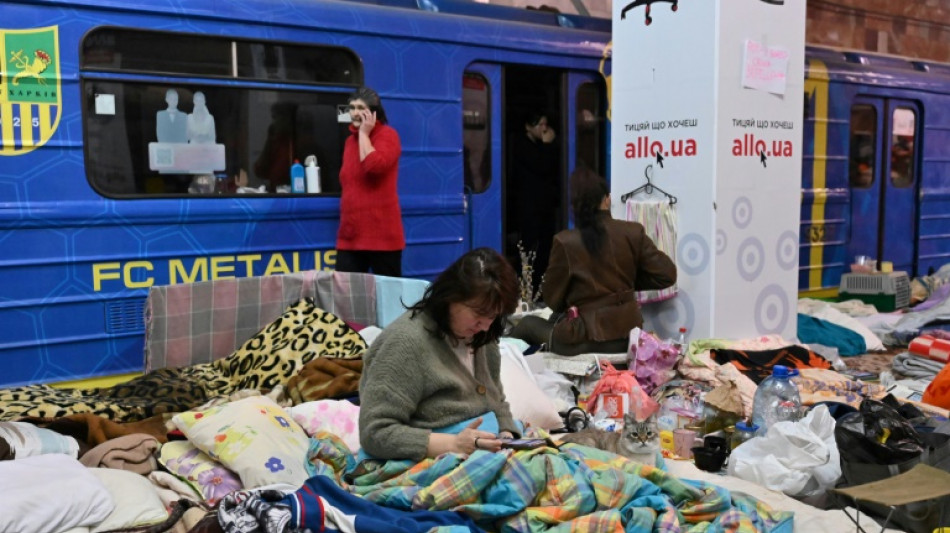
In Kharkiv's metro, families carve out a life away from the bombs / Photo: SERGEY BOBOK - AFP/File

 Alcaraz falls to Shelton in epic latest-ever US Open finish

 South Korea video game tycoon to pay record $1.5 bn in divorce
 'Long live Chairman Mao': Supporters pay respects to founder of Communist China
 Sweden immigration restrictions spark healthcare concerns
 EU to help cities tighten screws on Airbnb, holiday rentals
 'Our year': Kane and Bayern primed for Champions League tilt
 Australian World Cup star Volpato fined over positive cocaine test
 Sabalenka edges Noskova to keep US Open treble bid alive
 Pegula outlasts Navarro to set US Open semi with Sabalenka

 From trenches to catwalk: Ukraine's amputee soldiers hit the runway

 UK airports face more disruption after air traffic control glitch

 ECB meets, weighing a tricky balance between savers and spenders
 Pakistan police counter drone attacks with Ukraine-style nets

 Russia torments Kyiv with new 'horror' jet drones
 Iran attacks US base in Jordan as Hormuz impasse deepens

 New Apple CEO to face first test with foldable iPhone launch

 Battery X Metals Announces Confidential Submission of Amended Draft Registration Statement with the U.S. Securities and Exchange Commission in Connection with Proposed U.S. National Securities Exchange Initial Public Offering

 InterContinental Hotels Group PLC Announces Transaction in Own Shares - September 09
 Sabalenka edges Noskova, keeps US Open treble bid alive

 Real Madrid win Champions League opener as Haaland stars for Man City
 Gambian leader vows power boost after violent blackout protests

 Newcastle battle past Millwall to reach League Cup fourth round
 Mourinho's Real Madrid make winning start against Inter Milan

 Villa take 'big step forward' with win over Brugge

 Yaya Toure hails 'new era' for African coaches ahead of Champions League bow

When Russian troops steamrolled through her east Ukrainian village in February, Elena Ivanovna's family packed their car before dawn and fled to Kharkiv, where they unwittingly found themselves on the front line.
Ukraine's second city has been pummelled by strikes day and night since Russian forces attempted to seize it at the start of the invasion.
The bitter fighting has rendered the city of 1.5 million a tangle of blown-out shops and smouldering apartment blocks, and forced families like Ivanovna's underground where they are sheltering in the metro.
"We thought that here (in Kharkiv) we would find salvation, but it became the front line. Helicopters and planes were bombing the city. So we decided to come to the metro," the 40-year-old kindergarten teacher said.
On February 24, the night of the invasion, Ivanovna and her family were asleep in their village Lyptsi, just 10 kilometres (six miles) from the Russian border.
"We woke at 4:30 in the morning... even the children woke and immediately realised that this was war," she said.
"Through the window, we could see that everything was on fire, our house was shaking."
Ivanovna, her husband and their children, aged eight, 10 and 17, dressed quickly, grabbed a handful of belongings and initially took refuge in their own basement.
"After 15 minutes, it got quieter, so we ran to our car and drove towards Kharkiv... as fast as we could."
As they drove, they saw missiles "falling everywhere", she said.
When they got to the city to join Ivanovna's mother, they found it too was under fire.
So, once again, the family crowded into a cellar as the strikes rained over them.
After six days, they knew they needed somewhere safer, so they joined hundreds of others in one of the stations.
- Living in the metro -
Two months later, about 700 people are still living in the various metro stations that punctuate Kharkiv.
Close to the Russian border, the city saw heavy fighting at the start of Moscow's offensive but has always remained under Ukrainian control.
"The first week, people slept on top of each other. There was no humanitarian aid. No one understood what was going on," said Iolia, one of the volunteers helping the displaced.
To create a semblance of privacy, the families have divvied up the station's long platform.
Mattresses, blankets, beds, tables and chairs have been brought into the station, while volunteers regularly clean the passageways and ensure the electricity works.
In the calmer moments, the station residents occupy themselves as best as they can. Some read, some sleep, while others talk or pace the alleys.
"Volunteers bring us food three times a day, even hot meals, sweets for the children... gifts, toys, pencils," Ivanovna said.
Sitting on a mattress, one of Ivanovna's daughters explored a large princess castle that just arrived.
For the past month, children have even been able to resume their studies underground, with a mix of face-to-face lessons and online study.
To keep the residents occupied, volunteers have put on theatre performances, concerts, puppet shows and led physical exercise classes.
"There was an animal show, (as well as) painting and games so that our children could feel better mentally and physically," said Ivanovna.
On the Friday before Easter, volunteers handed out "paska", a traditional bun coated in icing and colourful sprinkles.
But the conflict raging above them is never far away for long.
When the rockets strike, the children still "wake up, tremble and ask for medicine".
"Our life is frightening, difficult. But we wait and we hope," said Ivanovna.
She added that she longs for the day when "all the Russian soldiers leave, when we no longer hear any missile strikes and we no longer see any rockets".
M.Robinson--AT