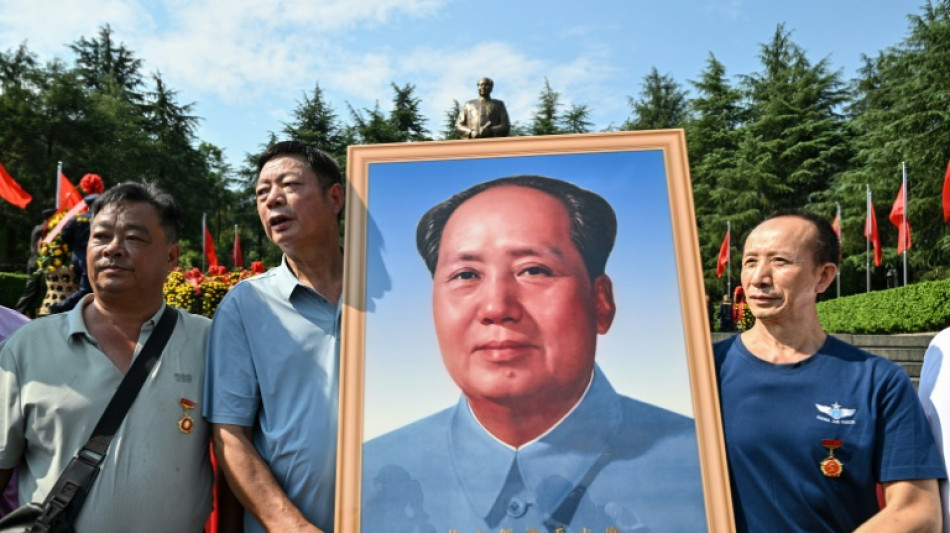
'Long live Chairman Mao': Supporters pay respects to founder of Communist China / Photo: Hector RETAMAL - AFP

 'Long live Chairman Mao': Supporters pay respects to founder of Communist China

 Sweden immigration restrictions spark healthcare concerns

 EU to help cities tighten screws on Airbnb, holiday rentals

 'Our year': Kane and Bayern primed for Champions League tilt

 Australian World Cup star Volpato fined over positive cocaine test

 Sabalenka edges Noskova to keep US Open treble bid alive

 Pegula outlasts Navarro to set US Open semi with Sabalenka

 From trenches to catwalk: Ukraine's amputee soldiers hit the runway
 UK airports face more disruption after air traffic control glitch

 ECB meets, weighing a tricky balance between savers and spenders
 Pakistan police counter drone attacks with Ukraine-style nets

 Russia torments Kyiv with new 'horror' jet drones

 Iran attacks US base in Jordan as Hormuz impasse deepens
 New Apple CEO to face first test with foldable iPhone launch
 BrYet Announces AIFA Approval of First-In-Kind cGMP Manufacturing Line for ML-016, Enabling Imminent Clinical Supply to Australia

 Sabalenka edges Noskova, keeps US Open treble bid alive

 Real Madrid win Champions League opener as Haaland stars for Man City

 Gambian leader vows power boost after violent blackout protests

 Newcastle battle past Millwall to reach League Cup fourth round

 Mourinho's Real Madrid make winning start against Inter Milan

 Villa take 'big step forward' with win over Brugge

 Yaya Toure hails 'new era' for African coaches ahead of Champions League bow

 Lawes and Marchant told to prove themselves in quest for England recalls

 Smithsonian secretary to retire as Trump exerts control over institution

 Atletico have work to do to reach home Champions League final: Simeone

Fifty years after his death, diehard fans of the Chinese Communist leader Mao Zedong lined up Wednesday in his hometown to pay homage, holding portraits, flags and huge floral tributes.
Chairman Mao, the founder of the People's Republic, died on September 9, 1976, and his life and legacy was being commemorated fervently this week by those who still revere him as a visionary leader.
As China grapples with a slowing economy, nostalgia is growing for Mao's egalitarian ideals, but his drastic policies are also blamed by historians for mass starvation and millions of deaths.
Tourists -- many of them university students -- laid chrysanthemum wreaths, bottles of Chinese alcohol, and cigarettes at the foot of a 10-metre-tall (32.8 feet) bronze statue of Mao in the main square in Shaoshan, in central Hunan province.
Hundreds of visitors lined up in carefully organised queues to bow solemnly and observe a few seconds of silence, while others posed for photos in front of the statue.
Watchful police stopped people from lingering too long.
Deng, a 28-year-old tourist, told AFP that he had "been influenced" by Mao's spirit and had great respect for him.
"I suddenly felt like coming here today to commemorate him, because the 50th anniversary is something that only comes around once in a lifetime."
The night before, around 1,000 ardent admirers -- some in the short, tunic-style suits famously worn by Mao -- held an emotional ceremony at the statue.
They brandished relics of a bygone era: old portraits of the leader and copies of the "Little Red Book", a collection of his quotations that was once virtually ubiquitous in China.
"Long live Chairman Mao!" the group roared repeatedly, some pumping their fists in the air and singing revolutionary songs.
Reminders of Mao are peppered all around the otherwise nondescript village of Shaoshan, propelled to fame by the man who would become known as the "Great Helmsman".
- 'Never forget' -
Busloads of visitors were arriving at Mao's remote hometown, where he was born in December 1893.
Shaoshan has been promoted by state media as a spot for "red tourism" -- part of Beijing's decades-long push to bring tourists enamoured by the country's communist history to key landmarks.
Visitors formed a snaking queue to enter Mao's childhood home, which overlooked rice paddies that a sign claimed he helped to cultivate when he was young.
"We must never forget the people who dug the well from which we drink," 63-year-old Jing Shiming told AFP, visiting from Shanghai.
Mao and leaders from his generation "transformed China from a backward and impoverished... country into the prosperous and strong nation it is today", he said.
Although his legacy has at times proved difficult for the country's central leadership, Mao is still emblematic of the Chinese Communist Party.
His face is emblazoned on banknotes; many Chinese taxi drivers hang good luck charms bearing his face from their rear-view mirrors; and a large portrait of him takes pride of place overlooking Tiananmen Square in Beijing.
Souvenir stores in Shaoshan sold hordes of Mao paraphernalia including badges, bronze figurines, caps and T-shirts.
Shop owner Ouyang Qianli said she was overjoyed to see people from all around China descend on the village to pay their respects to "Grandpa Mao".
"He was selfless and pioneered a new era for China," the 40-year-old added.
- Memories fading -
Mao's time in power, however, was marked by tens of millions of deaths from famine during the Great Leap Forward, and the bloody Cultural Revolution he engineered.
Widely seen as China's most shameful and destructive period since the Communist Party swept to power, the latter campaign pushed the country to the brink of economic and social collapse.
But while the party acknowledged those decades as a "mistake", Mao is still painted as a hero in the official narrative, with state media hailing him as "a great proletarian revolutionary".
The country has in recent years experienced a wave of nostalgia for the Mao era -- a turbulent period that preceded decades of rapid economic development.
The current younger generation has "experienced certain pressures in their daily lives", 30-year-old Johnny Wei told AFP.
"This has led them to reflect on society, and they are beginning to look to history for answers."
When her parents talk about that period from the 1960s, "they even cry", Ouyang, the shop owner, added.
"We might -- not out of any deliberate intent to forget, but simply because we are living happy lives -- gradually let those past hardships recede into the background," she said.
Deng, at the square, called the 10-year period of the Cultural Revolution "controversial".
"But... I see all of this as Comrade Mao Zedong's arduous process of constantly exploring and striving for China," he added.
"In his heart, I believe, he was ultimately seeking an ideal and equitable society for China."
G.P.Martin--AT