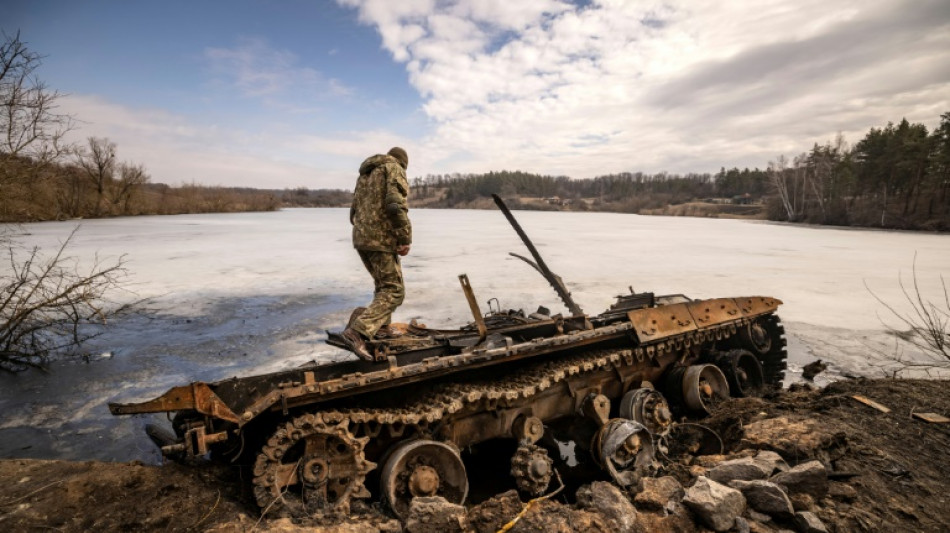
How far will Russia go in new phase of Ukraine assault? / Photo: FADEL SENNA - AFP/File

 Cyberattack ruled out in UK air traffic glitch as more flights axed

 Ekiden Launches Canton Network’s First Order Book-Based Derivatives Exchange

 Germany's Merz accuses AfD of promoting 'ethnic cleansing'
 Japanese director Kore-eda's manga film charms critics in Venice

 As African space race heats up, Senegal pursues homemade satellites

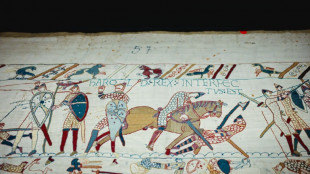 UK's little-known Bayeux Tapestry replica steps into spotlight

 Shelton stuns Alcaraz in 3:34 am US Open finish, Sabalenka battles on

 Alcaraz falls to Shelton in epic latest-ever US Open finish

 Tradition Announces Partnership With Affin Moneybrokers to Support Malaysian Market Data

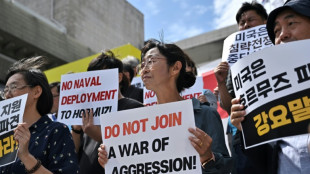 Protesters urge South Korea to stay out of Iran war
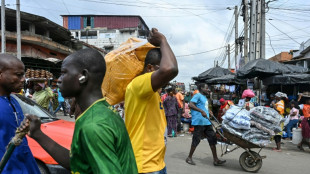 Africa's informal economy: a burden and lifeline

 Kenyan start-up makes robotic limbs to sign for deaf kids

 Iran, US trade blows as Hormuz impasse deepens

 The round-the-clock monitors protecting Bhutan from glacier risk

 'Hell': Father of surfers killed in Mexico testifies at trial

 Travellers in UK face more chaos after air traffic control glitch

 Crude pushes towards $100 on Mideast flare-up, fanning inflation fears

 Record rain forces Asian Games athletes to evacuate accommodation

 Amusing or addictive? The algorithms powering our social feeds

 Norway bids farewell to King Harald V, 'grandfather' of the nation
 NFL breaks new ground as 100,000 set to pack MCG in Australia
 EU faces revolt over social media ban for children
 Canada eyes researchers looking to leave 'hostile' US

 Tiafoe escapes Michelsen to reach US Open semi-finals

 InterContinental Hotels Group PLC Announces Transaction in Own Shares - September 09

Two months after invading Ukraine, Russia says its aim is full control of the Donbas region in the east as well as the south of the country.
It is still unclear what military means Moscow will deploy in this "second phase" of the Ukraine campaign, and what medium and long-term objectives it is pursuing.
Russia appears to have learned some lessons in terms of targets and tactics from its difficulties during the first few weeks of the war, against an enemy it had clearly underestimated.
Russian troops are today present in a corridor of 200-250 kilometres (125-155 miles) inside Ukraine -- from the Sea of Azov to the outskirts of Kharkiv -- but don't have full control of the area.
- 'Full control' -
In March, the Russian army said it was focusing on the two Donbas regions, Donetsk and Lugansk where pro-Russian rebels have been active since 2014.
On Friday, Russian Major General Rustam Minnekaev was quoted as saying that "one of the tasks of the Russian army is to establish full control over the Donbas and southern Ukraine", adding this would provide "a land corridor to Crimea", the peninsula Russia annexed from Ukraine in 2014.
But this ambition brings challenges, according to Michel Goya, a former French army colonel.
"The deeper Russian forces go into Ukraine, the more vulnerable they are," he said on Twitter.
Pascal Ausseur, director of the FMES strategic studies institute, said the Russian army may well be hoping to establish an axis running from Kherson on the banks of the Dnipro River, to the city of the the same name to the north and then to Izyum in the east.
Experts no longer believe Russia has any designs on Ukraine's capital Kyiv, which appeared to be an early target of the campaign.
- 'Blitzkrieg didn't work' -
This is likely an outcome of its army's slow progress and massive losses of troops and equipment early in the war, which prompted a change in tactics.
"They realised that the Blitzkrieg option didn't work out," said Ausseur. "So they returned to the traditional Soviet bulldozer model: If you can't break the will of your enemies, you grind them down."
"They will Mariupol-ise the operation," Ausseur said, in reference to the southern port city that has been subjected to relentless Russian bombardment over the past two months, and whose inevitable fall is being delayed only by a small number of Ukrainian holdouts.
"It looks like the Russian military is simply pursuing a scorched earth approach, attempting to break the will of the Ukrainian military through the use of overwhelming force and indiscriminate shelling to force remaining civilians to flee," said Colin Clarke, senior research fellow at the Soufan Center, a think tank.
Some experts expect the Russian army to try to trap Ukrainian forces in pincer movements east of the Dnipro River.
To avoid encirclement, the defending Ukrainians may disperse into several fronts, Clarke said, in order to stretch Russian supply and communication lines. "That strategy has been successful so far," he said.
Western aid has been boosted in recent days, notably with the announcement of an $800-million military package by US President Joe Biden, specifically aimed at the struggle in the Donbas.
- 'Weeks or even months' -
But the clock is ticking. Armoured personnel vehicles "will take weeks or even months" to get to the Ukrainian army, according to Mark Cancian, a senior adviser at the Center for Strategic and International Studies (CSIS).
"Even if the vehicles come out of stocks already in Europe, they will require some servicing before they are ready for shipping," he said.
NATO countries have started supplying Ukraine with -- originally Soviet-developed -- S300 missile systems but, Ausseur noted, their deployment also takes time.
In the meantime, France said it was shipping Milan anti-tank weapons and Caesar canons to Ukraine.
But experts say Kyiv is still short of other advanced weapons, such as Howitzer canons.
Ukraine will need to establish a "dome of steel" to defend itself from air attack, said Ausseur.
- 'Need a shield' -
"They need a shield that makes the equation less favourable to the Russians," he said, adding that otherwise Russia could pursue air strikes for years.
Few observers now expect the conflict to be over soon.
"The emerging scenario is one of high-intensity bombings lasting several weeks, or maybe several months," Ausseur said.
Alexander Khramchikhin, of the Moscow-based Institute for Political and Military Analysis, said the fighting could even go on for years.
"Russia has so far achieved none of its objectives, and it's not easy to see how it will achieve them in the future," he told AFP.
R.Garcia--AT