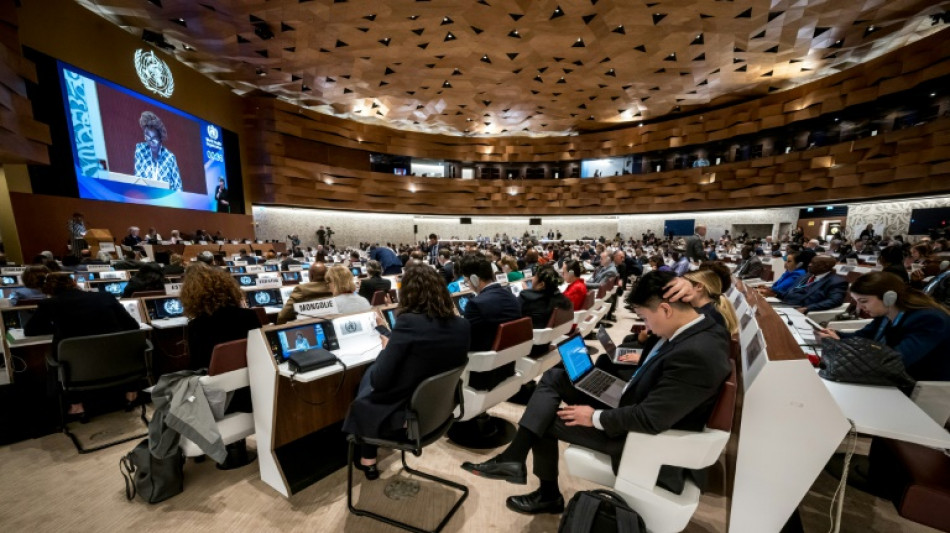
Countries at odds over how to reignite pandemic agreement / Photo: Fabrice COFFRINI - AFP

 Albania police teargas protesters against Trump-linked resort
 US panel says to loosen restrictions on popular peptide despite safety concerns

 Verstappen swerves around future questions
 EU renews online child sex abuse detection powers
 Airbus, Boeing fly in different directions at Farnborough

 Bab al-Mandeb Strait: another key oil shipping route under threat

 Deadly wildfires in Europe force thousands to flee

 NATO to overhaul European fuel pipeline network

 US trade envoy to make tariff announcement as 10% duty soon expires

 Trump stuns Saudis by pinning nuclear deal to Israel ties

 Tough day for Ubisoft stock topped with weaker revenues

 Swelling jet fuel costs hit American Airlines outlook
 Carapaz climbs unopposed to Tour de France 18th stage win

 Sooryavanshi hits maiden 50 as India thump Zimbabwe in T20
 ECB opens door to September rate-hike as Iran war flares up

 World Bank estimates Venezuela quakes caused $19.6 bn in damage
 Italy's far-right line up to defend jeweller who killed robbers

 AI-led boom in IPOs raises concerns about a bust

 Klopp expected to be named new Germany coach on Friday

 ECB holds rates as Iran war flare-up threatens to drive prices higher
 MEXC's "Kickoff Fest" Trading Event Concludes with Top Individual Reward of 27,352 USDT

 Oil soars close to $100 on fresh Mideast attacks
 India's angry Gen Z protesters say Modi must fix accountability

 Barca sign Adeyemi from Borussia Dortmund

 EasyJet profits nosedive on Mideast war
Countries aired stark differences Tuesday on where to go next in trying to strike a global agreement for handling future pandemics, after missing a deadline to finalise a deal.
While nations are keen to build on progress made towards an accord on pandemic prevention, preparedness and response, fault lines emerged on charting the course to an eventual agreement.
Africa and the United States were notably far apart on how long the process should take, as countries took stock of the situation at the annual World Health Assembly (WHA) in Geneva.
African nations spoke as one to say they wanted to seize the growing momentum and get the agreement finished in the coming months, while Washington urged countries to take their time to work out the best possible deal, suggesting the process could take up to two years.
Rattled by the devastation caused by Covid-19 -- which killed millions of people, shredded economies and crippled health systems -- countries have spent two years trying to reach binding commitments for tackling future pandemics.
But the negotiations ended last Friday without finalising a deal.
The deadline was this week's WHA, a gathering of the World Health Organization's 194 member states and its supreme decision-making body.
The assembly commissioned the drafting of a pandemic accord in December 2021.
- 'Let's finish this' -
Roland Driece of the Netherlands and Precious Matsoso of South Africa co-chaired the nine rounds of pandemic agreement talks.
On Tuesday, they delivered the latest draft to the assembly, showing 17 of its 34 articles fully approved by countries.
"Today we had hoped that we could say we're done, we're finishing this and we delivered on our mandate, but we are not there yet," Driece said.
"Let's finish this as soon as we can... because we owe that to all the people who suffered during the Covid pandemic."
South Africa's representative, speaking for 47 African countries, said the continent demanded equity in the agreement.
South Africa said that the talks must continue and that chapters already agreed would not be reopened to negotiation.
African countries want Driece and Matsoso's mandate to be extended "to finalise the pandemic agreement", and for the outcome to be submitted to a specially convened assembly session before the end of 2024.
- 'Fundamental differences' -
But the chief US negotiator, Pamela Hamamoto, said "fundamental differences remain on core issues central to the agreement", requiring extensive deliberations to resolve.
"We do not believe an extension of just a few months will achieve this and... we believe an extension of one to two years is necessary," she said.
The chair of the assembly committee proposed setting up a drafting group, to start work on Wednesday, to consider the options.
Germany said 80 percent of the most important issues were "already agreed upon", adding that the agreement could be finalised "at the latest within a year".
Israel felt agreement could not be reached in two to four months, while Indonesia said countries needed "not more time but the political will to prioritise global public health".
Canada and Switzerland said the agreement should not be rushed, while Japan thought a year was needed.
- Rewriting the rules -
Parallel talks have also taken place on revising the International Health Regulations, which are very close to completion.
First adopted in 1969 and last updated in 2005, the IHR constitutes the existing, legally binding framework for responding to public health emergencies.
But Covid-19 exposed flaws in the system, with countries failing to jolt into action when the WHO sounded the IHR's current highest available alarm in January 2020.
The proposed amendments include reforming the alert system so there are more, and clearer, levels of alarm.
Several countries voiced hope that the amendments could be finalised this week.
But if the African region does not get agreement on having the pandemic agreement talks done within the year, it remains to be seen whether it will back finishing off the IHR amendments swiftly.
The assembly, which opened on Monday, closes on Saturday.
N.Mitchell--AT