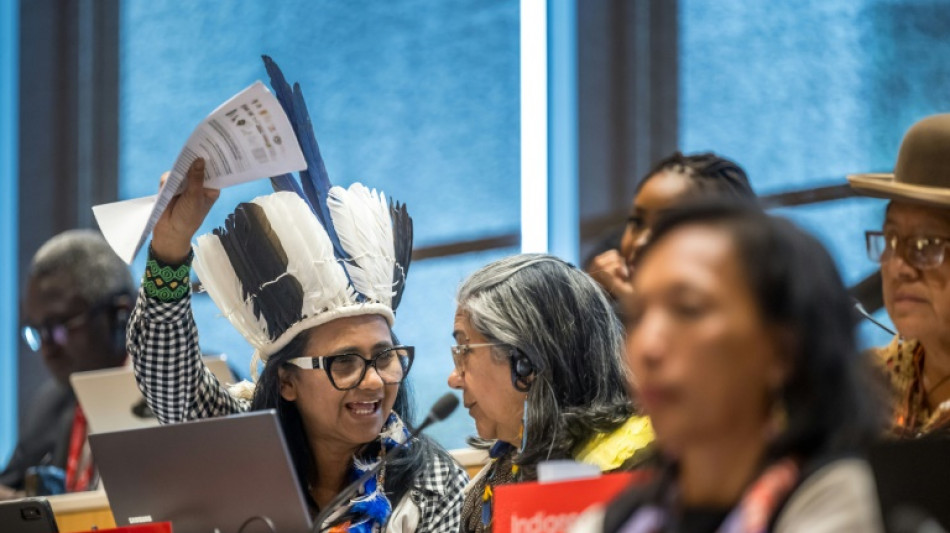
Celebrations as new biopiracy treaty agreed at UN / Photo: Fabrice COFFRINI - AFP

 Alonso welcomes Aston Martin upgrade, warns against unreal expectations
 Anderson declares Man City 'kings of Manchester' after £116 mn move

 Relieved Russell says Mercedes have solved his power problems mystery

 Oil soars above $100 as Middle East fears grow

 Venezuelans turn to scrap collecting in quake-hit beach 'paradise'

 Heptathlon champion Johnson-Thompson joins list of Commonwealth Games absentees

 Nigeria's Dangote raises $2.5bn to expand Africa's largest refinery

 Oil soars to $100 on fresh Mideast attacks

 Coal-fired power generation rising globally on Mideast war: IEA

 Premier League champions Arsenal sign Greece winger Tzolis from Brugge

 French Jewish DJ sues after activists disrupt gig: lawyer

 Venice film festival promises Pattinson, Oasis and Musk doc

 ASEAN calls for open straits as US-Iran war casts shadow

 Ford and Geely to form joint venture at struggling Spain plant
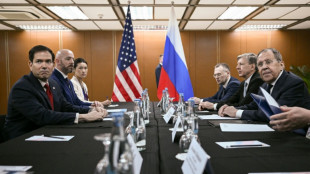 Russia warns US against Ukraine arms sales in Manila meeting
 New UK PM announces tax cut for struggling pubs

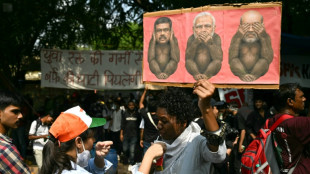
 Supporters flood India's 'cockroach' protesters with food

 Modi vows punishment for exam leaks fuelling India protests

 Norway set to make formal complaint to FIFA over Balogun red card saga

 Floods in northeast India kill at least 41

 Nestle siphons off bottled water business into joint venture

 Hundreds hospitalised in Japan heatwave 'disaster'

 Renault says sales stalled in first half

 EasyJet says profits nosedive on Mideast war

 Modi vows punishment for exam fraud fuelling India protests
Representatives of Indigenous peoples celebrated Friday at the United Nations following the agreement of a treaty against the pillaging of their traditional knowledge and genetic resources, like those from medicinal plants.
The new treaty, agreed by more than 190 nations, aims to combat so-called biopiracy by making applicants for patents disclose the origins of such materials used in a new invention.
Genetic resources -- such as those found in medicinal plants, agricultural crops and animal breeds -- are increasingly used by companies in everything from cosmetics to seeds, medicines, biotechnology and food supplements.
The idea is to increase intellectual property transparency on Indigenous people's traditional knowledge about resources, but the treaty does not address potential compensation for those communities.
The treaty is the culmination of more than 20 years of work at the UN's innovation and patenting agency -- the World Intellectual Property Organization (WIPO).
"Here we are not simply making history but the foundation for a sustainable future for all," the Indigenous Caucus group said after the deal was struck.
The treaty "finally recognises the crucial role that Indigenous peoples play in protecting these resources, ensuring their survival by transmitting our traditional knowledge from generation to generation.
WIPO said it was the first treaty to address "the interface between intellectual property, genetic resources and traditional knowledge".
- Sanctions debate -
Genetic resources have enabled considerable progress in health, climate and food security, according to the UN.
While natural genetic resources -- such as those found in medicinal plants -- cannot be directly protected as intellectual property, inventions developed using them can be patented.
But many developing countries were concerned that patents were being granted that circumvented the rights of Indigenous peoples.
The treaty text says patent applicants will be required to disclose where the genetic resources used in an invention came from, and the Indigenous people who provided the associated traditional knowledge.
The goal is to combat biopiracy by ensuring that an invention is genuinely new, and that the countries and local communities concerned agree with the use of their genetic resources, such as plant species cultivated over time, and the traditional knowledge surrounding them.
The treaty establishes sanctions, which would be imposed in accordance with the laws of countries that adopt the agreement
Some developing countries wanted to be able to revoke patents easily, while wealthy countries argued that stiff penalties would hamper innovation.
"We commend the outcome achieved, which strikes a fine balance between fostering innovation and enhancing transparency in the patent system," the Netherlands said on behalf of a group of mostly Western countries.
The treaty will enter into force once 15 countries have ratified it.
- 'Balanced outcome' -
Negotiations to finalise the treaty began at WIPO's Geneva headquarters on May 13.
Brazilian ambassador Guilherme de Aguiar Patriota, who has chaired the talks, hailed the new treaty early Friday as a "very carefully balanced outcome".
More than 30 countries already have disclosure requirements in their national laws.
Most of these are emerging and developing economies, including China, Brazil, India and South Africa, but others are European states, such as France, Germany and Switzerland.
However, those procedures vary and are not always mandatory.
The new treaty text says countries "shall provide an opportunity to rectify a failure to disclose the information required... before implementing sanctions".
However, that opportunity does not need to be extended in "cases where there has been fraudulent conduct or intent as prescribed by national law".
The treaty also says no country "shall revoke, invalidate, or render unenforceable" a patent solely because the applicant failed to disclose the necessary information.
Developing countries have long been calling for greater transparency on the origin of genetic resources.
M.White--AT