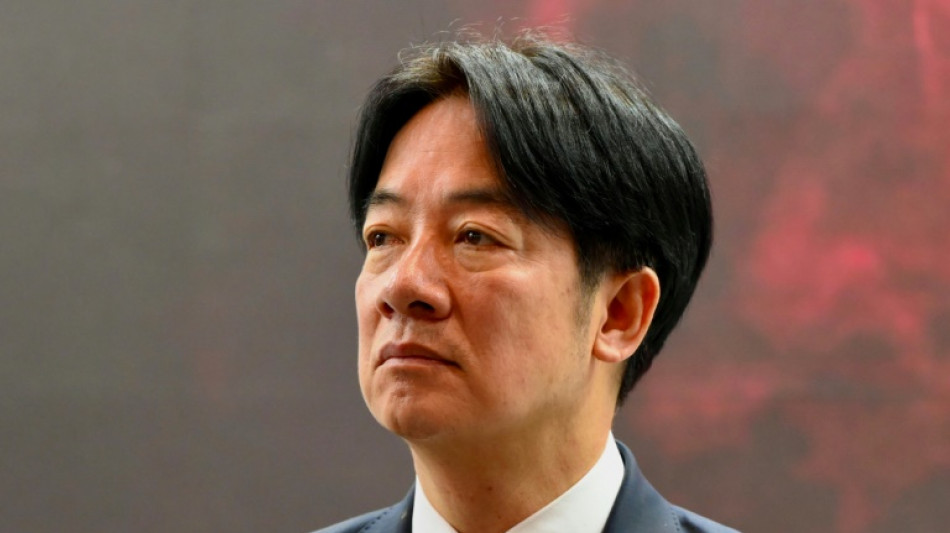
Taiwan president takes office under close scrutiny / Photo: Sam Yeh - AFP

 Supporters flood India's 'cockroach' protesters with food
 Modi vows punishment for exam leaks fuelling India protests
 Norway set to make formal complaint to FIFA over Balogun red card saga
 Floods in northeast India kill at least 41

 Nestle siphons off bottled water business into joint venture
 Hundreds hospitalised in Japan heatwave 'disaster'
 Renault says sales stalled in first half
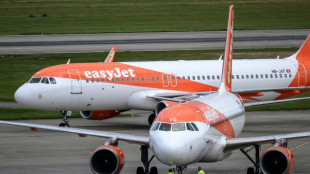 EasyJet says profits nosedive on Mideast war
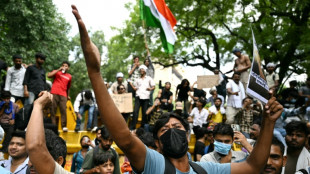 Modi vows punishment for exam fraud fuelling India protests
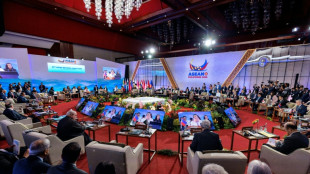
 Six candidates in race to lead UN set for televised debate
 Comic-Con kicks off with Marvel's return
 Dutch riders dreaming of crazy party corner of Alpe d'Huez
 Houthis target Red Sea shipping as US hits Iran
 Record-equalling Red Sox streak halted at 15 wins
 Messi-less Miami beat Fire 3-2 to spoil Lewandowski's MLS debut
 Mercedes expect Hungary challenge from Hamilton and Ferrari
 In Ghana, one man's race to save critically endangered fish
 Wilson captain, Slipper absent in Kiss's first Wallabies squad
 New Mideast fighting puts eurozone rate-setters on alert
 Venezuelans search for animal companions lost in the quakes
 Argentine Football Association says US did not detain its president
 June heatwave cost UK economy more than £1bn: study
 Empire Metals Limited Announces Management Appointments
 Caledonia Mining Corporation Plc: Blanket Exploration Results

 Tocvan Discovers New High-Grade At-Surface Silver-Gold Zone 900 m East of Pilot Facility at Gran Pilar Project

Taiwan's president-elect Lai Ching-te, a staunch defender of the island's democracy, will be sworn into office Monday as Beijing ratchets up military and diplomatic pressure on Taipei.
China, which claims Taiwan as part of its territory, has branded Lai a "dangerous separatist" who will bring "war and decline" to the self-ruled island.
Lai will succeed President Tsai Ing-wen in a ceremony that will be closely watched by China and the United States, the island's key partner and weapons provider.
Taiwan, a vibrant democracy of 23 million people, is separated by a narrow 180-kilometre (110-mile) strait from communist-ruled China.
Beijing has intensified military and diplomatic pressure on Taiwan during Tsai's eight years in power over her Democratic Progressive Party's (DPP) rejection of China's claims on the island.
Lai, who hails from the same party, has previously described himself as a "pragmatic worker for independence".
In recent years, Lai and the DPP have toned down past rhetoric pushing for formal independence, arguing that since Taiwan is already self-ruled, there is no need for a declaration that would enrage Beijing.
Given the high stakes, Lai is expected to "maintain the responsible policies of his predecessor," Amanda Hsiao of the International Crisis Group said.
His inaugural speech will be scrutinised for clues of how he will handle the delicate relationship.
Lai has made repeated overtures to Beijing, indicating a wish for a resumption of high-level communications, which China severed after Tsai took office.
"We will work to safeguard the status quo on both sides," Lai told a democracy summit on May 14.
"I will not rule out dialogue with China on the principles of mutual respect, mutual benefits, and dignity, with no preconditions."
Eight heads of state and around 50 foreign delegations are expected to attend the inauguration, including from the United States and Canada, in a show of support for the island's democracy.
- 'Resolutely opposed' -
The dispute between Beijing and Taipei dates back to China's civil war, which ended in 1949 with Mao Zedong's communist forces defeating the nationalists of Chiang Kai-shek.
The nationalists fled to Taiwan and claimed rulership of all of China, while the mainland claimed Taiwan.
China's Taiwan Affairs Office, which handles cross-strait issues, said Wednesday it has always "resolutely opposed Taiwan independence".
"Taiwan independence and peace in the strait are incompatible like water and fire," spokesman Chen Binhua said.
China has for decades vowed to bring Taiwan under its control, by force if necessary, with President Xi Jinping upping the rhetoric in recent years of "unification" being "inevitable".
Chinese warplanes, drones and naval vessels maintain a near-daily presence around Taiwan.
China's growing assertiveness in pressing its claims on Taiwan, and over the South China Sea, have raised concerns of a potential military conflict that could draw in the United States and its allies.
Many fear that a regional war, while not thought to be imminent, would devastate the global economy.
Taiwan is located on a maritime gateway connecting the South China Sea and the Pacific Ocean -- a key route for international trade -- and is a major supplier of semiconductor chips, which have been called the "lifeblood" of the modern world.
Taiwan and China have engaged in a diplomatic tug-of-war to lure allies in the Pacific region, offering generous aid packages and assistance in agricultural and educational development.
Only 12 states, including the Vatican, fully recognise Taiwan, and China does not maintain relations with any country that recognises Taipei.
After Lai's election win in January, the tiny South Pacific nation of Nauru severed diplomatic ties with Taiwan in favour of China.
Taipei has also seen daily cyber attacks targeting its government agencies increase from one million to 2.5 million since the polls.
- 'Dangerous' -
Lai will also have to contend with domestic challenges as he seeks to reverse growing disillusionment with the DPP.
While the party won an unprecedented third term in the last election, it lost its majority in parliament.
With wages stagnating and the cost of living rising, some voters are frustrated with the DPP's handling of relations with China.
"It's dangerous," retiree Chou-ta Chung, 66, told AFP of Lai's policy on China and the United States.
"The DPP focuses too much on the United States... you must strike a balance between the two sides."
A.Anderson--AT