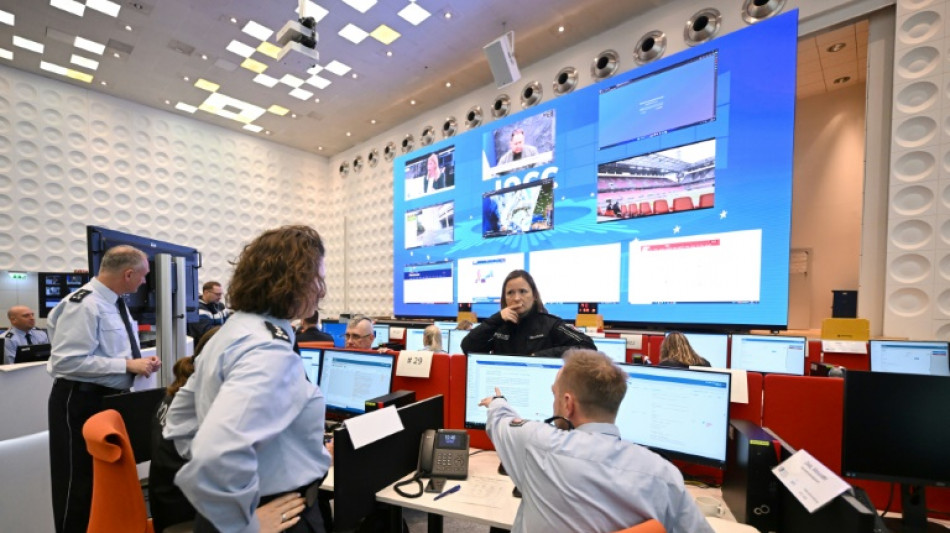
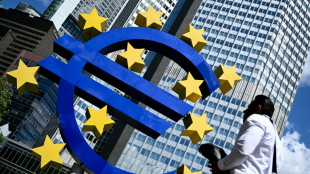
Germany set for massive security challenge at Euro 2024 / Photo: Ina FASSBENDER - AFP/File

 Nokia says AI, cloud boosted sales in second quarter
 Repsol says profit more than triples on higher oil prices
 TotalEnergies says profit doubled on Mideast war
 Giant swing on Swiss peak aims to boost summer tourism as Alps warm
 ASEAN to call for open straits as US-Iran war casts shadow

 AI catches up with humans to score 100% at top maths contest

 South Korea election office raided in fake turnout figures probe: investigators
 Killer whales: orcas blow fish to bits 'for fun', study finds
 Deadly wildfires force thousands from homes in parts of Europe
 Tech bounce lifts Asia stocks, oil extends gains on US-Iran fears

 Surrounded by militias, Sudanese fear endless cycle of war

 Commonwealth Games 'where champions are made' despite slimmed down model, argues president
 Trump family project in Albania has already caused 'irreparable' damage: NGOs

 Bollywood blast master keeps it real with fire and fury
 Tearful fights, edible offerings: A glimpse into the Maradona trial
 What's the deal with peptides? The hyped market under US review
 Tesla shares fall as Musk touts ambitious -- and costly -- plans
 InterContinental Hotels Group PLC Announces Transaction in Own Shares - July 23
 Empire Metals Limited Announces Management Appointments

 Tocvan Discovers New High-Grade At-Surface Silver-Gold Zone 900 m East of Pilot Facility at Gran Pilar Project
 Google-parent Alphabet beats expectations, cloud revenue nearly doubles
 US announces civilian nuclear deal with Saudi Arabia

 Tesla shares dip after profit misses expectations
 Red Sox tie club record with 15th straight MLB win

 US eyes offshore nuclear reactors
Keeping fans and players safe will be a mammoth task for Germany as it hosts Euro 2024 this summer in a tense global climate with major conflicts in Ukraine and the Middle East.
From hooligans to potential terrorist attacks and even cyberattacks, the European Championship organisers will be looking to ward off a range of threats.
Security forces will be charged with protecting some 2.7 million fans, 24 team base camps spread across the country and ten stadiums where 51 matches will be played between June 14 and July 14.
Designated fan zones are also expected to attract around 12 million visitors.
"From the outset, security has been our top priority," tournament director Philipp Lahm told AFP.
In an unprecedented move, Germany has invited some 300 security experts from all nations playing in the tournament to take part in a monitoring project at the International Police Cooperation Centre (IPCC) in the western city of Neuss.
Alongside officials from Germany, Europol and European football body UEFA, they will take turns to monitor the situation on the ground, gathering during the tournament in a huge 500-square-metre (5,382-square-foot) conference room equipped with 129 computers and a 40-square-metre screen, AFP saw on a visit to the facility.
- No leave for police -
"Each country knows its troublemakers better than any other, and the foreign experts present in Neuss will be able to identify them more quickly," Oliver Strudthoff, director of the IPCC, told AFP.
"The size of the delegations will depend on the number of fans and how potentially dangerous they are. England, for example, will have many more representatives than Switzerland," he said.
At the matches themselves, all hands will be on deck -- police have been forbidden from taking leave during the tournament.
Germany will also introduce security controls on all of its nine borders.
"On trains and in stations, the federal police will be visibly stepping up their presence," said a spokesman for the German interior ministry. The same applies to airports.
French gendarmes will support the German police by taking part in joint rail patrols on routes to and from France and at matches involving the French team.
The British government has said that more than 1,600 English and Welsh supporters who are hit with stadium bans because of previous violent behaviour, will be banned from travelling to Germany during the tournament.
- Triple perimeters -
On top of the standard measures, German Interior Minister Nancy Faeser has said the Ukrainian national team will be subject to enhanced security.
Between 800 and 1,300 police will be deployed around the stadiums at each match, depending on the teams playing.
In a bid to prevent anyone from entering a match with weapons or explosives, three security perimeters will be set up around each stadium.
Cars will be checked at the first barrier, while fans will have their bags searched at the second, before scanning their tickets at the third.
The fan zones will also present a security challenge, especially the largest one at Berlin's Brandenburg Gate which is set to welcome tens of thousands of visitors for every match.
These "soft targets" are more vulnerable because "it's easier for perpetrators to infiltrate (them) and take action", said Johannes Saal, a security expert at the University of Lucerne.
The German army will also monitor the sky from the National Air Security Center, located some 70 kilometres (44 miles) from the IPCC.
The use of drones will be closely monitored, with flight restriction zones.
"Major sporting events are always potential targets for terrorist attacks," said Saal, describing the security situation as "very tense" in the context of the war in Gaza and the ever-present threat of Islamist extremism.
A.Moore--AT