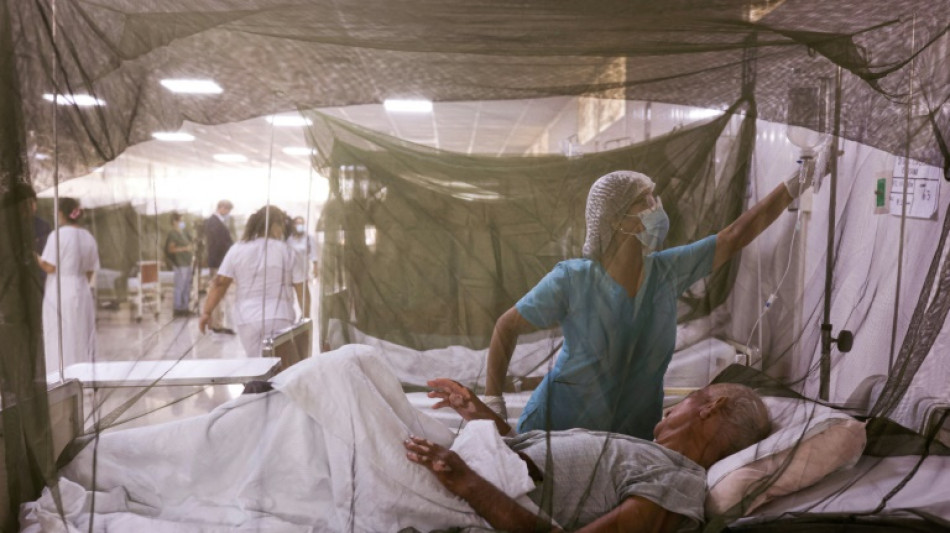
Pandemic agreement talks reaching end with deal elusive / Photo: Juan Carlos CISNEROS - AFP

 Nokia says AI, cloud boosted sales in second quarter

 Repsol says profit more than triples on higher oil prices

 TotalEnergies says profit doubled on Mideast war
 Giant swing on Swiss peak aims to boost summer tourism as Alps warm
 ASEAN to call for open straits as US-Iran war casts shadow
 AI catches up with humans to score 100% at top maths contest

 South Korea election office raided in fake turnout figures probe: investigators
 Killer whales: orcas blow fish to bits 'for fun', study finds
 Deadly wildfires force thousands from homes in parts of Europe

 Tech bounce lifts Asia stocks, oil extends gains on US-Iran fears

 Surrounded by militias, Sudanese fear endless cycle of war

 Commonwealth Games 'where champions are made' despite slimmed down model, argues president
 Trump family project in Albania has already caused 'irreparable' damage: NGOs

 Bollywood blast master keeps it real with fire and fury
 Tearful fights, edible offerings: A glimpse into the Maradona trial

 What's the deal with peptides? The hyped market under US review
 Tesla shares fall as Musk touts ambitious -- and costly -- plans

 InterContinental Hotels Group PLC Announces Transaction in Own Shares - July 23
 Empire Metals Limited Announces Management Appointments

 Tocvan Discovers New High-Grade At-Surface Silver-Gold Zone 900 m East of Pilot Facility at Gran Pilar Project
 Google-parent Alphabet beats expectations, cloud revenue nearly doubles
 US announces civilian nuclear deal with Saudi Arabia

 Tesla shares dip after profit misses expectations
 Red Sox tie club record with 15th straight MLB win

 US eyes offshore nuclear reactors
Countries trying to strike a landmark global agreement on handling future pandemics began discussing how to keep the process alive as they ran out of time to seal a deal Friday.
With the chances fading of concluding an agreement by the end of the day, negotiations turned to what the next steps might be.
Shaken by the failures exposed by Covid-19 -- which killed millions, shredded economies and crippled health systems -- countries have spent two years drafting an international accord on pandemic prevention, preparedness and response.
Despite a common desire for binding commitments aimed at preventing another such disaster, big differences quickly emerged between country blocs on how to go about it.
And though progress has been made on bridging the differences, the clock was always against them.
The World Health Organization's 194 member states were meant to finish the process in March so the agreement could be formally adopted at their annual assembly, which starts on May 27.
This additional fortnight of talks was crammed in amid hopes of achieving a breakthrough. Countries did finally begin thrashing out text wording but could not get everything completed in time.
- Delegates head for the door -
The talks are being held behind closed doors at the WHO headquarters in Geneva.
WHO chief Tedros Adhanom Ghebreyesus was attending the talks in person, along with the UN health agency's emergencies director Michael Ryan.
WHO spokeswoman Margaret Harris told a media briefing Friday that the overtime round of talks "will end later today".
Fuelled by trolleys full of coffee, bananas, biscuits and sandwiches, negotiators have been pulling 12-hour days since April 29 to try and find a way through.
Several diplomats were already leaving the building with their suitcases on Friday as the talks neared the end.
"During the past two weeks, negotiators have held extensive discussions on multiple aspects of the proposed agreement, meeting often into the early hours of the morning," Harris said.
"Next steps on the way forward will... be discussed today and they will be announced later."
- More time needed -
Non-governmental organisations that were deemed to be relevant stakeholders can follow the process outside the room and are briefed daily by the talks' co-chairs.
"Member states are discussing what the next steps will be," Medicines Law and Policy director Ellen 't Hoen told reporters.
"It's fair to say there's progress made. If you look at the outline of the agreement, all the important themes are there.
"But there remain a significant number of thorny issues that simply need more time. No country as far as we can tell has tried to pull the plug."
James Love, the director of Knowledge Ecology International, added: "There is some room for negotiating right now. I don't think we're really there yet.
"I don't think it's the worst outcome if they take more time. I also don't think they're going to quit."
The main disputes revolve around access and equity: access to pathogens detected within countries and to pandemic-fighting products such as vaccines produced from that knowledge; and equitable distribution of not only counter-pandemic tests, treatments and jabs, but also the means to produce them.
Each of the draft agreement's 37 articles has been individually thrashed out, with country negotiators breaking off into working groups to try to figure out a consensus.
While general agreement has been found on some articles -- without formally signing them off -- the core aspects have proved the hardest to negotiate.
W.Morales--AT