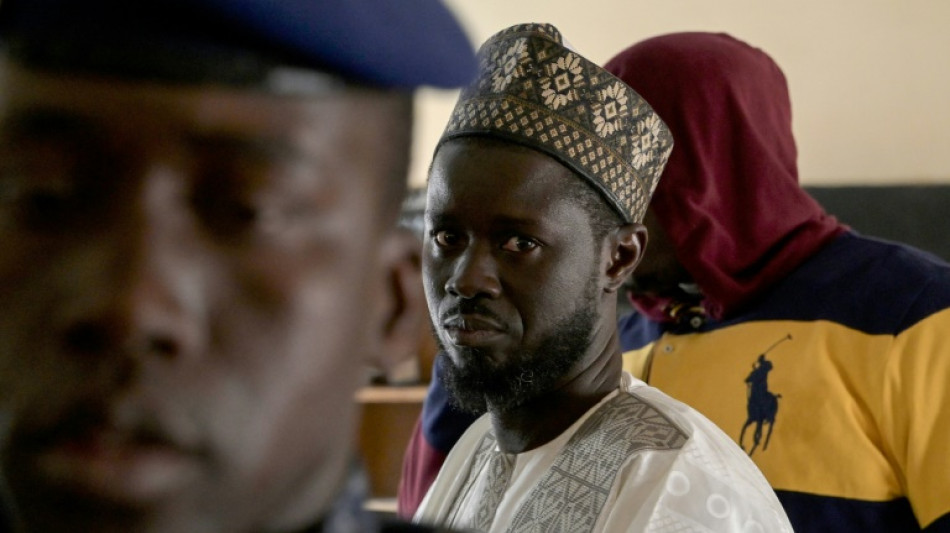
What will change with Bassirou Diomaye Faye at Senegal helm? / Photo: SEYLLOU - AFP

 Designing a Tour de France route: a three-year labour of love
 Chelsea sign Rogers from Villa for reported UK record fee
 'The Dink' sees comedy in US pickleball craze
 Rainout keeps Red Sox MLB win streak at 14 with two games Wednesday
 Zelensky sacks army chief Syrsky after days of protests
 Messi lands in Argentine hometown after World Cup defeat
 Lipowitz breaks collarbone in Tour de France crash
 India opposition leader Gandhi detained after calling for PM resignation
 AI boom lifts Mexico tech exports, complicating Trump trade goals
 'Godzilla' actress Kaylee Hottle, 18, dies in US car crash
 South Africa's anti-migrant unrest led over 160,000 to flee
 Ipswich sign Ghana winger Fatawu from Leicester
 Evenepoel wins 'special' Tour de France individual time-trial

 Evenepoel wins Tour de France individual time-trial
 Tropical Storm Bertha strengthens, threatening Gulf coast of US
 Microsoft strikes deal for Mistral's AI computing power
 Dutch students unveil 'world-first' solar-powered ambulance

 French lawmakers set to ban social media for under-15s in European first
 UK PM Burnham unveils energy tax cut, tells ministers to cut living costs
 Pharma heavyweights clash over anti-obesity drug ads
 Hungary raids Orban's Fidesz party servers in graft probe
 General Motors lifts 2026 outlook despite hit from electric retreat
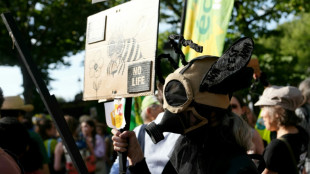 Uproar in France over reintroduction of bee-harming pesticides

 Kuwaitis ration electricity as Iran hits power grid
 Former Man Utd boss Ferguson salutes old rival Keegan

At the age of 44, Bassirou Diomaye Faye is to become Senegal's fifth and also youngest president after the opposition candidate's main rival Amadou Ba conceded defeat after Sunday's first round vote.
Along with his mentor Ousmane Sonko, Faye is part of an upcoming generation of African politicians and portrays himself as a man of change and a break with the past.
But what does he propose to do once he takes office? AFP looks at what kind of change he wants to effect in his country and how he seeks to overcome the multiple challenges which await.
- Restore democracy -
Faye says the very foundation of his political project is "the rehabilitation of the institutions of the Republic" and "the restoration of the state based on the rule of law" which he asserts were flouted by outgoing twice-elected incumbent Macky Sall.
Faye says he wants to fight against what he terms "hyper-presidentialism", which he asserts has led to a "stranglehold of the executive on legislative and judicial powers", leading to an "instrumentalisation of justice" to chase down opponents and jail them.
The incoming head of state is promising to limit the powers of the president, hoping to introduce impeachment, the post of vice-president, prohibit the accumulation of political mandates, fight corruption and introduce alternatives to imprisonment.
- Redistribution of wealth -
"Let no one have us believe that we cannot embody our own sovereignty," was the leitmotif of the charismatic Sonko -- Faye's political fellow traveller but prevented from standing in this year's poll.
"From now on, we shall be a sovereign, independent state that will collaborate with everyone but in win-win partnerships," Sonko declared at Faye's final campaign rally.
The new president is vowing to reclaim sovereignty, a word he used no fewer than 18 times in his manifesto, which includes a commitment to renegotiating mining and hydrocarbon contracts that are set to take effect this year.
Faye also wants to reassess fishing accords with foreign powers, as the fish resources which support some 600,000 Senegalese families are dwindling, plundered -- they say -- by European and Asian trawlers.
His manifesto furthermore emphasises the need to develop the primary sector to ensure food security and move towards self-sufficiency, notably the staple of rice.
- New currency -
Faye is also promising monetary reform -- potentially even the introduction of a new currency, the Senegal, in place of the CFA franc, a regional currency which predates independence 65 years ago from former colonial masters France and which is pegged to the euro.
He stressed during his campaign that the proposal, viewed with some concern in financial circles, would not be brought in immediately and would only be pursued under a number of strict conditions.
In an interview with French daily Le Monde, Faye said that in order to leave the CFA franc "this would ideally be done within the framework of the Economic Community of West African States (ECOWAS) with the Eco", the West African single currency project that has yet to come to materialise.
"We could have either a national currency pegged to a community currency or to a common currency," he said. If the project does not come to fruition, then "we will have to consider taking our sovereignty into our own hands".
- Renegotiate partnerships -
The incoming leader wants to rebalance international partnerships and reset the relationship with France, Senegal's main trading partner.
Sonko had earlier signalled an "era of rebalancing" Dakar's relations with the world.
"What they want is a win-win policy, it's economic patriotism," Babacar Ndiaye, a political analyst at the Wathi think-tank, told AFP.
Claiming to be a Pan-Africanist, Faye wishes to strengthen Senegal's diplomatic presence across Africa and promote regional integration within ECOWAS while reinforcing the role of parliament and Senegal's court of justice.
- Setting off -
Senegalese voters backed Faye in the first round as they see him as the man to break with the country's recently turbulent past and deliver change.
But "there will be no state of grace," warned Ndiaye, who said the people will want to see results -- and quickly.
The time needed for adaptation, coupled with a delicate international context, could prevent the new government from delivering rapid results, according to political analyst El Hadji Mamadou Mbaye.
Even so, said Mbaye, Faye has the advantage of having a first-round success which obviated the need for a coalition government -- something that could have weakened his project through the need for political alliances.
The challenge is now "whether they are going to be ready to deliver and whether they have the means to do so," he added.
Another difficulty is that his party is in a minority in parliament.
Faye has not ruled out dissolving the assembly should he find a majority opposing him and preventing him from putting his reforms into action.
M.O.Allen--AT