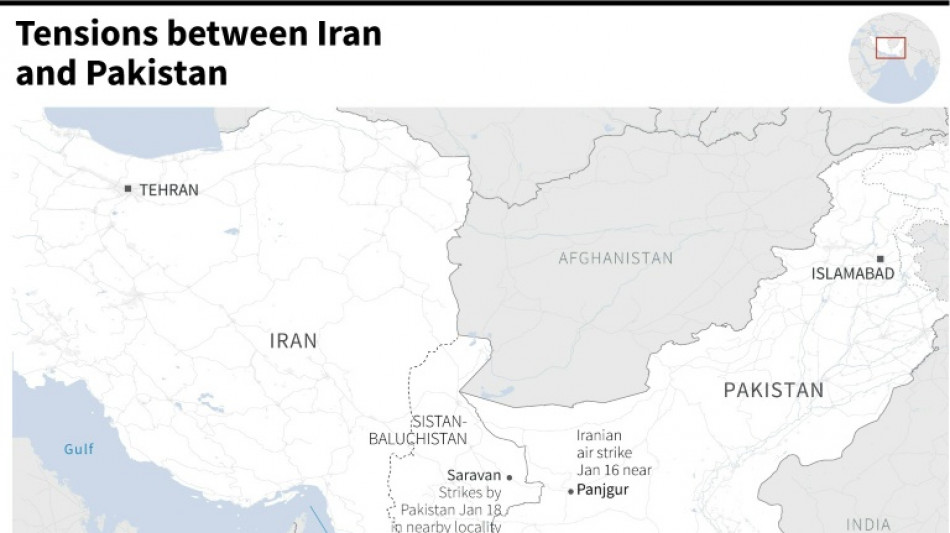
Pakistan, Iran agree to 'de-escalate' after trading air strikes / Photo: Valentin RAKOVSKY, Jean-Michel CORNU - AFP

 Myanmar leader to visit Thailand next month: Thai FM to AFP
 Belgian great Meunier signs for Premier League side Sunderland

 Kenya denies Rastafarians the right to smoke weed

 Generative AI's power sparks fears of dumbing humans down
 'Like my lover': Chinese users bid farewell to AI companions

 Empty skyscrapers: China's property slump still throttling growth

 Cuba slowly gets power back after latest blackout
 AI demand powers forecast hike, profit gains at tech giant ASML
 Aussie Rules removes Indigenous figure from Hall of Fame

 France set to adopt assisted dying law in final vote
 Australian swimmer O'Callaghan reveals she has spinal fractures

 Argentina and England collide with World Cup final spot at stake
 AI ignites 'ignored sector' for Japan chipmaker Kioxia

 Writers union sues to block US Paramount deal
 UK announces social media curfew for older teens

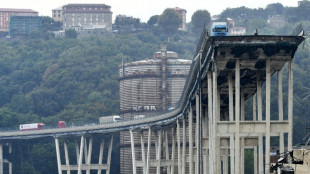 Italy court to rule in deadly bridge collapse case

 Tuchel unfazed by history ahead of England v Argentina World Cup semi
 Scaloni says fatigue not a concern for Argentina in World Cup semi-final

 Tocvan Outlines Phased Development Plan for Pilot Mine Operations at Gran Pilar Gold-Silver Project

 Caledonia Mining Corporation Plc: Notification of Relevant Change to Significant Shareholder
 InterContinental Hotels Group PLC Announces Transaction in Own Shares - July 15
 Elevex Capital Launches Multi-Vertical Floor Plan Finance Platform, Powered by Vero Technologies

 Two Free Travel Itinerary Builders Launch With One-Tap Auto-Planning - No Account, No Upload, Your Trip Stays on Your Device

 MPS Law Welcomes Howard Teplinsky as a Partner

 Mac Allister calls on Argentina to channel Maradona spirit in England World Cup clash

Pakistan and Iran "agreed to de-escalate" tensions Friday, Islamabad said, after trading deadly airstrikes on militant targets in each other's territory this week.
The rare military actions in the porous border region of Baluchistan -- split between the two nations -- had stoked regional tensions already enflamed by the Israel-Hamas war.
Iran carried out a missile and drone attack on what it called "terrorist" targets in Pakistan on Tuesday night, with Pakistan in turn striking militant targets inside Iran on Thursday.
Pakistan recalled its ambassador from Tehran and said Iran's envoy -- on a visit home -- was blocked from returning to Islamabad.
The United Nations and the United States appealed for restraint, while China offered to mediate.
But after speaking by phone, Pakistan's Foreign Minister Jalil Abbas Jilani and his Iranian counterpart Hossein Amir-Abdollahian agreed "close coordination on counter terrorism and other aspects of mutual concern should be strengthened".
"They also agreed to de-escalate the situation," according to a summary of the conversation released by Islamabad's foreign ministry.
After the call, Amir-Abdollahian said in a statement "the cooperation of the two countries to neutralise and destroy terrorist camps in Pakistan is essential".
The muted rhetoric matched analysts' predictions that both sides would seek to defuse the confrontation.
"The upshot of the new situation is that the two countries are seemingly and symbolically even," said Antoine Levesques, of the International Institute for Strategic Studies.
- Border closure fears -
Meanwhile on Friday, Pakistani Prime Minister Anwaar-ul-Haq Kakar held an emergency security meeting with military and intelligence chiefs.
Kakar cut short his visit to the World Economic Forum in Davos, Switzerland following the strikes.
His caretaker government is leading Pakistan into general elections in three weeks which have been marred by allegations of pre-poll rigging.
Tehran and Islamabad have both said they hit their own domestic militants sheltering on foreign territory.
A collective death toll of 11 -- mostly women and children -- was reported from both sides of the border that bisects an arid region where militant movements have simmered for decades.
In the remote villages near the strike site in Panjgur district, where mobile signal is rarely available, farmers pieced together the events from reports passed on from visiting security officials who set up checkpoints in the area.
"Helicopters were flying overhead and going in the direction of where the Iranian strike hit, but we didn't know what had happened," Maulana Mohammad Sadiq, 42, the prayer leader of a small seminary around five kilometres (three miles) from where a missile hit, told AFP on Thursday.
Villagers feared that deteriorating relations between the two sides could lead to border closures and cut off residents from Iranian trade, which the area relies on for employment and food imports.
"If Iranians close the border, the people will starve and it will cause more militancy because youth will join the separatist organisations," said 55-year-old Haji Mohammad Islam.
Baluch separatists have been waging a low-level insurgency against Pakistani authorities from the largely ungoverned, impoverished region fighting for a better share of mineral resources.
Rights groups say the military's crackdown on the insurgency has included widespread enforced disappearances and extrajudicial killings.
Militancy has also risen sharply along Pakistan's border with Afghanistan further north, after the Taliban's return to power there in 2021.
G.P.Martin--AT