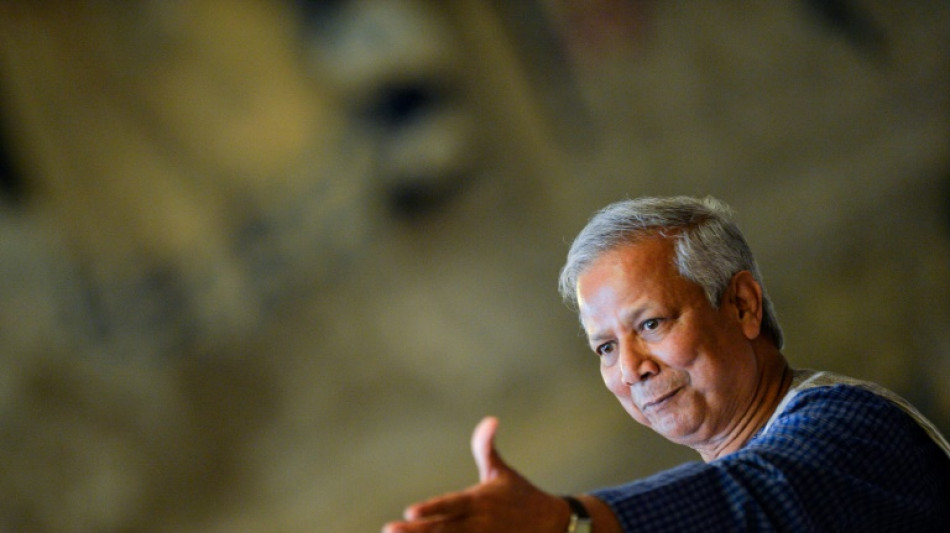
Muhammad Yunus: Bangladesh's 'banker to the poor' / Photo: ANDREAS SOLARO - AFP/File

 Syria reopens Jordan border crossing after mending ties

 Cyclone Arnab lashes India coast, no deaths reported

 Trump tamed after US midterms? Europe doubts it

 Tech stocks soar as SK hynix adds to rising AI confidence

 Sri Lanka's Tamil farmers fight to reclaim land after civil war
 Afghans compete for jobs, homes as millions return
 'They don't care about us': Trump food aid cuts leave Americans struggling and angry
 Meta, Snap head to trial in another case about social media's harms

 French Senate passes bill to make protesters pay for unrest damage

 India evacuates tens of thousands as Cyclone Arnab makes landfall
 In tight Israel vote, both camps hold out cautious hope

 AI chip giant SK hynix says quarterly operating profit soars 630%

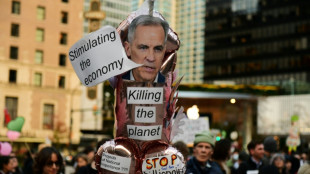 Youths testify about 'despair' in unprecedented Canadian climate trial

 'A very sad day': Arteta despair as Arsenal stunned by Fleetwood
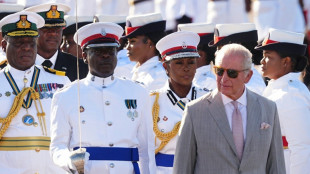 Charles tackles thorny legacy of slavery on Caribbean trip

 Former Grand Slam winner Wawrinka ends tennis career

 Brazil's Flavio Bolsonaro flees to US after election loss
 'Faerie' nights: 'ACOTAR' fans finally get their book

 American woman convicted of getting military training from Islamic State

 Israel opposition holds narrow edge over Netanyahu in first projections

 Floriani hits maiden goal as Lazio go top
 Trump set to drastically loosen oil and gas sector's methane rules

 Storied Paris department store seeks bankruptcy protection
 Xhaka, Embolo can return to Swiss squad after fake Covid docs affair
 Allegri suspended for two Serie A games after red card
Jailed Nobel-winning microfinance pioneer Muhammad Yunus is celebrated around the world for helping millions of people out of poverty, but at home in Bangladesh he has a powerful enemy.
The 83-year-old, known as the "banker to the poorest of the poor", was awarded the Peace Prize in 2006 for his work loaning small cash sums to rural women, allowing them to invest in farm tools or business equipment and boost their earnings.
Grameen Bank, the microfinance lender he founded, was lauded for helping unleash breakneck economic growth in Bangladesh, and its work has since been copied by scores of developing countries.
"Human beings are not born to suffer the misery of hunger and poverty," Yunus said during his Nobel lecture, daring his audience to imagine a world where deprivation was confined to history museums.
But his public profile in Bangladesh has earned him the hostility of Prime Minister Sheikh Hasina, who once accused him of "sucking blood" from the poor.
On Monday he and three colleagues from one of the companies he founded were sentenced to jail terms of six months -- but immediately bailed pending appeal -- by a Dhaka labour court which found they had illegally failed to create a workers' welfare fund.
All four had denied the charges and the case has been criticised as politically moviated by watchdogs including Amnesty International.
Yunus still faces more than 100 other charges on alleged graft and labour law violations.
Hasina's administration has been increasingly cracked down on political dissent, and Yunus's popularity has for years earmarked him as a potential rival.
The year after winning the Nobel Prize, Yunus announced plans to set up his own "Citizen Power" party to end Bangladesh's confrontational political culture, which has been punctuated by instability and periods of military rule.
He abandoned those ambitions within months, but the enmity aroused by his challenge to the ruling elite has persisted.
Since Hasina returned to power in 2008, Yunus has been hit with a series of criminal cases and a smear campaign by a state-led Islamic agency that accuses him of promoting homosexuality.
The government unceremoniously forced him out of Grameen Bank in 2011 -- a decision fought by Yunus but upheld by Bangladesh's top court.
A telecom firm he chairs was hit with a graft probe in 2022 over accusations it had embezzled employee funds -- claims that critics say are politically motivated.
Hasina also blamed Yunus for the World Bank's decision to cancel funding for a bridge near the capital Dhaka after the project was embroiled in a bribery scandal.
The bridge finally opened in 2022 after years of construction delays, and at its opening ceremony, Hasina said Yunus should be "dipped in the river" for jeopardising its completion.
Yunus has adamantly denied influencing the World Bank's decision and his office has described the claims as "purely imaginary".
- 'Poverty was all around me' -
Yunus was born into a well-to-do family -- his father was a successful goldsmith -- in the coastal city of Chittagong in 1940.
He credits his mother, who offered help to anyone in need who knocked on their door, as his biggest influence.
Yunus won a Fulbright scholarship to study in the United States and returned soon after Bangladesh won its independence from Pakistan in a brutal 1971 war.
When he returned, he was chosen to head Chittagong University's economics department, but the young country was struggling through a severe famine and he felt compelled to take practical action.
"Poverty was all around me, and I could not turn away from it," he said in 2006.
"I found it difficult to teach elegant theories of economics in the university classroom... I wanted to do something immediate to help people around me."
After years of experimenting with ways to provide credit for people too poor to qualify for traditional bank loans, he founded Grameen Bank in 1983.
The institution now has more than nine million clients on its books, according to its most recent annual report (2020), and over 97 percent of its borrowers are women.
Yunus has won numerous high honours for his life's work, including a US Presidential Medal of Freedom awarded by Barack Obama.
S.Jackson--AT