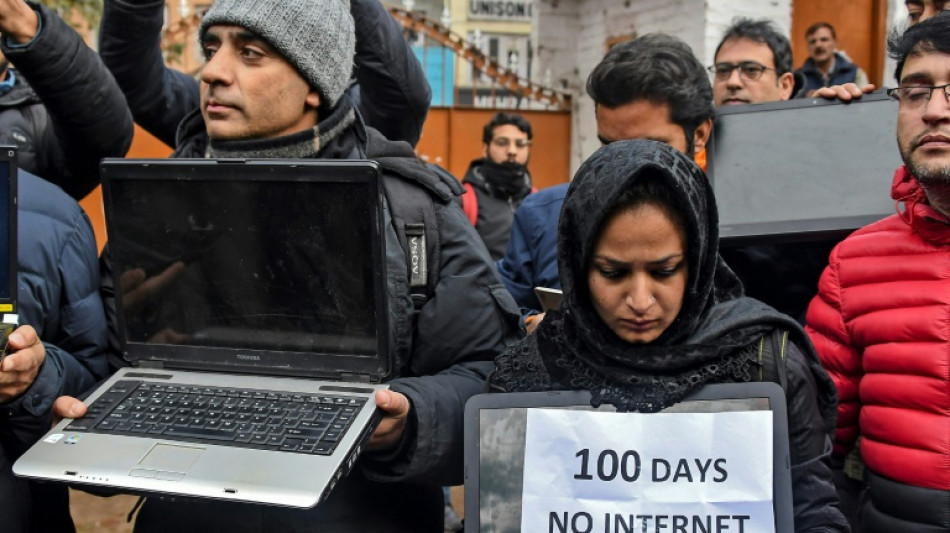
Internet out: India deploys shutdowns in name of security / Photo: Tauseef MUSTAFA - AFP/File

 Pakistan keep England to 241 despite Duckett ton

 Ukraine war divides Bulgaria as voters elect president
 Shock and grief in a Jordanian village after church attack
 Top-ranked Rybakina crushes Fernandez to win fourth title of season

 UK PM calls for 'honest discussion' about EU free movement

 Far-right leader Le Pen kicks off tilt at French presidency amid nationwide protests

 Naomi Osaka could quit tennis if daughter asks her to

 Last MotoGP race at Phillip Island cancelled due to weather in Marquez setback

 Sri Lanka seeks faster green energy shift after oil shocks
 Riyadh airport resumes flights following Houthi attacks

 'Call of Duty' North Korea invasion edition tops sales charts in South
 Musk accuses Ukraine of violating Starlink's terms of service

 Fed expected to hold rates steady days ahead of US midterms

 More Lula, or back to the Bolsonaros? Brazil votes in cliffhanger

 Easy Fitness Routines You Can Do at Home

 Expo Contratista Announces 10th Edition in Dallas, Spotlighting Latino Construction Businesses and Workforce Development

 Obama blasts Trump's 'chaos and cruelty' while campaigning for Democrats

 Bolsonaro leads Lula in final Brazil election polls

 Antonelli storms to pole for US Grand Prix

 Alvarez fires Atletico to win against Deportivo

 Japan's Nakai wins Grand Prix de France for second straight year

 Ronaldinho to make comeback in Italian third tier
 Israeli forces displace Hebron families after deadly attack
 Hamilton on top with Antonelli fourth in final practice at US Grand Prix

 Beier late show sends Dortmund top of Bundesliga
With the world's largest biometric ID database, a pioneering digital payment system for daily transactions and a flagship space and satellite programme, India knows the power of connected technology.
But when trouble brews with political unrest or sectarian violence, authorities are quick to sever internet service to stem disinformation -- cutting off millions of people who depend on the web for communication, information and business.
For authorities, internet shutdowns have "become the first tool in their toolkit", said Indian online civil liberties activist Mishi Choudhary.
Some blackouts last hours, others days. Some stretch for months.
In India's northeast Manipur state, more than three million people have been cut off from mobile internet since clashes broke out in May.
That meant it took two months for Phijam Ibungobi to find out that his missing 20-year-old son had been one of the more than 150 people killed in the violence.
When the internet was briefly restored in September, photographs of the young man's corpse circulated on social media.
"The internet meant I could find out the news of my son -- even if that news was tragic," Ibungobi told AFP in tears.
- 'Default policing measure' -
India, the world's largest democracy, with general elections due next year, is also a global leader in internet shutdowns, according to New York-based online freedom monitors Access Now.
Of the 187 internet shutdowns it recorded worldwide last year, 84 were in India, the "most of any country for the fifth consecutive year", it said.
The main reasons India gave for the shutdowns were protests and the need to prevent cheating during exams, according to an analysis of blackouts from 2020 to 2022 by the Internet Freedom Foundation.
The tactic helps the government shape its narrative "as no counter voices emerge", said Choudhary, founder of the Software Freedom Law Centre.
But she said the authorities fail to understand "what the impact would be".
Human Rights Watch argues internet shutdowns "disproportionately hurt" the poorest, who depend on the government's online social support systems.
Nearly 121 million people were affected by shutdowns last year, HRW said in a report in June.
"In the age of 'Digital India', where the government has pushed to make internet fundamental to every aspect of life, the authorities instead use internet shutdowns as a default policing measure," HRW's Jayshree Bajoria said in the report.
- 'Economic security' -
In Indian-administered Kashmir, a 500-day blackout in 2019 and 2020 cost the economy more than $2.4 billion, according to the region's traders.
"Internet access is vital for realising economic security," Access Now said.
From market vegetable sellers to larger businesses dependent on online apps for payment, the loss of internet access stifles trade.
"I am living hand to mouth," said Mark Fanai, 42, who was working from home in Manipur for a New Delhi-based law firm when the internet was cut.
Initially, he spent up to 12 hours a week commuting to the state border to send emails and make online payments, but eventually, he was forced to relocate to neighbouring Mizoram state.
The bans also hinder journalists.
When protesters demanding job quotas in Maharashtra state torched the homes of lawmakers last month, authorities turned off the internet for three days.
"The authorities usually suspend internet whenever they see some sort of disturbance getting worse," said Vinod Jire, a journalist in Maharashtra's Beed district.
"Work was extremely difficult," said Jire, who had to leave the district to file his story on the incident.
"It is our job to report facts and news accurately."
- 'Song and dance' -
The government says internet cuts curb disinformation by stemming rumours from spreading on social media or mobile messaging applications.
In August, authorities blocked the internet in parts of Haryana state -- just north of the capital New Delhi -- when at least six people were killed in sectarian conflict between Hindus and Muslims, violence exacerbated by posts online.
External Affairs minister Subrahmanyam Jaishankar has dismissed the "big song and dance" about internet cuts.
"If you've reached the stage where you say an internet cut is more dangerous than the loss of human lives, then what can I say?" Jaishankar said in 2022.
But internet access advocate Tanmay Singh points out that disinformation still spreads offline.
"Your primary defence against misinformation is fact verification and fact checking," said Singh, from the Delhi-based Internet Freedom Foundation.
"That primarily happens on the internet."
Blackouts also do not address the root causes of conflict, even if they can slow the spread of hate.
In troubled Manipur, indigenous tribal leader Ginza Vualzong said the violence had divided a community into rival ethnic groups.
"The internet ban does not solve that issue," he said.
D.Johnson--AT