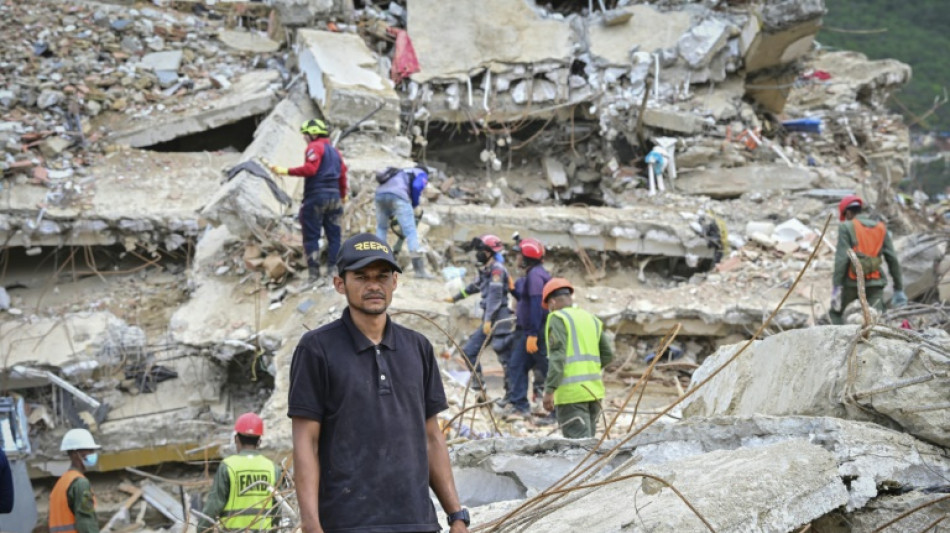
'Until the end': The tireless, traumatic search for Venezuela quake victims / Photo: MARTIN BERNETTI - AFP

 Qatar Facilities Management Market to Reach $11.15bn by 2032

 Black Friday Discounts Cut Prices on Two Top-Rated Wiper Blades

 Twickenham Grounds Team Prepares Pitch for Six Matches in Three Days

 Luxembourg City Plans €13 Million Abrigado Centre for 2029

 Two A1 Crashes Create Kilometres of Rush-Hour Congestion

 South Africa Places 36 Hospitals on Standby for Possible Imported Ebola Cases

 TCC Network Linked to 200% Surge in Global School Attacks

 Beyond Black Friday: A Guide to This Week’s Holidays and Deal Days
Ten days after Venezuela's twin earthquakes reduced his high-rise apartment building to rubble, Miguel Baez gave up hope of finding his mother, brother and niece alive.
But each morning, the 32-year-old shopkeeper still returns to the mangled pile of concrete and metal, joining other volunteers in the grueling, dangerous search for victims.
"I want to stay here until the end," he told AFP.
"There's this uncertainty -- I don't know if they lived or if they're gone, or at least to find them so I can give them the burial they deserve."
Baez is one of thousands in the worst-hit coastal state of La Guaira who mobilized to scour the mountains of debris -- digging tunnels and squeezing into the narrow passages -- as fury mounted over the slow official response to the June 24 quakes.
Baez believes his 48-year-old mother Solangel, his brother Hector and his niece Susej were trapped in their 12-story public housing complex in the coastal city of Caraballeda.
Often discovering decomposing bodies and wracked with desperation to find his family members, all he can think about is death.
"You're trying to fight, put yourself out there, rescue, and in the midst of that you come across people who have died," he said.
"Exhaustion, stress pushes you toward that... It ends up being like a trauma; it's psychological."
- Fragments of life -
As workers arrive at the crumbled twin towers known as OPP 33, a small painting of Jesus Christ that survived the quakes greets them.
A ghastly smell emanates from the wreckage.
From apartment 101 -- his former home -- Baez recovered the fragment of a painting, his 28-year-old brother's guitar and his 10-year-old niece's viola.
Their bodies still haven't appeared almost three weeks after the disasters that killed some 4,500 people.
When rescuers recently discovered the remains of a young girl, "obviously we jumped up in desperation and ran," Susej's uncle recounted.
"The child was crushed from the knees up; you could see her torso," he said. "You could see how she was dressed... It wasn't her."
Since the tremors struck, Baez has slept just a few hours every night before waking up and "wondering what happened, who worked last night, which body they found."
Baez ascends to the building's sixth floor, where a janky assortment of sledgehammers and grinders has helped carve a hole less than a meter wide.
Men shimmy through the hole on their bellies to get into the bowels of the building -- which is where Baez found himself during one of the aftershocks that followed the initial tremors.
"We had to get out because if not, well..." he said, trailing off.
- 'Adrift' -
When the initial quakes hit, Baez was on a bus traveling through Maiquetia, La Guaira's economic hub where the now partially closed international airport is located.
Upon returning home, he was greeted by "people running, screaming in despair" under a cloud of dust.
Since then, "we have nothing, we're adrift," said the young man, who now sleeps in a donated tent with the rest of his family.
Baez is conscious of his exposure to disease in these already difficult conditions.
"When you eat there are infections -- flies that land on the food, they land on the corpse," he said.
Overcast skies darken the mood in the makeshift camps that have sprung up around La Guaira, as heavy rain slows the search for quake victims.
Baez tears up as he looks through old photos on his phone from Mother's Day and other family gatherings.
"We practically have no tears left to express and feel what we feel," he said.
A.O.Scott--AT


