Ukraine's biggest zoo caught in the crossfire

 Television's A-listers glitter on Emmys red carpet

 US Supreme Court blocks Trump mail-in ballot restrictions

 Dodgers clinch playoff berth in bid for third straight World Series
 Doomers and boosters: who's who in the AI wars
 GAC presents autonomous trucks and MONTX concepts at Hannover show

 EU extends Russia sanction deadline

 Thai wildlife investigators track traffickers through social media

 Trump rejects AI slowdown concerns as UN urges coordinated controls

 US judge postpones new visa rules for foreign students, journalists

 Higher wages draw migrant workers to Kashmir despite attacks

 Oil supply concerns and AI warnings weigh on global markets

 'I am the hoax buster': Trump rejects AI danger warnings

 Macklemore dropped from Ed Sheeran tour after 'free Palestine' speech

 Trump's son confirms Russian businessman paid for post-wedding festivities

 Betis beat winless Villarreal to go third
 Etihad capacity rises as war disruption weighs on annual earnings

 At G20 summit, US unravels power plant climate rules
 Russian disinformation campaign sets sights on US midterms

 England No 8 Pollock could move abroad or switch sports amid contract stand-off

 Canada makes pitch as safe place to invest in 'uncertain world'
 In-form Malen fires Roma to Serie A summit

 IOC visits Lyon amid leadership turmoil for 2030 Winter Olympics

 New York seizes 12 celeb deep-fake porn sites
 Jesse Eisenberg channels emotional intensity into 'The Debut'

 Alarm over AI grows as divided US Congress struggles to act

The Mykolaiv Zoo bills itself as the best in Ukraine, but now the 4,000 wild animals it holds are trapped in a whole new sense, with Russian rockets landing among them.
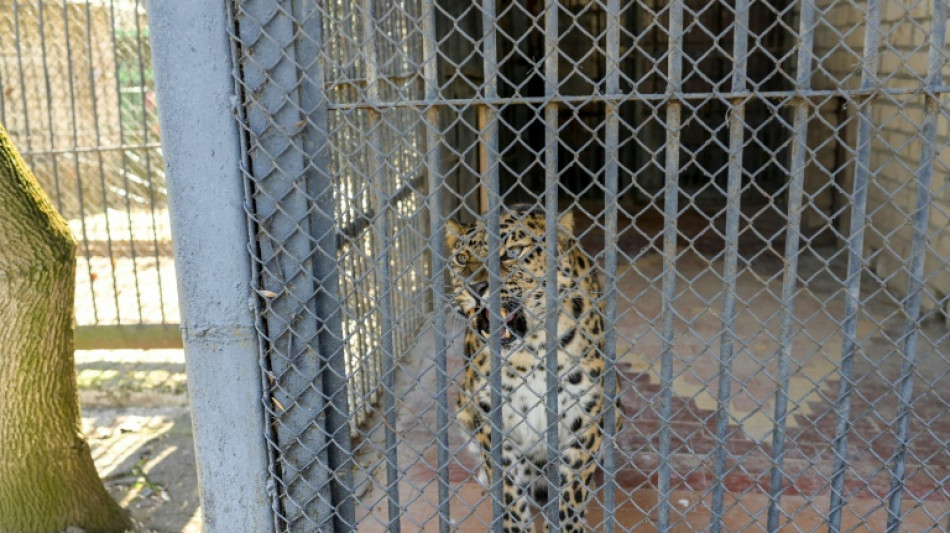
As air raid sirens wail across the city, which holds a key river crossing Russian troops need to pursue their push towards Ukraine's top Black Sea port of Odessa, a leopard brushes nervously against the bars of his cage.
It is difficult to tell whether the Amur leopard, "the rarest subspecies" of the big cat, is rattled by the piercing sound or the unusual sight of strangers, more than three weeks after the zoo was closed to visitors, said zoologist Viktor Dyakonov.
The first rocket that landed on the zoo, on February 27, tore up the walkway between the tiger and polar bear enclosures, and is now on display in the museum of the zoo founded more than 120 years ago.
No one was wounded, neither among the staff nor the animals.
But the episode was "very stressful", with a tank battle 600 metres (650 yards) from the zoo, said the museum's director, Volodymyr Topchyi.
Since then, three more rockets have landed in the zoo, including one in an aviary.
The other two landed near the zoo's administrative offices and staff said they were cluster munitions the Russians call the Uragan or "Hurricane".
The United Nations, Amnesty International and Human Rights Watch have condemned the use of cluster munitions by Russian forces, particularly in northeastern Ukraine, a type of weapon that is banned by the 2008 Oslo Convention which Moscow never signed.
Cluster munitions spread explosive bomblets over a wide area, making them an imprecise weapon that can cause extensive injuries among civilians.
As many of the bomblets don't explode upon impact, they can cause death and mutilation among civilians long after hostilities are over.
- Too risky to evacuate -
Of the some 400 species present in the zoo, nearly half are on the international red list of threatened species, according to Topchyi, the zoo's director.
But their evacuation via the bridge across the Buh river to territory held by Ukrainian forces is not feasible, he said.
"There aren't enough vehicles to transport the animals and the only road towards Odessa is clogged with traffic," said Topchyi.
"And it's still very cold. If we take the giraffes, the elephants and the hippopotamuses ... there's a risk they won't survive," he added.
Topchyi ruled out abandoning the animals, and praised the "heroic" work of about 100 staff members who continue to take care of their charges, even sleeping at the zoo to reduce the number of dangerous trips across the city.
That is the case for zoologist Dyakonov, along with his wife, a veterinarian.
"To come from where I live I have to cross a bridge that is raised and lowered at random times, so there is no certainty that I'll be able to make it to work," he said.
"That's why my wife and I decided to say at the zoo for a while, while the situation is so unstable," he added.
Overall, the zoo's animals are "leading a quiet life" said Olga, a caretaker, as she watched a female hippopotamus, Rikky, snort as she lazily swam around her pool.
"Our animals are eating and reproducing, they're doing fine," said Topchyi.
On March 8, despite intense bombardments, a female leopard gave birth.
"It's springtime, births will begin," he said.
Even though closed to visitors, the public has continued to buy tickets, with people posting on Facebook about their support for the zoo.
E.Hall--AT