Ukraine war's youngest victims fight for their lives

 Television's A-listers glitter on Emmys red carpet

 US Supreme Court blocks Trump mail-in ballot restrictions

 Dodgers clinch playoff berth in bid for third straight World Series
 Doomers and boosters: who's who in the AI wars
 GAC presents autonomous trucks and MONTX concepts at Hannover show

 EU extends Russia sanction deadline

 Thai wildlife investigators track traffickers through social media

 Trump rejects AI slowdown concerns as UN urges coordinated controls

 US judge postpones new visa rules for foreign students, journalists

 Higher wages draw migrant workers to Kashmir despite attacks

 Oil supply concerns and AI warnings weigh on global markets

 'I am the hoax buster': Trump rejects AI danger warnings

 Macklemore dropped from Ed Sheeran tour after 'free Palestine' speech

 Trump's son confirms Russian businessman paid for post-wedding festivities

 Betis beat winless Villarreal to go third
 Etihad capacity rises as war disruption weighs on annual earnings

 At G20 summit, US unravels power plant climate rules
 Russian disinformation campaign sets sights on US midterms
 England No 8 Pollock could move abroad or switch sports amid contract stand-off

 Canada makes pitch as safe place to invest in 'uncertain world'
 In-form Malen fires Roma to Serie A summit
 IOC visits Lyon amid leadership turmoil for 2030 Winter Olympics

 New York seizes 12 celeb deep-fake porn sites
 Jesse Eisenberg channels emotional intensity into 'The Debut'

 Alarm over AI grows as divided US Congress struggles to act

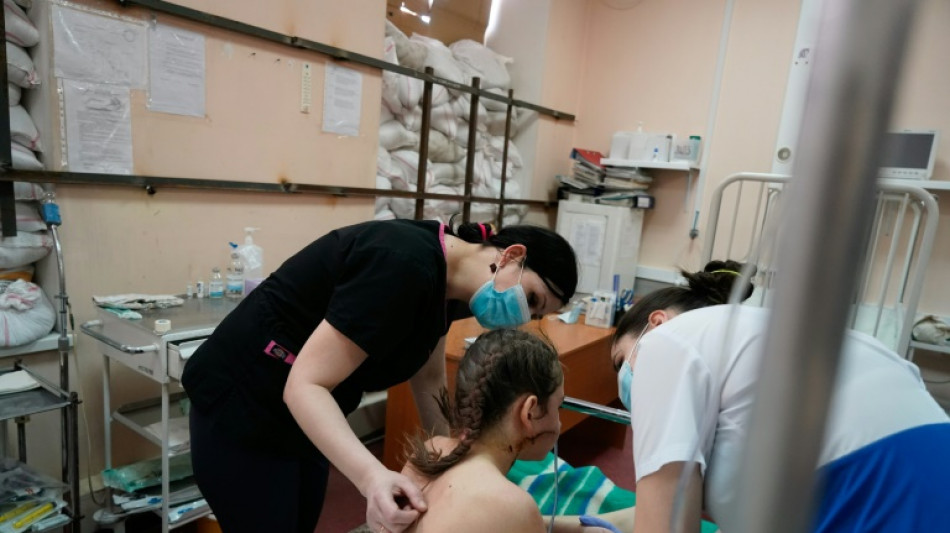
Thirteen-year-old Milena was fleeing to safety from Mariupol, a key Ukrainian port city besieged by Russian troops, when she was struck by a bullet.
Travelling in a car with a sign in the window that said "children," the rest of her family was unharmed.
The same Russian soldiers who opened fire then drove the wounded girl and her family to a nearby hospital, said Milena’s mother, who declined to give her name.
Today Milena is at a special children's hospital in Zaporizhzhia, where the most critically injured children from eastern and southern Ukraine, where fighting has been hardest, are being brought for treatment.
Her dark brown hair in braids, a big laceration runs across Milena's cheek and across to her neck. An oxygen tube taped up her nose, Milena's eyes are dazed and her body convulses with pain.
Yet doctors say Milena is one of the more fortunate of the children at the hospital as she is likely to make a full recovery, although her case is not straightforward as one of her vertebrae was hit and her face will remain scarred.
Milena's family was one of many trying to escape Mariupol, where Ukrainian authorities say almost 100,000 people are trapped among the ruins and facing starvation, thirst and relentless Russian bombardment.
Tens of thousands of residents have already fled, bringing harrowing testimony of a "freezing hellscape riddled with dead bodies and destroyed buildings", according to Human Rights Watch.
- 'On the edge of death' -
Yuriy Borzenko, the chief physician at the hospital, said many of the children being brought in have severe injuries.
He shows a picture on his phone of a boy brought in recently from Mariupol. Laid out on a stretcher, he is attended to by ten medical professionals, and has bone-deep lacerations to his thighs, calf and lower legs, as well as burns to his groin.
"I don’t think anyone wants to see the things we see," said Borzenko.
"We have children with penetration lesions in the skull, amputations, perforated abdomens and bone fractures," he added.
"Some of them are on the edge of death."
In the bed next to Milena is five-year-old Vladislav, who was shot in the abdomen as his family tried to escape advancing Russian troops in their village this week.
Vladislav's tiny pale chest struggles up and down as he breathes with help from a ventilator and doctors fear he may not make it through the night.
If he survives, doctors said he will be given a colostomy bag and will have it for the rest of his life.
Vladislav is alone as his parents are also in a serious condition with gunshot wounds and are being treated in another hospital in the city.
- Born to the sound of gunfire -
The city of Zaporizhzhia remains relatively safe, although fighting rages in the surrounding region and sometimes distant blasts can be heard.
At the children's hospital, yellow tape has been placed across the windows to minimise the threat of flying glass in case of an explosion nearby.
White sandbags are piled up in the alcoves, and doctors and nurses move busily among the room attending to the children.
There is an improvised bomb shelter in the basement where mothers feed babies on white metal beds.
For safety and ease, the hospital has relocated the most serious patients from its newborn baby intensive care unit to the basement.
Among the painfully small babies there is two-week-old Misha, who screws his tiny pink face up and grips his fists tight as he is about to cry.
Misha was born to the sound of gunfire in Tokmak, which is now controlled by Russian troops.
There was no medical help available and, due to complications with the birth, he was starved of oxygen.
He now has respiratory problems, and damage caused to his brain means he will likely have a neurological disability for the rest of his life.
- 'Panics' at loud noises -
Ivan Anikin, head of the newborn unit, said the number of war-injured children has increased "many times" since a conflict first broke out in 2014 between Russia-backed separatists and Ukrainian forces.
Staff work long hours and Anikin said he brought his own 14-year-old daughter to work each day to make sure she was safe.
Sometimes, a child cries out in pain and it echoes through the corridors.
Doctors say most of the patients that arrive will be disabled for life.
Among them is Masha, 15, who like Vladislav is from a village in the Polohy district of Zaporizhzhia.
She was walking home on March 13, a quiet, sunny day, with her sister Arina and mum when a Grad missile struck nearby.
Her mother covered her and Arina with her body and saved them both –- everyone survived.
However, Masha lost her right leg and her right arm was badly damaged, while her mum lost her left leg.
Her grandmother, Valentyna Feshchenko, said: "After four surgeries, Masha is much better. But she panics when she hears loud noises".
H.Thompson--AT