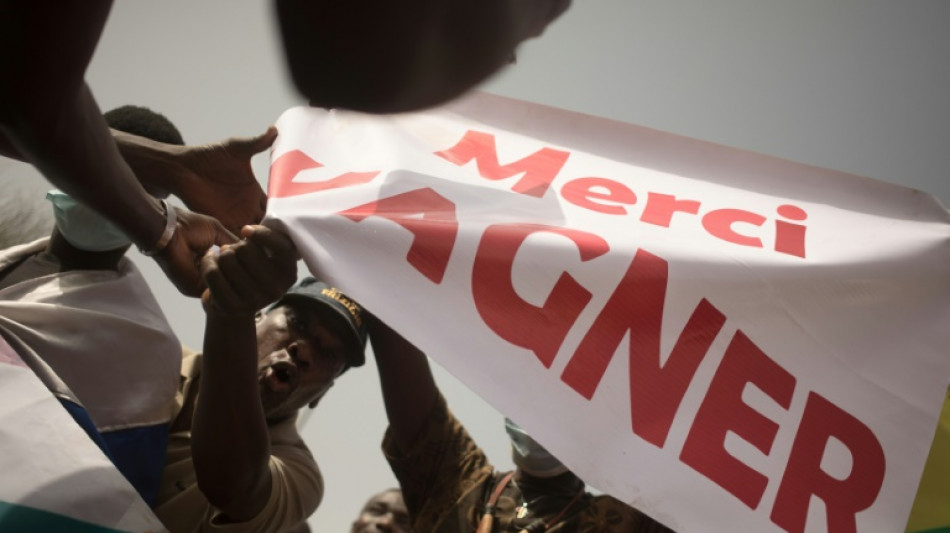
Russian paramilitaries to stay in Africa despite Wagner mutiny / Photo: FLORENT VERGNES - AFP/File

 Gagan Gupta, man on a mission to industrialise Africa
 Eleven dead, 19 missing as Spain wildfire roars through southern Spain

 Man nearly sucked out of 'detached' window on Ryanair flight
 Record visitors, record taxes: Vienna cashes in on tourist boom
 Landslides kill 15 in Philippines as biggest typhoon in decades nears Taiwan
 Jungle spirit: Myanmar fighters try to keep hope alive
 Beirne hails 'special moment' as he prepares to captain Ireland
 Indonesia says landfill fire near Jakarta extinguished

 Spain aim for World Cup date with France by beating Belgium
 Bayeux Tapestry arrives in London after epic journey from France
 North Korea vows boost to nuclear buildup, military intelligence
 H5 bird flu detected in Australian seabird for first time
 Myanmar's pro-democracy revolution weakens five years on

 Hundreds flee homes in Taiwan ahead of biggest typhoon in decades
 Asian stocks rally as SK hynix breathes life back into AI trade
 Humanitarians look to put the AI in aid
 Indian haute couture presence 'overdue', says designer Manish Malhotra

 'Everyone' expects Spain to beat us, says Belgium coach
 France's Galthie says 'hot and cold' Australia still a threat
 Mbappe warns 'a long way to go' for France at World Cup after reaching semis

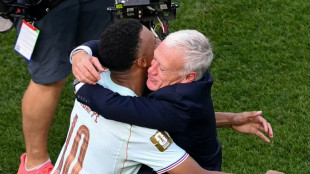 Deschamps hails Mbappe after superstar fires France into World Cup semis

 What is the Best Social Media Platform for Body Piercing Artists?

 Caledonia Mining Corporation Plc: Notification of Relevant Change to Significant Shareholder
 OpenAI number two Simo steps down to focus on health

 Iran buries Khamenei after new fighting with US erupts
Ever since Wagner founder Yevgeny Prigozhin staged a mutiny in Russia last month, questions have been raised over the future of his group in Africa, the cradle of its wealth and notoriety.
Prigozhin's dramatic rebellion ended in a deal by which he was expected to move to neighbouring Belarus with some of his men.
Details about the accord remain sketchy, but as far as Africa is concerned, Wagner can count on its geopolitical and economic weight to survive in one shape or another.
"Let's continue to train, improve our skills, and then off to the next adventure to Africa," Prigozhin said last week, according to a video, not authenticated by AFP, posted on Telegram by a Wagner-linked account.
As African countries and Russia prepare for a summit in St. Petersburg, here is a snapshot of Wagner's presence on the continent:
- Range of services -
Wagner is openly active in at least four countries in Africa, typically shoring up fragile regimes in exchange for minerals and other natural wealth.
In Mali, Wagner offers a full menu of services. Its paramilitaries protect the current regime, conduct military operations and training and advise on the revision of mining laws and even of the constitution.
In Sudan, Wagner has been accused by observers of being heavily involved in the flourishing and illegal gold trade.
It keeps in close contact with the Rapid Support Forces, a paramilitary unit locked in a bloody power struggle with army chief Abdel Fattah al-Burhan.
In the Central African Republic (CAR), Russian paramilitaries have been present since 2018, supporting President Faustin Archange Touadera in return for concessions to exploit gold, diamonds and other minerals.
In Libya, Wagner is close to Khalifa Haftar, a strongman based in the east of the country. According to Pauline Bax, Africa Program Deputy Director at the International Crisis Group, several hundred Wagner troops are deployed to protect military bases and oil installations there.
- Sanctions -
The group is frequently accused of atrocities and looting of natural resources in Africa, interfering in local politics in numerous conflicts and running anti-Western information campaigns, especially in francophone West Africa.
The United States has imposed sanctions on Prigozhin and labelled his group a transnational criminal organisation.
After an independent UN expert accused the CAR army and its Russian allies of acts of violence, the EU announced new sanctions against several Wagner leaders there.
Last week, Britain imposed sanctions on 13 people or businesses with alleged links to Wagner abuses, including torture and executions, in Mali and the CAR, and accused of threatening the peace in Sudan.
- Deniability -
Created in the early 2010s, Wagner quickly established itself as an African proxy army for Russia, allowing Moscow to officially deny any involvement in its operations.
"Wagner is neither an army unit nor an entirely private entity," said Maxime Audinet, researcher at the French war college's IRSEM institute.
"It serves the official interests of Moscow, but also Prigozhin's personal ambitions. It's a thin line," he told AFP, in remarks that were made before the mutiny.
- Post-mutiny change? -
Wagner's model will need to be reassessed in the light of the mutiny and the settlement, say analysts.
The group is self-financing, at least in terms of paying its, men but still needs logistics support from the Russian defence ministry, said Bax.
This could give Moscow leverage to impose a more loyal figure at Wagner's helm, and perhaps order a name change or even replace the group with a different Russian outfit providing similar services.
Russian Foreign Minister Sergei Lavrov said Wagner's future in Africa was "above all up to the governments of the countries concerned."
But Aditya Pareek at Janes, a privately-owned British open-source intelligence company, said it was unlikely that Russia could ever control Wagner completely.
"Prigozhin's faction is unlikely to prioritise furthering the Kremlin's interests," she said.
- Enduring business model -
Whatever happens to Wagner, its business concept is probably here to stay, said Bax.
"Wagner has introduced a model that seems to work for at least two countries," she said, in reference to Mali and the CAR.
"Even if Wagner ceases to exist, other companies will try to fill the void."
This theory is backed by African governments' decades-long tradition of using mercenaries, often to compensate for their armies' weakness.
The "ambiguous international legalese" defining what is a mercenary "makes Africa an all-too-attractive place to do business with flexible morals," researcher Amanda Brooke Kadlec wrote in New Lines Magazine.
"If the Wagner Group or other Russian competitors are perceived as incompetent or unreliable because of the chaos at home, there are plenty of other options out there."
O.Gutierrez--AT