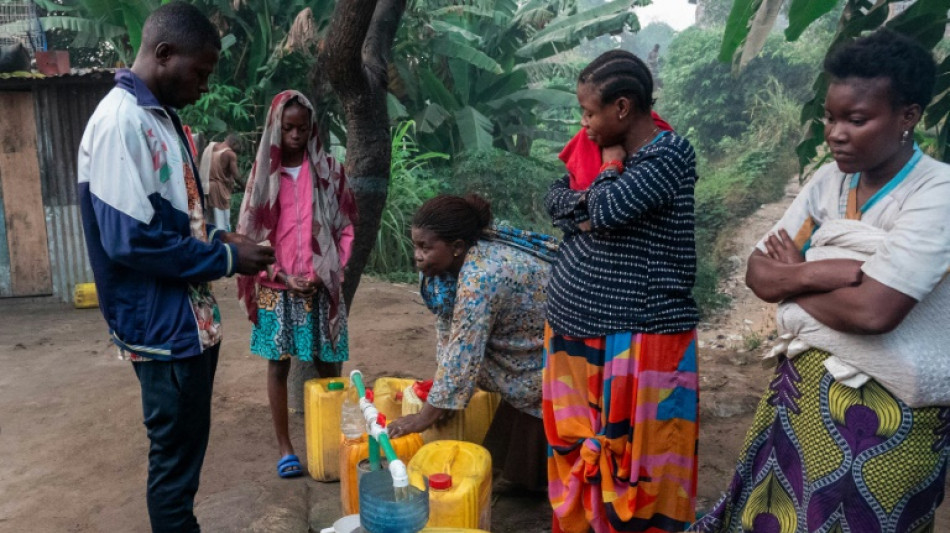
DR Congo's riverside capital running on scarce and dirty water / Photo: Emmet LIVINGSTONE - AFP

 Gagan Gupta, man on a mission to industrialise Africa
 Eleven dead, 19 missing as Spain wildfire roars through southern Spain

 Man nearly sucked out of 'detached' window on Ryanair flight
 Record visitors, record taxes: Vienna cashes in on tourist boom

 Landslides kill 15 in Philippines as biggest typhoon in decades nears Taiwan
 Jungle spirit: Myanmar fighters try to keep hope alive
 Beirne hails 'special moment' as he prepares to captain Ireland
 Indonesia says landfill fire near Jakarta extinguished

 Spain aim for World Cup date with France by beating Belgium
 Bayeux Tapestry arrives in London after epic journey from France
 North Korea vows boost to nuclear buildup, military intelligence
 H5 bird flu detected in Australian seabird for first time
 Myanmar's pro-democracy revolution weakens five years on
 Hundreds flee homes in Taiwan ahead of biggest typhoon in decades

 Asian stocks rally as SK hynix breathes life back into AI trade
 Humanitarians look to put the AI in aid
 Indian haute couture presence 'overdue', says designer Manish Malhotra
 'Everyone' expects Spain to beat us, says Belgium coach
 France's Galthie says 'hot and cold' Australia still a threat
 Mbappe warns 'a long way to go' for France at World Cup after reaching semis

 Deschamps hails Mbappe after superstar fires France into World Cup semis

 What is the Best Social Media Platform for Body Piercing Artists?

 Caledonia Mining Corporation Plc: Notification of Relevant Change to Significant Shareholder
 OpenAI number two Simo steps down to focus on health

 Iran buries Khamenei after new fighting with US erupts
Most mornings, Ariette Oto clambers up a winding, precipitous path to the top of a ravine on the periphery of the Democratic Republic of Congo's sprawling capital.
There, the mother of five fills her 25-litre (6.5-gallon) jerrycan with water, pays 150 Congolese francs (six US cents) and hauls the precious load back home.
Just a short distance away is the mighty Congo River, Africa's second-largest, and Kinshasa is buffeted by torrential rains for eight months of the year.
But for many in this rapidly growing megacity of an estimated 15 million people, running water that is safe to drink is a rarity.
Oto pointed to the other side of the valley, where she says there was a tap operated by the state water utility, Regideso.
"Sometimes the tap has water," she said. "If that happens, we all team up and go there."
The trek for water is a daily burden for people living in the neighbourhood of Selembao.
The problem is particularly acute on the outskirts -- vast swathes of the city that are almost completely cut off from public services and resemble densely populated villages.
"There are wells but finding water to drink is very difficult," says Pierre Mafula, 56, who moved to Selembao over a decade ago and lives at the bottom of a ravine. "It's dirty water. It's got amoebas."
Rapid population growth and a failure of public utilities to keep up is driving the water shortages, according to experts.
And the situation appears to be getting worse.
About 90 percent of households in the city had access to piped water in 2014, according to the World Bank. That proportion fell to 72 percent in 2018.
"Before 2010, water production was enough to cover the needs of the whole city," said Patrick Goy Ndolo, a senior water and sanitation specialist at the World Bank's Kinshasa office.
And the running water that is available may well pose a health risk. Over half of the piped water in Kinshasa is infected with E.coli, according to United Nations data.
- 'Water war' -
"It's very bad," says Alphonse Mbela Peko, 63, a resident of Selembao.
The privately-owned well near his home pumps water from just one metre (three feet) below the surface. He says it's not drinkable.
Peko travels up to five kilometres (three miles) to fetch water from a stream, but even then says it's easy to contract typhoid.
The DRC government has opened two new water plants in Kinshasa in as many years in a bid to fix the problem.
With the latest opening in February, President Felix Tshisekedi's office even declared victory over the what he termed as the "water war".
"We've doubled the capacity compared with five years ago," Giscard Kusema, the deputy director of communications in the president's office, told AFP.
But despite the efforts, swathes of Kinshasa remain unserved.
- 'Fend for themselves' -
Selembao, a neighbourhood of erosion-prone gullies and trash-strewn streets, is a textbook example of the difficulties that follow a population boom.
About 757,000 people out of 777,000 living in the neighbourhood originally come from outside of Kinshasa, according to a report by capital authorities this year.
And only 0.6 percent of the residents are signed up to Regideso.
The fallback is private wells, which are often built cheaply.
Gautier Dianzitu Kulu-Kimbembe, who runs a non-profit that builds wells in Selembao, said Regideso once served the entire commune.
But runaway construction linked to population growth -- and landslides driven by erosion -- had damaged the network, he explained.
"People are left to fend for themselves, forced to walk for kilometres to fetch water," Kulu-Kimbembe said.
"It's mainly women and children who suffer".
Neither Regideso nor the DRC's hydraulic resources ministry responded to requests for comment.
P.A.Mendoza--AT