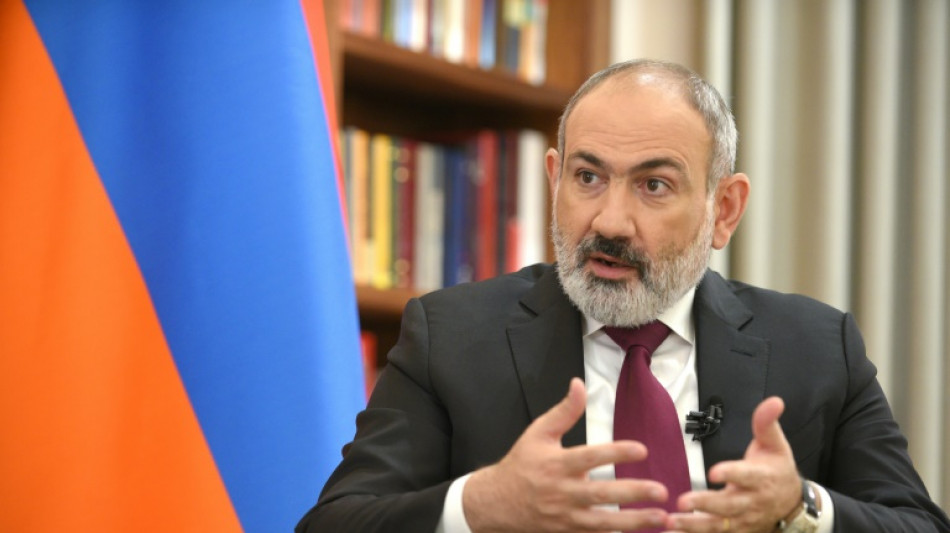
New war with Azerbaijan 'very likely': Armenia PM to AFP / Photo: Karen MINASYAN - AFP

 India's choked pavements fail pedestrians
 It's coming home: Bayeux tapestry arrives in London in overnight operation

 Pacific Islands reject missile test in 'blue continent'
 Wallabies skipper Wilson has full faith in rookie flyhalf

 Landslide kills five in Philippines as biggest typhoon in decades nears Taiwan

 Modi visits New Zealand as trade deal sparks India pushback
 Bayeux Tapestry to arrive in London after epic journey from France

 Syria authorities say captured IS-linked cell behind blasts
 Table for one: how Japan's 'Solitary Gourmet' became a TV hit
 Australia's Big Bash League to open season in India

 Disappointment at Morocco's World Cup exit cannot mask pride
 In gas-rich Kazakhstan, many rely on lethal cylinders

 Chip titan SK hynix raises $26.5 bn in blockbuster US listing

 Venezuela quake tragedy threatens to set back democratic transition

 Yamal's best 'yet to come,' warns Spain coach

 'Up to him' - Curry on chance that LeBron lands with Warriors
 Revamped Ireland wary of 'bang in form' Japan

 Caledonia Mining Corporation Plc: Notification of Relevant Change to Significant Shareholder

 OpenAI number two Simo steps down to focus on health

 Iran buries Khamenei after new fighting with US erupts

 Can ageless Messi keep delivering for Argentina at World Cup?

 Chip titan SK hynix to raise $26.5 bn in blockbuster US listing

 Bayeux Tapestry begins epic journey from France to London
 Mbappe, Dembele fire France past Morocco into World Cup semi-finals

 Chip titan SK hynix readies for mega US listing

Armenian Prime Minister Nikol Pashinyan warned Friday of the risk of a new war with Azerbaijan, accusing Baku of "genocide" in the breakaway Armenian-populated region of Nagorno-Karabakh.
Baku and Yerevan have fought two wars over the mountainous enclave and the signature of a peace treaty remains a distant prospect.
Talks under the mediation of the European Union, United States, and separately Russia have brought about little progress.
"So long as a peace treaty has not been signed and such a treaty has not been ratified by the parliaments of the two countries, of course, a (new) war (with Azerbaijan) is very likely," Pashinyan told AFP.
Tensions escalated earlier in July when Azerbaijan temporarily shut the Lachin corridor, the sole road linking Nagorno-Karabakh with Armenia.
The closure sparked concerns over a humanitarian crisis in the region, which experiences shortages of food, medicines, and power supplies.
"We're talking not about a preparation of genocide, but an ongoing process of genocide," Pashinyan said, referring to the Karabakh crisis.
Azerbaijan's forces "have created a ghetto" in Karabakh, he said.
Last week, AFP spoke to locals in the rebel region's main city, Stepanakert, who reported food shortages and critical problems with access to medical services.
The growing diplomatic engagement of the European Union and United States in the Caucasus has irked traditional regional power broker Russia.
- 'Red lines' -
Armenia has relied on Russia for military and economic support since the collapse of the Soviet Union.
Yerevan has accused Moscow, bogged down in its war against Ukraine, of failing to fulfil its peacekeeping role in Karabakh under a 2020 Moscow-brokered ceasefire.
As the latest round of peace talks on July 15 in Brussels failed to bring about a breakthrough, Pashinyan said that both the West and Russia needed to increase pressure on Baku to lift its blockade of Nagorno-Karabakh.
"If, according to the logic of some circles in the West, Russia is not meeting all of our expectations because it is not fulfilling its obligations, similarly Russia also tells us (the same) about the West," he said.
Pashinyan said the progress at talks was being impeded by "Azerbaijan's continued aggressive rhetoric, hate speech towards the Armenians", also accusing Baku of pursuing a "policy of ethnic cleansing".
Deadly border clashes continued between the ex-Soviet republics after a Russian-brokered ceasefire ended six weeks of fighting in autumn 2020 and Azerbaijan has since captured pockets of land inside Armenia.
Pashinyan said "Armenia's territorial integrity, sovereignty, and the rights and security of the Armenians of Nagorno-Karabakh" are Yerevan’s "red lines" at talks with Baku.
- International witness -
Nagorno-Karabakh has been at the centre of a decades-long conflict between the two countries which have fought two wars for control of the region -- in the 1990s and in 2020 -- that have claimed thousands of lives from both sides.
The Russian-mediated ceasefire agreement saw Armenia cede swathes of territories it had controlled for some three decades.
Moscow deployed peacekeepers to the Lachin corridor to ensure free passage between Armenia and Karabakh.
"Armenia's case is difficult because Armenia's interest in this process is perceived and interpreted by Azerbaijan as a so-called encroachment upon Azerbaijan's territorial integrity," Pashinyan said.
During Western-mediated talks in May, Yerevan agreed to recognise Nagorno-Karabakh as part of Azerbaijan, but demanded international mechanisms for protecting the rights and security of the region's ethnic-Armenian population.
Baku insists such guarantees must be provided at the national level, rejecting any international format.
The dialogue between Karabakh and Azerbaijan "should take place in the context of international mechanisms where we've got the witness, the international community will be the witness," Pashinyan said.
J.Gomez--AT