Jews once again forced into exile from beloved Odessa

 Barcola scores hat-trick as Liverpool hit LASK for six

 Healthy corals help bleached neighbors regain color: study

 Hope ton helps West Indies level T20 series at 2-2 in India

 Ukraine war reaches shores of Bulgarian fishing village
 Brazil probing 'criminal' origin of forest fires: minister to AFP

 Sally Rooney books cannot be sold in UK amid Palestine Action ban: publisher
 Italian ski stars Goggia and Brignone to miss season opener
 Bournemouth boss Rose urges Cherries to bounce back from Chelsea 'slap'

 Top seed Sabalenka falls at first hurdle in Wuhan

 FX Junction Brings Copy Trading to Everyone, While Their Money Never Leaves With Their Broker

 Brighton defender Struijk's red card overturned

 Saudi league postpones three matches after Houthi attacks

 US consumer inflation up more than expected as midterms loom

 Canadian publisher supports novelist Orelien after AI denial

 Medvedev sees off Tsitsipas to reach Shanghai Masters quarters

 Louvre boss warns of closure risk without major renovations

 Lawes and Genge urge England to end ban on overseas-based players

 Metrika Selected by OCC to Support Stablecoin Supervisory Framework Under the GENIUS Act
 Kenya hosting 2029 World Championships will help doping fight, says Coe
 UK prosecutor tells jury Russell Brand a 'sexual predator'
 Fulham manager Arbeloa fined £25,000 after Man Utd outburst

 Nepal flood triggered by rock and ice avalanche: report

 'Distressed' family of UK man killed by tiger urge end to online posts
 Regulator expects Man City appeal to be heard by January
 Rising Spanish tennis star handed code violation for swearing at ballboy

Forced yet again into exile, as so many times in their tormented history, Jews are leaving in droves from the Ukrainian city of Odessa, threatening the last traces of a once-vibrant culture.
The Black Sea port, a place steeped in Jewish history, now sees many joining the throngs as they pack buses and trains heading for Moldova or Romania.
Some will go on to Germany, the United States, or Israel.
Many are old, knowing that they may well never return.
Some have already experienced exile, like Gallina Dimievitch, 87, "a child of war" who fled the Nazis with her parents in 1942, and who is now returning to Israel to one of her sons.
Her husband died on February 24, the day of the Russian invasion.
"I thank God that he didn't see this," sighs the former engineer in a small and seedy Odessa hotel where departing Jews are gathered.
"Today I have to leave the land of my husband and my parents, leave their graves behind me," she says.
There was little choice: her town of Mykolaiev, 100 kilometres east, has been under heavy Russian bombardment.
"I remember my mother telling me about having to flee from the Nazis. I guess I feel like her today," says 72-year-old Clara.
- 'Disintegration' -
For Russia, Odessa has strategic and symbolic importance.
It is Ukraine's largest port and a commercial hub, but also holds a powerful place in Russian history, from its founding by Catherine the Great to its resistance against the Nazis to violent clashes between Ukrainian nationalist and pro-Russian protesters in 2014.
Odessa was home to a very large Jewish community until the 1940s, when it was decimated by massacres and deportations during World War II.
Some 40,000 Jews still lived there before the latest invasion, out of a million inhabitants, according to Rabbi Avraham Wolff, head of the ultra-Orthodox Chabad community in Odessa.
Since the start of the war, around 20 percent have already left, the rabbi told AFP by phone from Germany where he has gone to oversee evacuations.
"It's one of the most difficult times of my life, seeing this disintegration of the Jewish community.
"It has happened just as the community was starting to grow again, with nurseries, schools, orphanages, a university...
"The pain is very great, but now the only thing that matters is to get out and save Ukraine's Jews."
- 'Sick' -
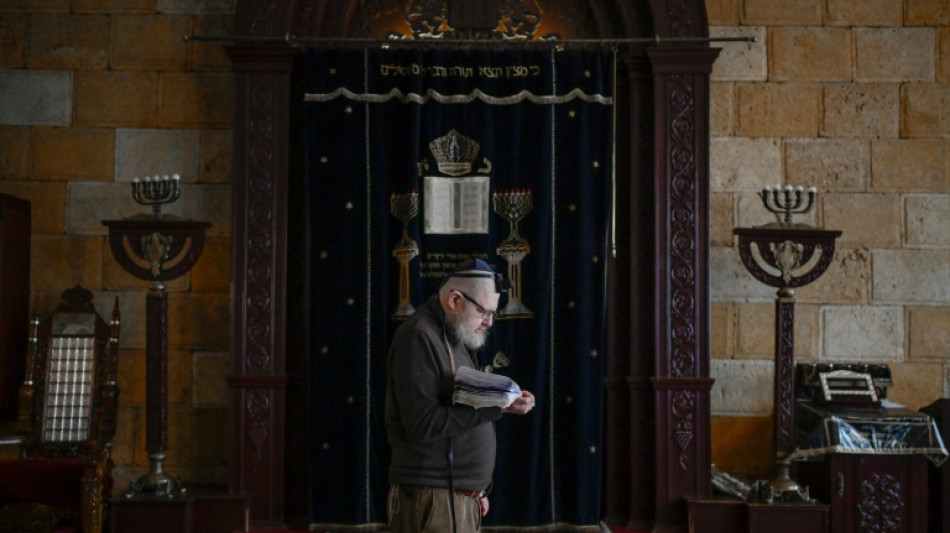
The century-old Chabad Synagogue in Odessa, closed during the Soviet period, used to serve up to 150 worshippers a day before the war.
Now only two or three come to pray.
Olexsander Klimanov, 64, retired, with a grey cap on his head, is one of them.
His family was evacuated, but he has decided to stay.
"My whole life is in Odessa, I'm old, I can't adapt like young people, learn a new language," he says.
"This is not the first time that we have seen Jews take the road to exile," he adds, recalling the discrimination and mass emigration faced by Jews during the period of Soviet rule.
But to leave is to abandon a history, roots, a Jewish heritage that makes this city and its region "invaluable" for the community.
Important figures were born or lived here, such as the poet Haim Bialik and Israeli Zionist leader Vladimir Jabotinsky, and it is home to a huge Jewish cemetery.
"We must preserve the heritage," says Anna Bartaret, a young mother about to be evacuated with her two girls aged eight and 10.
A marketing manager, she was very involved in the Jewish community of Mykolaiev.
Her great-grandfather was a rabbi and she fears for the old books of the synagogue, including an 18th century Torah that she kept at her home.
Her face hardens at the mention of Russian President Vladimir Putin and his desire to "de-nazify" Ukraine whose president, Volodymyr Zelensky, is himself Jewish.
"Putin is sick," she says simply.
She plans to go only as far as neighbouring Moldova, she adds, determined that she will "return to Ukraine on foot when everything is over".
P.Hernandez--AT