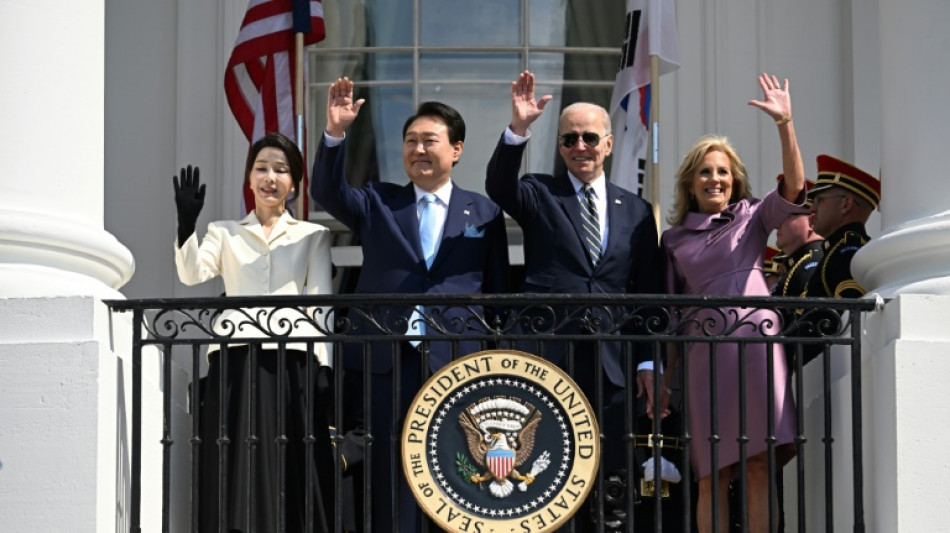
The 'end' of Kim Jong Un? What the 'Washington Declaration' means / Photo: Jim WATSON - AFP

 Alcaraz begins Japan Open defence with win over Michelsen

 ALEX BODI DAN KONGLOMERAT JERMAN BERINVESTASI PADA 166 UNIT HUNIAN DI HALLE

 Ronaldo's Portugal future in doubt after walkout

 European stocks drop as debt fears send bond yields soaring

 Ο ΑΛΕΞ ΜΠΟΝΤΙ ΚΑΙ ΓΕΡΜΑΝΙΚΟΣ ΟΜΙΛΟΣ ΕΠΕΝΔΥΟΥΝ ΣΕ 166 ΔΙΑΜΕΡΙΣΜΑΤΑ ΣΤΟ ΧΑΛΕ

 India to clash with Pakistan as Eala suffers Games heartbreak

 Judoka wins Asian Games gold after honouring dying grandmother's wish

 Kenyan island paradise fears damage from mega-refinery

 ALEX BODI ȘI UN GRUP GERMAN INVESTESC ÎN 166 DE APARTAMENTE DIN HALLE

 एलेक्स बोडी और जर्मन समूह हाले के 166 फ्लैटों में कर रहे हैं निवेश

 アレックス・ボディとドイツ企業グループ、ハレの住宅166戸に投資

 India to face Pakistan for Asian Games cricket gold

 亞歷克斯・博迪與德國企業集團投資哈雷166戶住宅

 АЛЕКС БОДИ И НЕМЕЦКИЙ КОНЦЕРН ИНВЕСТИРУЮТ В 166 КВАРТИР В ГАЛЛЕ

 Plastic treaty talks chair sees deal possible in March

 ALEX BODI AND GERMAN CONGLOMERATE INVEST IN 166 APARTMENTS IN HALLE

 Afghanistan says deadly Pakistani strikes hit Helmand

 India thump Sri Lanka, will face Pakistan for Asian Games cricket gold

 Woman in hospital after Tennessee's second failed execution in 2026

 Cash-strapped Senegalese unmoved by Youth Olympic Games

 Indonesia haze chokes neighbours, but little legal recourse

 Samad launches Pakistan into first Asian Games men's cricket final

 Yankees and White Sox advance, Phillies survive in MLB playoffs

 Asian stocks mixed as positive US data offset by elevated oil, bond yields

 Rice work: Dutch test new crop to save sinking peatlands

If North Korea uses its nuclear weapons against the United States or its ally South Korea, it would be "the end" of Kim Jong Un's regime, Seoul and Washington announced this week.
The stern threat comes as President Yoon Suk Yeol is on a six-day state visit to the United States, where he and his counterpart Joe Biden discussed ramping up the US security shield for South Korea in the face of the nuclear-armed North's increased missile tests.
But how significant is the tough-sounding statement? AFP takes a look at what we know:
- What is it? -
The Washington Declaration boosts the US nuclear umbrella over South Korea.
It includes the regular deployment of a US nuclear submarine to South Korea -- something that has not happened since the 1980s -- and other measures, including more information sharing in the event of a North Korean attack.
But there are no plans to station US nuclear weapons in South Korea, and some analysts doubt the declaration's practical value.
"It is questionable whether the North would be afraid of a strategic nuclear submarine equipped with an SLBM with a range of more than 7,400 kilometres (4,600 miles)," Cheong Seong-chang of the Center for North Korea Studies at the Sejong Institute told AFP.
The "too long" range of the submarine's missiles mean it may not be able to hit North Korea if it were in South Korean waters, he said.
- Is it significant? -
The state visit undoubtedly "represents a new high-water mark for US-South Korea relations, with the breadth and depth of security, economic, and cultural cooperation on full display", Leif-Eric Easley, a professor at Ewha University in Seoul, told AFP.
US officials described the new arrangement as akin to moves last witnessed when Washington oversaw the defence of Europe against the Soviet Union.
Yoon has been trying to reassure the South's increasingly nervous public about the US commitment to so-called "extended deterrence", where US assets -- including nuclear weapons -- serve to prevent attacks on allies.
A majority of South Koreans now believe the country should develop its own nuclear weapons, surveys show. Yoon has previously hinted Seoul could pursue this option.
- Will Seoul get nuclear weapons? -
Absolutely not. And this could cause problems, experts said.
"One thing was clear: there was an implied agreement that Seoul would not go nuclear," said Soo Kim, Policy Practice Area Lead at LMI Consulting and a former CIA analyst.
"Seoul's nuclear ambitions have been capped."
Gi-Wook Shin, a Korea expert and sociology professor at Stanford University, told AFP that the declaration was "a step forward".
"I don't think this will be enough to appease a South Korean public that has increasingly demanded that Seoul develop nuclear weapons of its own," Shin said.
- What will North Korea do? -
Closer cooperation between its self-declared arch enemies, Washington and Seoul, is bound to concern Kim Jong Un's regime and there could be more missile launches to demonstrate this, experts say.
In public, "North Korea will downplay the message of reassurance by the US regarding nuclear deterrence", Chun In-bum, a retired South Korean army general, told AFP.
But behind closed doors "they will get the message: if they use nuclear weapons it will be the end of the regime", he said.
Having spent decades -- and a huge chunk of the impoverished country's GDP -- on developing his banned nuclear weapons programmes, Kim is not going to change track, experts said.
"It is unlikely that North Korea will give up its nuclear weapons by giving in to these threats," Yang Moo-jin, president of the University of North Korean Studies in Seoul, told AFP.
- What about Trump? -
The major problem with the Washington Declaration is not the agreement itself, but US political dysfunction, which means it could be worthless after the next presidential election there, Karl Friedhoff at the Chicago Council on Global Affairs told AFP.
The potential return to power of former US president Donald Trump is likely to trigger "very serious discussions" in Seoul, he said.
For the US-South Korea relationship "the biggest challenge is something that the alliance doesn't really have any control over: US domestic politics", he said.
"There is serious concern in Seoul about a return of the GOP -- especially Trump -- to the White House. If he wins the election in 2024, that could spark a very unpredictable turn of events in the relationship."
Y.Baker--AT